
T. Rowe Price’s Active Crypto ETF Debuts with Model-Based Strategy and Robust Trading Infrastructure
The newly launched T. Rowe Price Active Crypto ETF introduces a disciplined, actively managed approach to cryptocurrency investing within a regulated exchange-traded product structure.
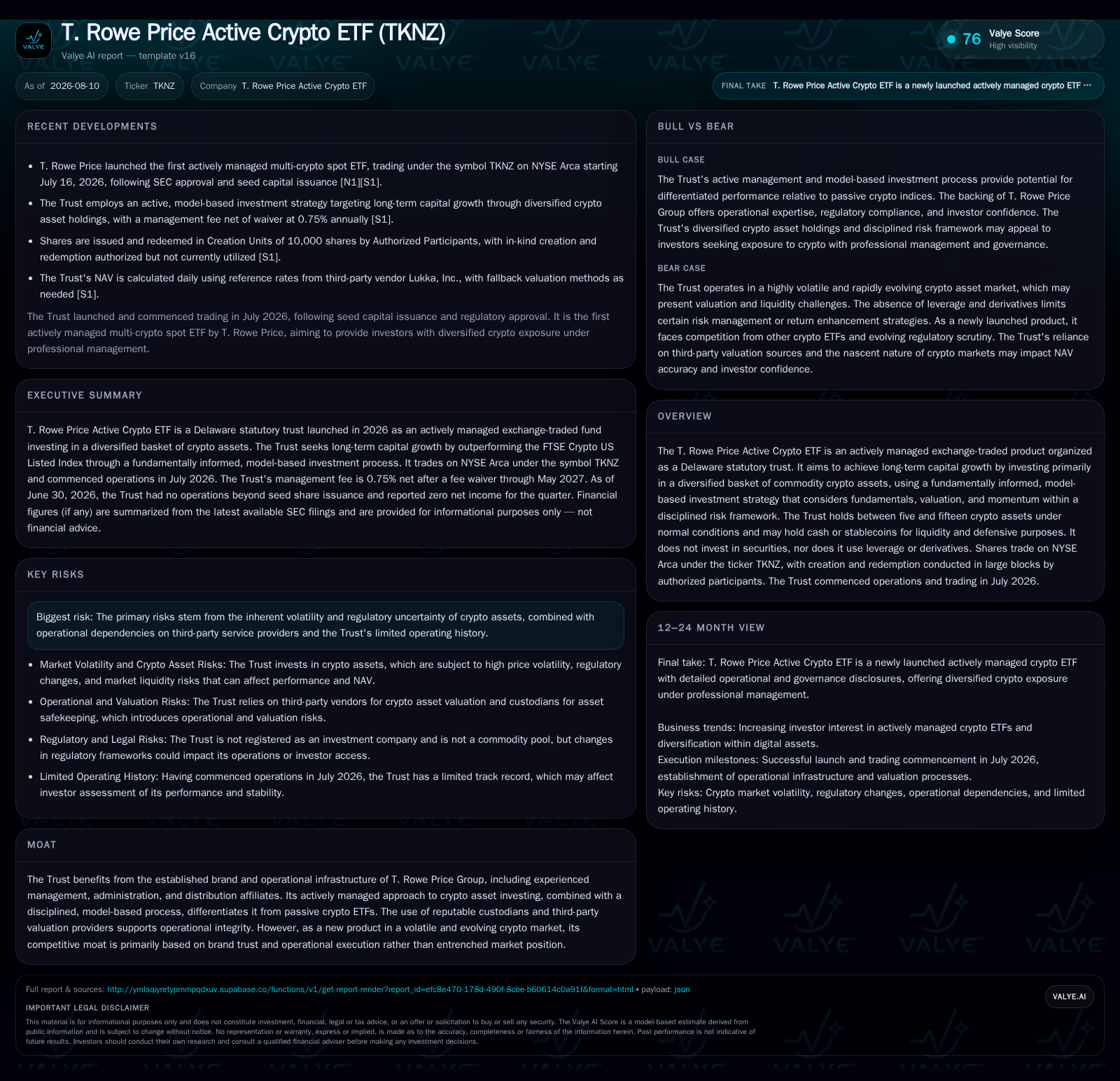
T. Rowe Price Active Crypto ETF (TKNZ) began trading in July 2026, offering investors access to a diversified basket of crypto assets through a fundamentally informed, model-based active management strategy. Leveraging T. Rowe Price’s established operational infrastructure and brand credibility, the Trust differentiates itself from passive crypto ETFs by targeting outperformance relative to the FTSE Crypto US Listed Index without using leverage or derivatives. Key operating developments include executed liquidity provider agreements with Virtu Financial Singapore and StoneX Digital to ensure principal-to-principal spot trading capability, bolstering its trading efficiency amid volatile crypto markets. The Trust’s ongoing challenges center on dealing with crypto asset volatility, regulatory uncertainty, and building AUM from its nascent launch stage.
Recent Operating Update
T. Rowe Price Active Crypto ETF (ticker: TKNZ) commenced operations officially on July 16, 2026, following SEC approval granted mid-June via its Form S-1 effectiveness [S9][S15]. The Trust is structured as a Delaware statutory trust sponsored by T. Rowe Price Sponsor LLC and administered by T. Rowe Price Associates Inc., both affiliates of T. Rowe Price Group. It trades on NYSE Arca where shares are created or redeemed only in large Creation Units of 10,000 shares by authorized participants under an in-kind mechanism — although currently only cash creations/redemptions are utilized [S2][S4].
In conjunction with its launch, the Trust rapidly finalized operational essentials critical for crypto asset ETFs: specifically a Liquidity Provider Agreement with Virtu Financial Singapore Pte. Ltd., executed in May 2026 to allow spot purchase/sale principal-to-principal trading [S3]. Additionally, a Digital Asset Trading Agreement was signed with StoneX Digital LLC enabling further counterparties for spot transactions necessary given the fragmented nature of crypto markets [S11][S13]. These contracts limit counterparty liabilities and provide indemnities designed to mitigate operational risks commonly faced when transacting highly volatile digital assets.
From an initial seed capital issuance starting April 1 of just 800 shares at $25 each (split between the Sponsor and Administrator), operational seed share sales expanded dramatically mid-July with nearly 600,000 shares sold at the same unit price totaling approximately $15 million in proceeds — marking the series’ capital formation phase [S9][S15]. No management fees were recorded through Q2 since operations were non-active until trading started.
NAV calculation employs a robust process led by Lukka's Digital Asset Median Reference Rate which aggregates trade flows across multiple spot exchanges between 3:00 p.m. to 4:00 p.m. ET daily for pricing each crypto holding [S7][S10]. This thorough pricing approach aims at taming the otherwise high intraday volatility typical of digital assets while complying with GAAP fair value measurement standards.
Business Model
The Trust operates as an actively managed exchange-traded product whose objective is long-term capital growth by investing primarily in a diversified basket of commodity crypto assets—currently limited to between five and fifteen different cryptocurrencies under normal market conditions [S2]. The active model employs fundamentally driven quantitative frameworks evaluating fundamentals, valuation signals, momentum indicators within disciplined risk controls rather than passively tracking indices like many existing products in this sector [S2].
Trading occurs predominantly through spot transactions backed by contracts with licensed counterparties (Virtu Financial Singapore and StoneX Digital) while custody is entrusted securely to Anchorage Digital Bank for digital assets and State Street Bank for cash equivalents [S2]. This separation facilitates compliance, operational integrity, and investor confidence necessary for adoption.
Revenue derives mainly from an annual management fee set at 0.90% of average daily net assets charging investors directly through NAV adjustments; however, this fee is currently discounted by a contractual waiver of 0.15% effective until May 31, 2027 — delivering an effective net fee of 0.75% during this introductory period without recoupment provisions [S15]. This fee arrangement contrasts moderately higher than many passive Bitcoin ETFs but aligns reasonably with active traditional equity ETFs considering the complexity costs involved.
The Sponsor covers all other routine trust expenses including administrative fees, audit & legal costs, trustee compensation, transfer agent services, SEC reporting compliance expenses excluding brokerage commissions or extraordinary charges — mitigating additional direct expense impact on NAV returns beyond management fees [S5].
Importantly, the Trust does not deploy leverage or use derivatives to pursue its investment objectives thus avoiding added financial risk layers often seen in alternative structures such as futures-based ETFs or commodity pools regulated under CFTC oversight which this fund explicitly excludes itself from [S2].
Industry Context and Competitive Position
Actively managed cryptocurrency ETFs remain a nascent segment that merges classic asset management practices with the complex realities of digital asset markets characterized by extreme volatility and evolving regulatory treatments globally.
Within the broader crypto ETF universe dominated by passive index-tracking funds such as Grayscale Bitcoin Trust (GBTC), TKNZ seeks competitive differentiation through active portfolio construction targeting outperformance versus the FTSE Crypto US Listed Index [S2]. This approach echoes strategies employed in traditional sectors where managers seek alpha beyond benchmark returns rather than pure beta exposure.
Operationally, TKNZ benefits from T. Rowe Price's well-established brand trust and infrastructure capabilities which provide scale efficiencies as well as access to top-tier custodians like Anchorage Digital Bank — comparable in stature to Coinbase Custody used widely across institutional crypto funds — thereby securing high degrees of safekeeping crucial for client retention [S2]
Meanwhile, liquidity provider engagements with Virtu Financial Singapore place the Trust alongside leading firms specializing in digital asset market-making activities (akin to Virtu's broader roles across equities and fixed income). These relationships enhance execution quality potentially lowering bid-ask spreads which matter significantly when underlying assets trade around the clock outside market hours affecting NAV accuracy and redemption efficiency.
The fee profile at net 0.75% situates it competitively above most passive trackers that range closer to sub-0.50%, indicating that sustained value delivery through active management will be critical to attract incremental investor capital amid intensifying competition from cheaper alternatives.
Growth Drivers
The primary catalysts driving potential growth include increasing institutional interest seeking regulated access pathways into diversified crypto exposure combined with growing retail demand framed around diversified baskets rather than single-asset Bitcoin or Ethereum bets.
Regulatory progress permitting fully transparent spot crypto ETFs fuels confidence among cautious investors historically limited to futures-based instruments carrying differing risk profiles. Enhanced custody solutions reduce perceived counterparty risks fostering broader adoption.
Innovations inherent in fundamental quant models exploring momentum alongside valuation add strategic appeal distinct from blunt replication strategies employed widely today.
Additionally key will be broadening authorized participant networks facilitating seamless creation/redemption volumes that underpin secondary market liquidity—a critical metric tracked closely by industry observers assessing trading volumes relative to AUM implicitly signaling investor engagement levels.
Risks and Watchpoints
Despite structural strengths several headwinds persist — most notably persistent high price volatility producing significant swings in NAV can impair investor sentiment especially for newer entrants lacking historical return demonstration.
Regulatory uncertainty remains acute given shifting global stances toward cryptocurrencies encompassing potential restrictions or enhanced compliance burdens affecting product availability or attractiveness.
Operational dependencies on third-party custodians like Anchorage Digital Bank or valuation vendors like Lukka represent concentrated single points of failure risk impacting accurate asset servicing during stressed market episodes.
Given modest operating history since only commencing mid-2026 actual performance data remains thin limiting early empirical validation of strategy efficacy while also constraining visibility into scale economies achieved over time.
Competition intensifies both from passive crypto ETFs leveraging minimal fee models alongside emerging actively managed peers such as Bitwise Crypto Industry Innovators ETF necessitating clear articulation of differentiating value proposition going forward.
What to Watch Next
Key near-term milestones include monitoring AUM expansion post-trading launch reflecting investor appetite across institutional versus retail segments as measured through quarterly filings.
Tracking inflow/outflow patterns will reveal distribution effectiveness particularly whether fee premium relative to passive players sustains attractive net cash flow.
Portfolio concentration dynamics within permitted five-to-fifteen asset range will indicate active manager conviction shifts responding effectively to changing market fundamentals.
Trading volume trends on NYSE Arca alongside secondary market spreads will offer insights into sequencing liquidity provider efficacy sustaining tight pricing essential amid volatile underlying asset prices.
Furthermore regulatory developments affecting ETF approvals or classification could materially adjust risk/reward dynamics hence deserve continuous monitoring.
In sum, TKNZ launches positioned at intersection of traditional active management rigor combined with innovative structural wraps tailored for cryptocurrency complexities—its future trajectory hinges critically on scaling operations while managing inherent cryptomarket risks underpinned by institutional-grade infrastructure backing and evolving investor acceptance patterns.
This analysis incorporates publicly available filings up through August 10, 2026 ([S2], [S3], others) focusing on operating disclosures without offering investment advice or performance forecasts.
Disclaimer: This is research-only, informational analysis and not investment advice. It may include AI-generated interpretation and general industry context. Always verify important details using primary sources.

Comments