
Apollo's Q2 Earnings Reveal Fee Revenue Dynamics Amid Expense Pressures
Apollo’s latest quarterly filing exposes shifts in fee income and expense growth amid active share repurchases, underscoring evolving challenges and strategies in its alternative asset management model.
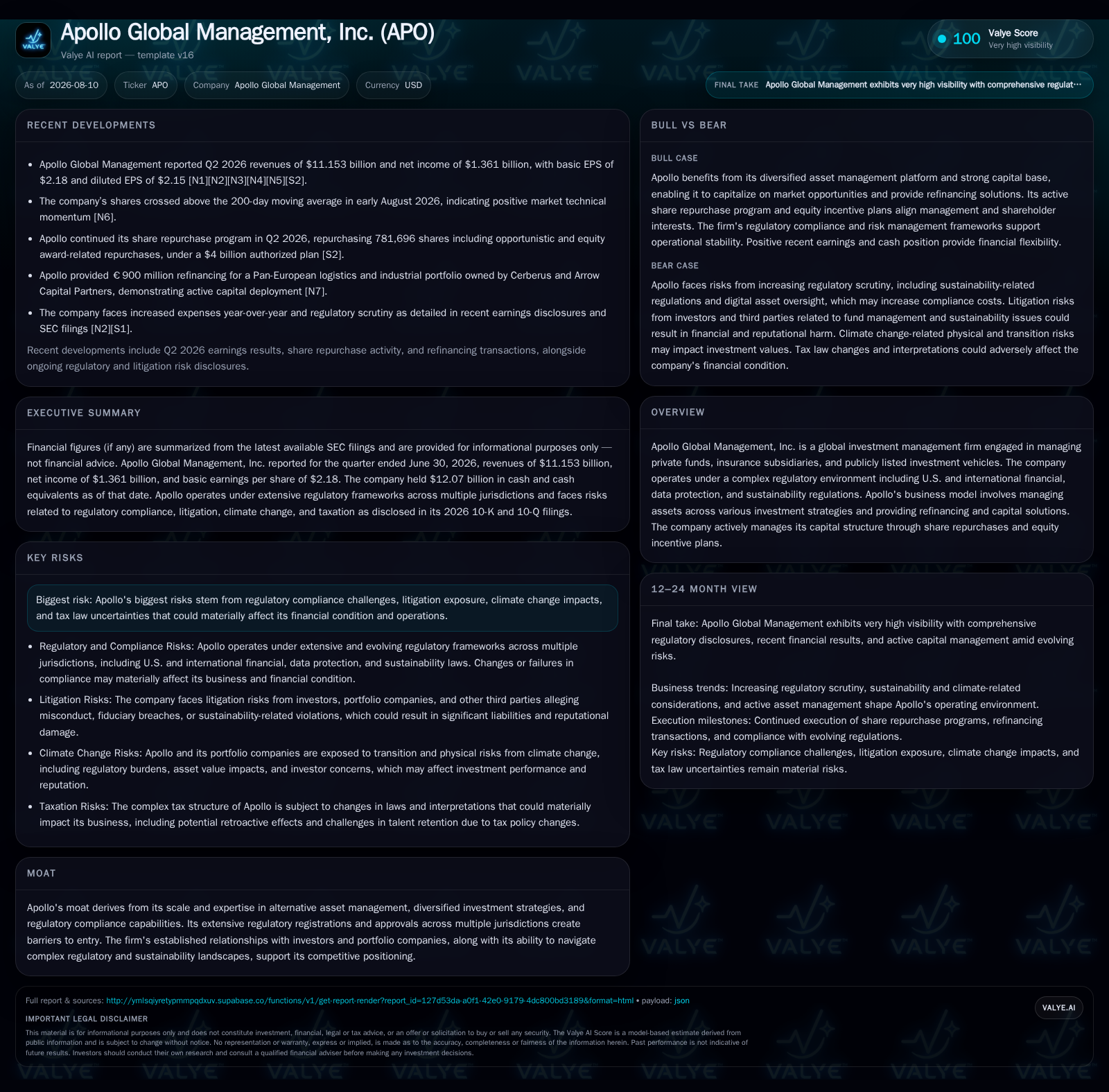
In its Q2 2026 results, Apollo Global Management reported mixed management and performance fee results against a rising cost base, partly driven by stock-based compensation and regulatory complexity. The firm continues to execute a $4 billion share repurchase program to offset dilution from equity incentive issuances. Apollo’s multifaceted business model leverages private equity, credit funds, and insurance subsidiaries under a demanding regulatory regime, with fee revenue linked closely to assets under management and capital deployment pace. Risks from compliance burdens and market volatility remain salient, while growth opportunities center on fundraising momentum and performance fee realization. Financially, Apollo maintains manageable net debt amid robust liquidity supported by cash and credit facilities.
Q2 Operating Results: Fee Revenues Pressure during Expense Growth
Apollo’s second quarter filing dated August 10, 2026 reveals nuanced dynamics in its fee revenue streams during elevated operating costs [S2]. Management fees displayed headwinds attributable primarily to slower-than-expected capital deployment across certain private funds despite steady asset gathering. Performance fees—typically volatile—were pressured by timing effects on realized investment gains but continue to hold potential upside if recent fund vintage IRRs persist [N2][S2]. Operating expenses have risen notably quarter-over-quarter; a significant driver is the surge in stock-based compensation associated with accelerating equity incentive plans, coupled with mounting regulatory compliance expenditures stemming from Apollo’s complex global footprint. This combination compressed operating leverage compared to prior periods [N2][S2].
Alongside earnings nuances, Apollo actively pursued capital structure optimization via its recently renewed $4 billion share repurchase program authorized in early 2026 [S2]. Quarterly repurchasing included substantial volumes executed opportunistically alongside retirements linked to equity awards issued under the Omnibus Equity Incentive Plan. This buyback strategy addresses dilution from equity grants while signaling confidence in the firm's intrinsic valuation
Business Model Overview: Complex Fees Tied to Diverse Asset Classes
Apollo’s business model rests on managing diverse pools of capital across private equity funds, credit strategies including CLOs, publicly listed investment vehicles like Athene Holding Ltd., alongside insurance subsidiaries—a structure that demands sophisticated coordination of capital raising, deployment, and regulatory adherence [S1]. Revenue generation is primarily bifurcated into fixed management fees calculated on assets under management (AUM) or committed capital, providing a stable baseline; alongside performance or incentive fees which are highly dependent on fund realization events or appraisal of unrealized portfolio gains [S1].
The sustained growth in AUM reflects both organic expansion through new funds (e.g., recent Accords credit series and flagship Fund X equity vehicles) and market appreciation that expands net asset value bases. However, the lag between capital raised (committed capital) and actual invested capital influences short-term fee recognition profiles since uninvested commitments typically generate lower or no management fees beyond certain thresholds [S1]. Vintage year IRRs across major credit and equity fund series demonstrate resilience but also underscore variability that places premium importance on effective investment selection and exit timing for performance fee capture.
Industry Context: Competitive Scale and Regulatory Complexity
Within the global alternative asset management industry context—home also to peers like Blackstone Group (BX), KKR & Co. (KKR), and The Carlyle Group (CG)—Apollo occupies a robust position attributable to its scale across multiple asset classes combined with integrated insurance platforms. Unlike some pure-play firms focused solely on private equity or credit assets, Apollo’s multifaceted exposure entails navigating overlapping regulatory regimes ranging from U.S. securities laws to European ESG mandates and data protection regulations articulated under GDPR variants [S1]
This regulatory complexity acts as a double-edged sword: it erects barriers deterring less compliant entrants yet inflates operating expenses materially as compliance teams expand and legal oversight intensifies—a trend reflected in Apollo's Q2 cost pressures [N2][S1]. Moreover, broker-dealer regulations complicate product distribution channels internationally. Sustained regulatory adaptability thus forms an integral part of Apollo's moat but also represents a persistent margin headwind.
Growth Catalysts: Fundraising Trends, Investment Performance, Capital Deployment
Institutional demand for alternative investments remains elevated globally due to client appetite for yield diversification beyond traditional equities and fixed income [S1]. Apollo benefits from this tailwind by leveraging its deep client relationships built over decades to raise sizeable new funds targeting emerging sectors such as infrastructure financing within its real assets portfolio segment alongside conventional private equity buyouts and credit strategies
Capital deployment efficiency is pivotal—faster conversion of committed capital into invested positions accelerates fee revenue recognition with attendant performance fee potential if vintage IRRs remain strong. Recent quarterly commentary suggests Apollo aims to sustain or improve deployment rates following previous quarters marked by cautious pacing amidst macroeconomic uncertainties [N1][S2]. Any strategic acquisitions that complement existing platforms or broaden distribution capabilities would serve as additive growth drivers although none were flagged explicitly for the quarter.
Risks that Could Restrain Growth: Regulatory Compliance, Litigation Exposure, Market Volatility
Apollo’s disclosures emphasize typical yet substantive risks endemic to large-scale alternative asset managers: evolving financial regulation could impose constraints or increase compliance spending unpredictably; ongoing legal proceedings may incur financial penalties or reputational damage; taxation reforms—especially internationally—could alter fund return structures necessitating operational adaptation; meanwhile volatility in valuation of portfolio companies impacts unrealized gains which feed directly into the volatile component of performance fees crucial for profitability spikes [S1][S2].
Environmental, social and governance (ESG) related regulations present a newer layer of operational overheads affecting product design and jurisdictional eligibility—potentially complicating cross-border marketing of sustainability-aligned funds. Cybersecurity threats remain a latent concern given the sensitivity of investor data handled within multi-tiered fund architectures.
Monitoring Forward: Expectations for Fee Income Recovery and Capital Allocation Execution
Given current trends, monitoring AUM trajectory relative to closing new fundraising campaigns will be essential to gauge management fee stability. In parallel, tracking realized versus unrealized gain trends from fund exits across vintage years will offer insight into the near-term sustainability of performance fees which are inherently lumpy but critical for earnings quality [N1][S2].
Additionally, execution of the share repurchase program serves as an indirect confidence barometer; accelerated repurchase volume suggests conviction in valuation support while helping offset dilution from incentivization schemes embedded within talent retention frameworks. Expense control initiatives will need scrutiny as elevated stock-based compensation raises operating leverage sensitivities.
Financial Profile Discussion: Capital Structure, Liquidity, and Share Repurchases
The comprehensive share repurchase authorization of up to $4 billion announced early 2026 was substantially executed during Q2 via both open-market purchases totaling over 232 thousand shares opportunistically alongside equity award-related retirements exceeding 549 thousand shares designed to satisfy tax withholding obligations related to incentive plans—a proactive approach mitigating implicit shareholder dilution while optimizing earnings per share metrics over time [S2]
In sum, Apollo stands as a deeply complex alternative asset manager balancing growth ambitions with intensifying cost pressures borne out of necessary compliance investments alongside a challenging macro backdrop impacting deployment cadence and performance fees—a profile common among leading peers yet distinguished by Apollo’s diversified asset exposure including insurance operations adding both opportunity synergies and layered risk dimensions.
Disclaimer: This is research-only, informational analysis and not investment advice. It may include AI-generated interpretation and general industry context. Always verify important details using primary sources.

Comments