
McDonald's Second-Quarter Update Highlights U.S. Operational Challenges Against Global Franchise Strength
McDonald’s reported solid franchise margin growth but flagged execution issues in its largest market, pointing to a nuanced outlook for systemwide sales and operating leverage in 2026.
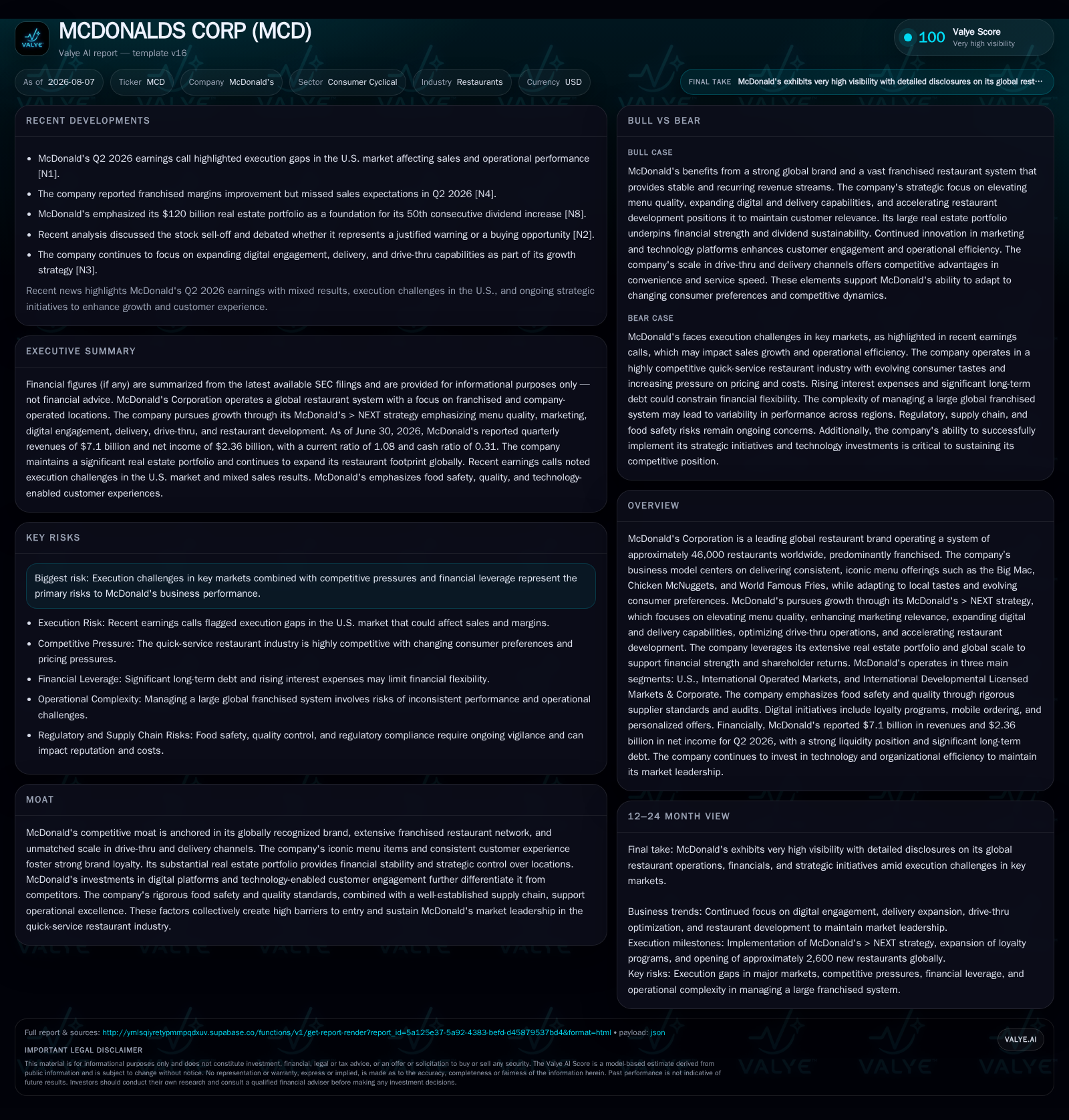
In its latest quarterly filing, McDonald's Corp disclosed mixed performance dynamics with franchisee segments expanding margins while company-operated stores in the U.S. experienced execution gaps impacting same-store sales growth [S2][N1]. The firm continues to rely on its McDonald’s > NEXT strategic framework focusing on menu innovation, drive-thru optimization, and digital-delivery integration as key growth drivers [S1]. Despite rising labor and commodity cost pressures typical in QSR operations, McDonald’s robust real estate portfolio coupled with a predominantly franchised model cushions cash flow volatility and strengthens its competitive moat [S1][F1]. Ongoing leadership transition in the U.S. segment introduces some near-term uncertainty, necessitating close monitoring of execution improvements [S3].
Recent Operating Update
McDonald's latest 10-Q filing for Q2 2026 reveals a complex operating environment where the franchise business units outperformed expectations on margins while the U.S. company-operated restaurants struggled with execution gaps that dampened same-store sales growth [S2][N3]. This dichotomy illustrates the varying pressures within McDonald’s system: franchised outlets continue to deliver strong royalty income due to efficient operations and cost management, whereas corporate-run stores face challenges in maintaining customer experience consistency that directly impacts top-line metrics.
Additionally, August 4th’s event filing announced a management change with Joseph M. Erlinger departing as Executive Vice President and President of McDonald’s USA, replaced by Skye Anderson who inherits responsibility during this critical execution improvement phase [S3]. Such leadership transitions in core markets often entail risks around operational continuity but also open opportunities for strategic refocusing.
Business Model Overview
McDonald's operates a hybrid model combining company-operated restaurants with a large majority of franchised units worldwide. The revenue stream is diversified between direct food & beverage sales from owned outlets and more capital-light royalty fees, rent, and service revenues from franchisees. This mix facilitates strong operating margin profiles because revenues from franchised locations have limited associated costs beyond property management while benefiting from scale economies in supply chain procurement.
The menu portfolio—anchored by iconic products like the Big Mac and Chicken McNuggets—balances global consistency with local customization. McDonald’s invests heavily under its "McDonald's > NEXT" growth plan prioritizing menu innovation (including health-conscious items), technological upgrade for digital ordering/delivery platforms, enhanced marketing relevancy, optimized drive-thru throughput times, and strategic restaurant expansion. These initiatives collectively aim to capture evolving consumer preferences towards convenience and quality while cultivating deeper brand loyalty [S1].
The franchise-centric approach reduces capital expenditure burdens compared to wholly company-operated chains like Wendy's or Burger King, enabling free cash flow generation even amid cyclical downturns. It further minimizes operational leverage risk since franchisees shoulder day-to-day retail expenses including labor and maintenance.
Industry Structure and Competitive Positioning
Within the quick service restaurant (QSR) industry—comprising peers such as Burger King, Wendy's, Yum! Brands—McDonald's distinguishes itself through unmatched scale with approximately 46,000 global restaurants primarily franchised [S1]. Its massive real estate holdings provide a durable competitive advantage uncommon among typical QSR operators reliant heavily on leased locations.
Brand strength is supplemented by rigorous food safety standards and tightly controlled supply chain logistics ensuring quality consistency. Digital ordering penetration is a critical battleground; McDonald's leads many competitors by integrating mobile app orders seamlessly with delivery partnerships enhancing convenience for customers alongside better data collection capabilities driving personalized marketing.
Drive-thru operations remain another strategic differentiator; continuous investments focus on reducing customer latency thereby boosting throughput volumes which directly impact average check sizes and overall sales velocity—a crucial metric amid lunch/dinner peak cycles.
Growth Drivers
Organic expansion through net restaurant unit additions is expected to contribute approximately 2.5% systemwide sales growth in constant currencies during 2026, echoing broader QSR industry trends of steady footprint enlargement in emerging urban areas as well as refurbishments in mature markets [S1]
Menu innovation targeting plant-based items and health-conscious consumers aligns McDonald’s offer set with shifting dietary trends that attract new customer cohorts while retaining traditional consumers. Digital channel enhancements not only expand ordering flexibility but also foster higher average check sizes via upselling algorithms embedded in apps.
Enhanced drive-thru technology paired with staff training aims to improve order accuracy and speed, mitigating previous bottlenecks that affected customer satisfaction scores particularly in the competitive U.S. market segment currently undergoing corrective action post Q2 reporting shortfalls [N1][N3]
Furthermore, loyalty programs integrated with mobile platforms incentivize repeat visits driving sustained average check improvement—a KPI closely watched across global franchises.
Risks and Constraints
Labor cost inflation remains a persistent pressure on margins due to tightening employment markets across key geographies; this challenge disproportionately impacts company-operated units bearing these expenses directly compared to franchised stores passing costs ultimately through pricing or operational adjustments [S2]. Supply chain volatility affecting commodity prices (notably beef, poultry, packaging materials) can squeeze profitability if not offset by pricing power or efficiency gains.
Execution risk was specifically flagged regarding U.S. operations where missteps in customer experience delivery contributed to slower-than-expected sales recovery despite robust demand fundamentals documented elsewhere globally [N1]. Leadership changes add transitional uncertainty; success depends on rapid stabilization of store-level execution errors.
Currency fluctuations hold moderate impact due to international diversified licensing agreements but require active hedging policies to avoid earnings variability especially from emerging market exposures common within International Developmental Licensed Markets & Corporate segment [S1]. Regulatory compliance—in food safety standards plus labor laws—and geopolitical tensions pose ongoing monitoring imperatives.
What to Watch Next
Investors should track quarterly same-store sales trends separating company-operated versus franchised outlets to gauge closure of U.S. execution gaps. Digital ordering penetration rates combined with delivery channel contributions are vital metrics signaling adoption success of technology investments per the > NEXT strategy.
Drive-thru throughput time improvements will serve as operational efficiency proxies; reported average times versus peer benchmarks can illuminate competitive positioning shifts. The new leadership's early operational reviews or commentary following Mr. Erlinger's departure will also provide insights into strategic priorities or potential restructuring needed.
Systemwide unit expansion rates kept at or above mid-single digits will confirm sustained growth momentum supporting royalty income stability without incurring heavy capex burdens.
Financial Profile Discussion
At mid-year 2026, McDonald's held approximately $822 million in cash and equivalents against total debt of about $39.9 billion, yielding a current ratio of approximately 1.08, indicating reasonable short-term liquidity coverage though reflecting a leveraged balance sheet typical for large-scale restaurateurs managing expansive real estate assets [F1][S2]
Net income for the first half stood at $4.35 billion supported by disciplined expense management despite input cost inflationary headwinds. Cash flow from operations generated $5.22 billion over the same period reflecting strong underlying earnings quality aided by the predictable royalty streams from franchise agreements.
Selling, general & administrative expenses approximate 2.2% of systemwide sales reflecting efficient overhead controls relative to broader QSR benchmarks.
Capital expenditures remain restrained primarily focused on remodeling initiatives alongside technology platform upgrades rather than aggressive build-outs ensuring solid free cash flow generation capacity underpins ongoing shareholder return programs.
This analysis synthesizes recently filed SEC disclosures alongside sector knowledge reflecting McDonald's position as a global quick service restaurant leader grappling simultaneously with emerging-operational challenges and entrenched structural advantages typical of its scale-driven franchise business model.
Disclaimer: This is research-only, informational analysis and not investment advice. It may include AI-generated interpretation and general industry context. Always verify important details using primary sources.

Comments