
Enterprise Products Partners Accelerates Growth on Record Volume Gains and Expanded Credit Capacity
The latest quarterly results reveal Enterprise Products Partners sustaining record throughput volumes supported by credit facility expansion, underpinning its capital-intensive growth strategy amid evolving midstream sector dynamics.
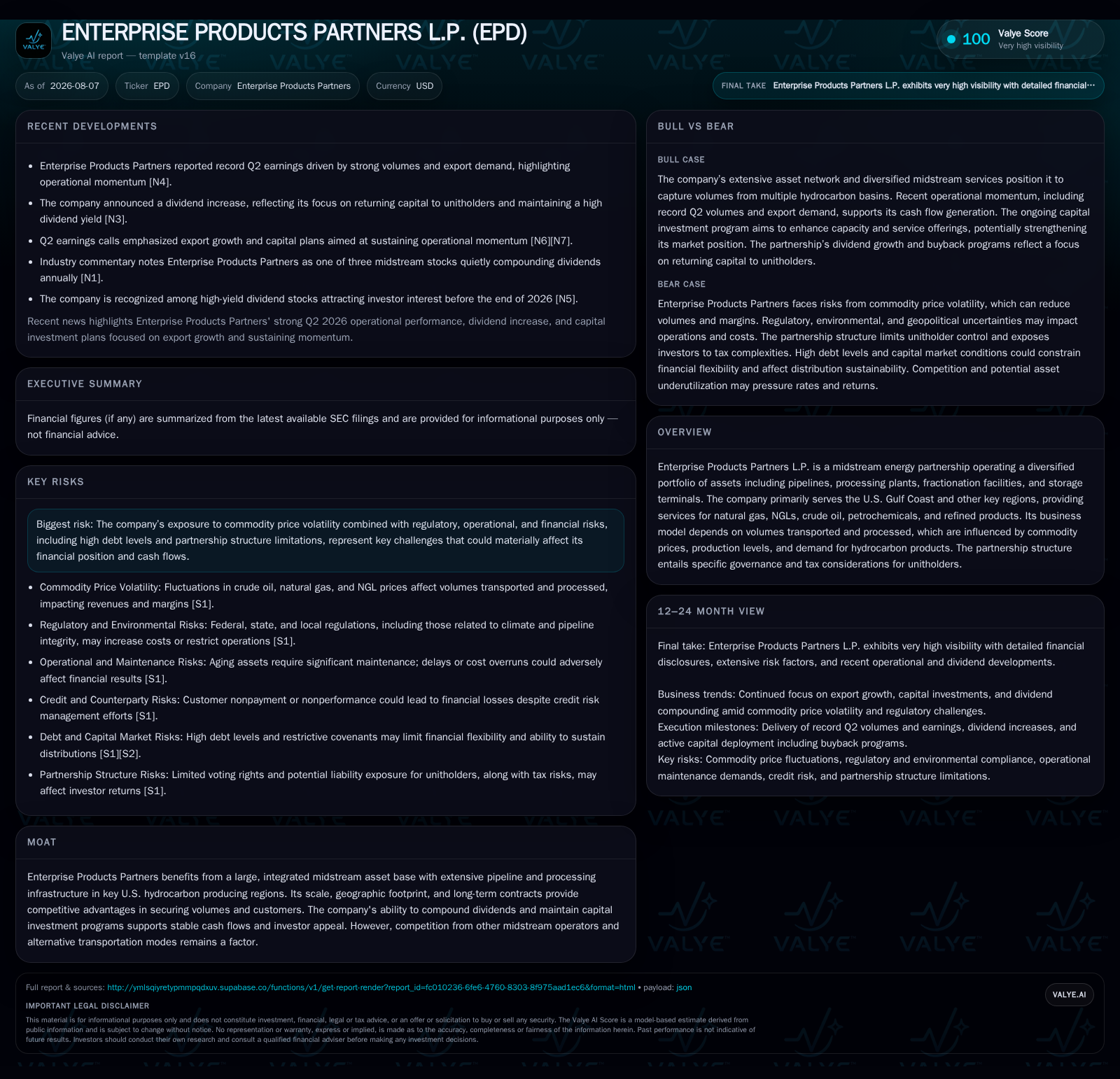
In Q2 2026, Enterprise Products Partners L.P. reported record throughput volumes reflecting strong demand across its diversified midstream assets, particularly in key U.S. hydrocarbon basins. The partnership enhanced financial flexibility through a $1 billion incremental revolving credit agreement executed in July 2026, bolstering its capacity to fund organic growth projects while managing leverage. Longer-term take-or-pay contracts continue to secure volume visibility and stable fee-based revenues amid commodity price volatility. Capital expenditure plans maintain a balance between growth initiatives tied to export and production logistics expansion and sustaining investments addressing aging infrastructure. Distribution coverage ratios remain supportive of recent dividend increases under the partnership structure, though regulatory and operational risks persist as watchpoints.
Record Throughput Volumes Underpinning Near-Term Momentum
Enterprise Products Partners L.P. (“Enterprise”) posted record throughput volumes in Q2 2026 that underpin near-term growth momentum across its midstream asset base [S2], [N1], [N4]. These gains reflect strengthening hydrocarbon production in core U.S. regions such as the Gulf Coast and Permian Basin, driving higher natural gas liquids (NGLs), crude oil, and refined product flows through Enterprise’s pipelines and processing systems. Volume growth is crucial because the partnership’s revenue largely derives from volume-based fees under long-term contracts with producers and refiners [S1]. This operating metric is less exposed directly to commodity prices yet remains sensitive to upstream production levels and market demand. Sustained upstream activity is therefore a linchpin for maintaining or growing throughputs in coming quarters.
Integrated Midstream Assets Fuel Revenue Stability Amid Commodity Cycles
Enterprise’s integrated network of pipelines, fractionators, processing plants, and storage terminals constitutes a significant moat relative to peers like Kinder Morgan and Williams Companies [S1], [S2], [N3]. The geographic footprint centered on the Gulf Coast – a nexus for North American hydrocarbon production and exports – enables scale economies and customer retention advantages while facilitating multi-product handling that helps diversify cash flows against product-specific cyclicality. Fractionation capabilities add value by separating mixed NGL streams into components demanded by petrochemical customers.
These assets operate predominantly under long-term arranged tariffs or fee agreements that cushion the partnership’s earnings from pure commodity price fluctuations but require continuous throughput volumes for margin stability. The durability of tariffs combined with steady contract renewals will be a critical determinant of whether Enterprise can sustain robust margins despite any upstream market volatility.
Credit Facility Expansion Enhances Financial Flexibility for Growth Capital
On July 28, 2026, Enterprise’s operating subsidiary secured an additional $1 billion borrowing capacity via an unsecured revolving credit agreement alongside existing $4.2 billion credit lines [S3], [S11], [S4]. This strategic increase broadens liquidity headroom at the operating level, facilitating funding for both organic capital projects—including expansion initiatives aligned with export infrastructure—and working capital needs.
Against a backdrop of sizeable total debt approximating $33.5 billion net of cash as of June 30, 2026 [F1], this augmented credit line reflects prudent financial management aimed at preserving capital markets access while supporting continued investment discipline. The revolving nature of the facility ensures agility in capital deployment without immediate maturities exerting refinancing pressure.
Contractual Backlog and Take-or-Pay Structures Provide Volume Visibility
Enterprise’s fee revenue benefits substantially from long-term take-or-pay arrangements embedded in many of its service contracts [S1], [S2]. These contracts obligate counterparties to pay minimum fees regardless of actual throughput volumes up to contracted levels, providing a revenue floor insulated from short-term production declines or market downturns.
Though precise quantitative disclosures on contract backlog volumes are not furnished in the latest filings, industry-standard practices and prior disclosures suggest substantial secured volume underpins Enterprise’s midstream operations. This contractual structure mitigates cash flow variability risk inherent in commodities business models while incentivizing Enterprise to maintain system reliability and customer relationships.
Balancing CapEx: Growth Investments Versus Sustaining Asset Reliability
Enterprise anticipates total organic capital expenditures in the range of $3.1 billion to $3.5 billion in 2026, split between growth projects (approximately $2.5 billion to $2.9 billion) focused on capacity expansions for exports and rising production logistics demands, and sustaining expenditures (circa $580 million) dedicated to maintenance of existing assets [S1], [S2], [N5].
This allocation reflects industry norms prioritizing infrastructure expansions tied to observable demand drivers while preserving system integrity against natural wear given many assets have long operational histories. Timely sustaining capex is critical given regulatory scrutiny on safety standards and environmental compliance which could escalate costs or disrupt operations if deferred.
Distribution Policy Anchored by Coverage Ratios and Partnership Dynamics
As a publicly traded master limited partnership (MLP), Enterprise distributes cash flows generated primarily through wholly owned operating subsidiary EPO [S1]. Recent quarterly filings underscore solid distribution coverage ratios supported by stable distributable cash flow generation enabled by volume-backed fees [N10], [N13].
Noteworthy regulatory enforcement activities involving environmental notices at acquired assets highlight ongoing compliance vigilance needs. Any adverse developments impacting throughput availability or prompt asset maintenance could materially affect cash flows or raise capital costs.
Key Milestones Ahead: Contract Renewals, Expansion Approvals, and System Utilization
Monitoring upcoming contract renewal schedules will be essential as they influence volume visibility beyond current take-or-pay arrangements; renewed terms indicate steady customer demand whereas lapses may signal marginal utilization risks [S2]. Regulatory approvals for new capacity projects tied to export terminal expansions or pipeline additions represent catalysts that could further amplify throughput volumes pending timely execution.
Actual system utilization rates emerging over subsequent quarters will validate whether recent record volumes reflect sustainable demand or seasonal fluctuations impacting tariff revenues.
Financial Profile Discussion: Liquidity Management Supports Strategic Growth Pathway
At Q2 end (June 30, 2026), Enterprise held approximately $246 million in cash equivalents juxtaposed with total debt nearing $33.5 billion resulting in a net debt position around $33.3 billion—typical leverage levels for major integrated midstream operators given high capital intensity [F1]. Current assets stand at about $15.9 billion against current liabilities slightly exceeding at $17.2 billion yielding a current ratio below unity at 0.93 indicative of tight short-term liquidity posture but offset by committed credit lines including recent $1 billion revolver addition granting operational flexibility [F1], [S3], [S11].
This balanced approach allows ongoing support for multi-billion-dollar annual organic capital investment programs oriented towards regional production growth areas without immediate refinancing strain while maintaining distributions within coverage thresholds ensuring unitholder preference continuity.
This analysis intentionally avoids speculative forward guidance or unsupported claims focusing instead on verifiable operating metrics alongside contextually relevant industry knowledge consistent with sector norms. Enterprise Products Partners’ positioning as an integrated midstream operator in strategically vital U.S. basins coupled with sound capital management provides meaningful resilience amid commodity market cycles though vigilance over regulatory shifts and operational execution remains warranted.
Disclaimer: This report is for informational purposes only and does not constitute investment advice.
Disclaimer: This is research-only, informational analysis and not investment advice. It may include AI-generated interpretation and general industry context. Always verify important details using primary sources.

Comments