
Cimpress plc Leverages Proprietary Mass Customization to Sustain E-commerce Leadership
Latest quarterly disclosures highlight Cimpress’s platform-driven scale and decentralized agility amid evolving margin challenges and strategic investments.
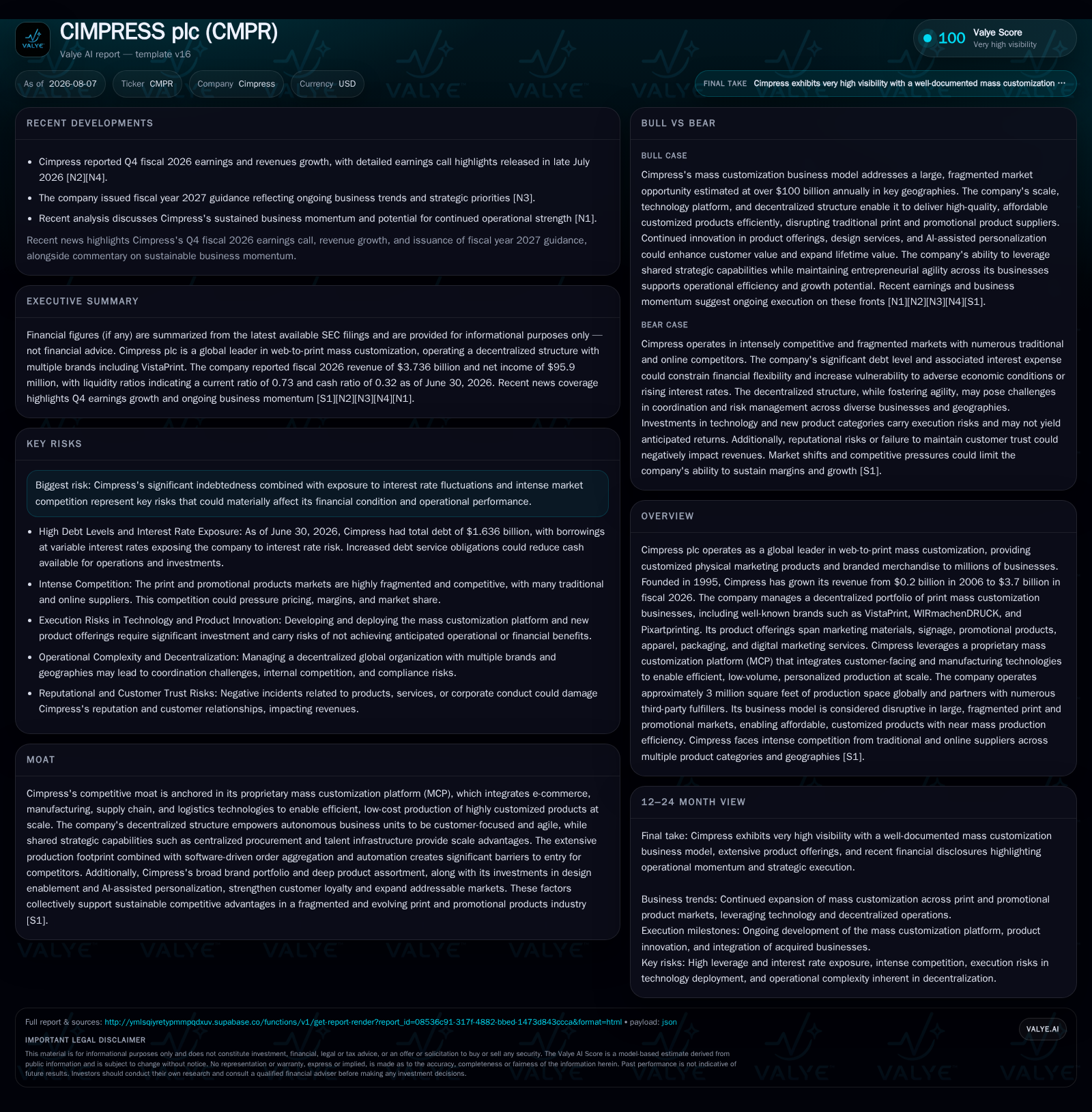
Cimpress PLC continues to reinforce its leadership in the print mass customization industry through its proprietary mass customization platform (MCP) and decentralized multi-brand structure. The latest quarter revealed steady revenue growth tempered by margin pressure from raw material costs and competitive pricing. Strategic acquisitions and AI-driven personalization underpin growth vectors, while leverage and input cost inflation remain key risks. Operational metrics point to continued resilience in order volume and customer retention despite industry headwinds.
Q4 Highlights Reveal Operational Trends Impacting Market Position
In its 10-Q filing dated May 1, 2026, Cimpress reported fiscal Q4 earnings that underscored a modest acceleration in order volume growth across its brands, notably VistaPrint which continues as the dominant revenue contributor with an average order value (AOV) near $100 [S2][F1][S15]. This topline strength was accompanied by elevated raw material costs driven primarily by paper and ink inflation, exerting negative gross margin pressure. The company cited competitive pricing intensity as a factor limiting pass-through of cost increases to customers, translating into compressed profit margins in the quarter [S2]. Despite these challenges, Cimpress maintained solid customer retention metrics indicative of healthy brand loyalty within a growing customized print market segment.
The operational update reflects structural shifts within the print mass customization landscape—where demand for personalized marketing materials remains robust yet highly price sensitive. Cimpress’s ability to sustain growth amid these dynamics hinges on leveraging its unique technology-enabled efficiencies and diversified brand portfolio.
Mass Customization Platform: The Core Driver Behind Scale and Agility
Central to Cimpress’s competitive strategy is its proprietary Mass Customization Platform (MCP), which integrates e-commerce storefronts, digital design enablement, automated manufacturing workflows, and supply chain orchestration [S1][S11]. This platform enables low-volume, individualized orders to be aggregated into efficient production batches using advanced process control and automation techniques. By effectively bridging scale economies with high customization flexibility, MCP disrupts traditional trade-offs between unit cost and order uniqueness prevalent in conventional printing.
Per the annual report narrative, MCP serves as a durable moat by fostering significant barriers to entry—rivals must replicate complex software-hardware integrations coupled with a wide distributed production footprint to compete effectively [S1][S11]. Future enhancements focus on AI-assisted personalization tools that streamline design simplification for users while increasing cross-sell opportunities into higher-margin product categories.
Confirmation of MCP's ongoing moat strength would come from rising digital platform traffic conversion rates combined with improvements in production capacity utilization without proportional labor cost increases. Conversely, commoditization risk would manifest if competitors develop superior automation or if MCP scalability plateaus.
Decentralized Business Units Enhance Customer Responsiveness Amid Complexity
Cimpress’s governance model delegates operational control across multiple autonomous business units—ranging from VistaPrint targeting micro-businesses to niche enterprises like PrintBrothers focusing on graphic professionals [S1][S11]. This decentralization fosters agility allowing each unit to tailor local marketing strategies, product assortments, and service delivery aligned with regional customer preferences.
Nonetheless, centralized shared services including group-wide procurement of raw materials and capital equipment investments provide scale cost advantages that individual units cannot replicate independently. This hybrid structure balances entrepreneurial customer focus with collective efficiency gains.
The model's success depends on maintaining effective peer-to-peer knowledge sharing without diluting accountability or slowing decision-making due to coordination overhead. Risks arise if cross-unit competition undermines collaboration or if centralized procurement fails to deliver consistent cost savings.
Industry Comparisons Highlight Competitive Strengths and Challenges
Relative to peers such as VistaPrint (within Cimpress) and external rivals like Shutterfly (specialist personalized photo products), Cimpress commands an advantage via its broad multi-brand portfolio underpinned by MCP-driven operational efficiencies.
Unlike pure-play web-to-print providers or traditional commercial printers transitioning digitally, Cimpress combines breadth in product categories—from small-format marketing materials to promotional apparel—with deep technological integration ensuring superior fulfillment accuracy and lead time control. Furthermore, centralized procurement contracts elevate cost competitiveness against smaller fragmented suppliers.
Challenges linger from intensifying market fragmentation where nimble niche entrants benefit from localized digital marketing tactics or innovative product concepts outside Cimpress's scope. Sustaining differentiation will require continuous innovation in design enablement tools alongside expansion into emerging segments like custom packaging.
Growth Catalysts: AI Personalization, Product Mix Expansion, and Global Reach
Strategic growth prospects center on harnessing AI-assisted personalization technologies currently being embedded within platforms to enhance user experience and deepen wallet share per customer [S1][N2]. These tools lower customer acquisition costs by simplifying design processes for non-expert users while enabling dynamic up-selling of elevated products such as promotional goods and packaging—categories witnessing faster adoption despite presently lower gross margins.
The recent acquisition announced in May 2026 of SAXOPRINT and viaprinto aims to bolster Cimpress’s footprint chiefly in Europe’s PrintBrothers segment with anticipated base case returns surpassing 20%, signaling accretive expansion prospects aided by anticipated synergies from overlapping supply chains and procurement consolidation [S12]
Geographic diversification also mitigates single-market risk exposure while enabling cross-fertilization of best practices across decentralized units. Near-term indicators supporting growth include stable or improving repeat purchase rates, rising average revenue per customer especially in elevated product lines, and sustained output utilization amidst cautious capacity expansion.
Risks and Limitations: Cost Pressures, Leverage, and Demand Volatility
The operational leverage inherent in manufacturing-intensive print mass customization engenders vulnerability to fixed cost under-absorption should demand soften unexpectedly [S13]. Moreover, fluctuations in paper prices, energy costs, logistics expenses, and global supply interruptions continue exerting margin compression pressure sporadically.
Competitive pressures also impose discipline on pricing strategies limiting ability to fully offset input inflation—additional risks stem from economic downturns lowering discretionary spending by small businesses which comprise a significant portion of customer base.
Lastly, regulatory complexities spanning tariffs, local labor laws impacting facility operations across geographies add execution uncertainties impairing optimal supply chain management [S13].
Upcoming Milestones and Market Indicators to Monitor
Investors should closely monitor the finalization of SAXOPRINT/viaprinto acquisition expected within first half fiscal 2027 alongside subsequent integration updates that may reveal realization pace of projected returns [S3]. KPIs such as sequential trends in order volume growth rates across primary brands will signal underlying demand health post recent macroeconomic shifts.
Further updates on AI personalization rollout efficacy with leading indicators including improved digital platform conversion rates or decreases in customer acquisition costs would validate technology investments driving top-line expansion [N2]. Also important will be margin trends reflecting successful mitigation of raw materials inflation through mix improvements or supply chain optimization.
Tracking shifts toward higher-margin promotional products or packaging revenue percentages will indicate progress capturing evolving addressable market segments where mass customization penetration remains nascent but expanding rapidly.
Financial Profile Discussion: Leverage and Capital Deployment
The balance sheet portrays a capital-intensive operating model typical for large-scale print mass customization firms investing heavily in production automation assets alongside spectrum-wide geographic facilities requiring substantial working capital [F1][S7]. With total debt at approximately $1.64 billion net of cash around $249 million at quarter-end June 2026, leverage remains elevated reflecting past expansion initiatives including acquisitions such as SAXOPRINT/viaprinto announced recently [F1][S12].
Variable rate debt components expose interest expense sensitivity exacerbated amid an environment of rising benchmark rates; although partial derivative hedging reduces some volatility risk it does not eliminate it entirely leaving potential credit cost fluctuations up to an estimated $7.4 million annually for each incremental 100 basis point change calculated inclusive of swaps effect [S7]
Capital expenditures continue channeling resources toward technology upgrades including production automation enhancing throughput efficiency aligned with MCP advancements albeit balanced against disciplined free cash flow management given debt service obligations [F1][S21]
Overall financial positioning underscores pragmatic caution amid macroeconomic uncertainty while sustaining strategic investment momentum designed for durable competitive advantages through platform-led scale economies.
This analysis reflects publicly available information as of mid-2026 filings without investment research view. All forward-looking statements remain subject to risks outlined by the company including competitive dynamics, macroeconomic conditions, input cost variability, operational effectiveness of technological implementations, acquisition integrations, financial leverage constraints, regulatory environment changes, and evolving customer preferences.
Disclaimer: This is research-only, informational analysis and not investment advice. It may include AI-generated interpretation and general industry context. Always verify important details using primary sources.

Comments