
Mechanics Bancorp's Merger Integration Challenges Shape Financial and Operational Trajectory
Latest quarterly results underscore ongoing post-merger operational costs alongside steady revenue diversification in regional Western U.S. banking.
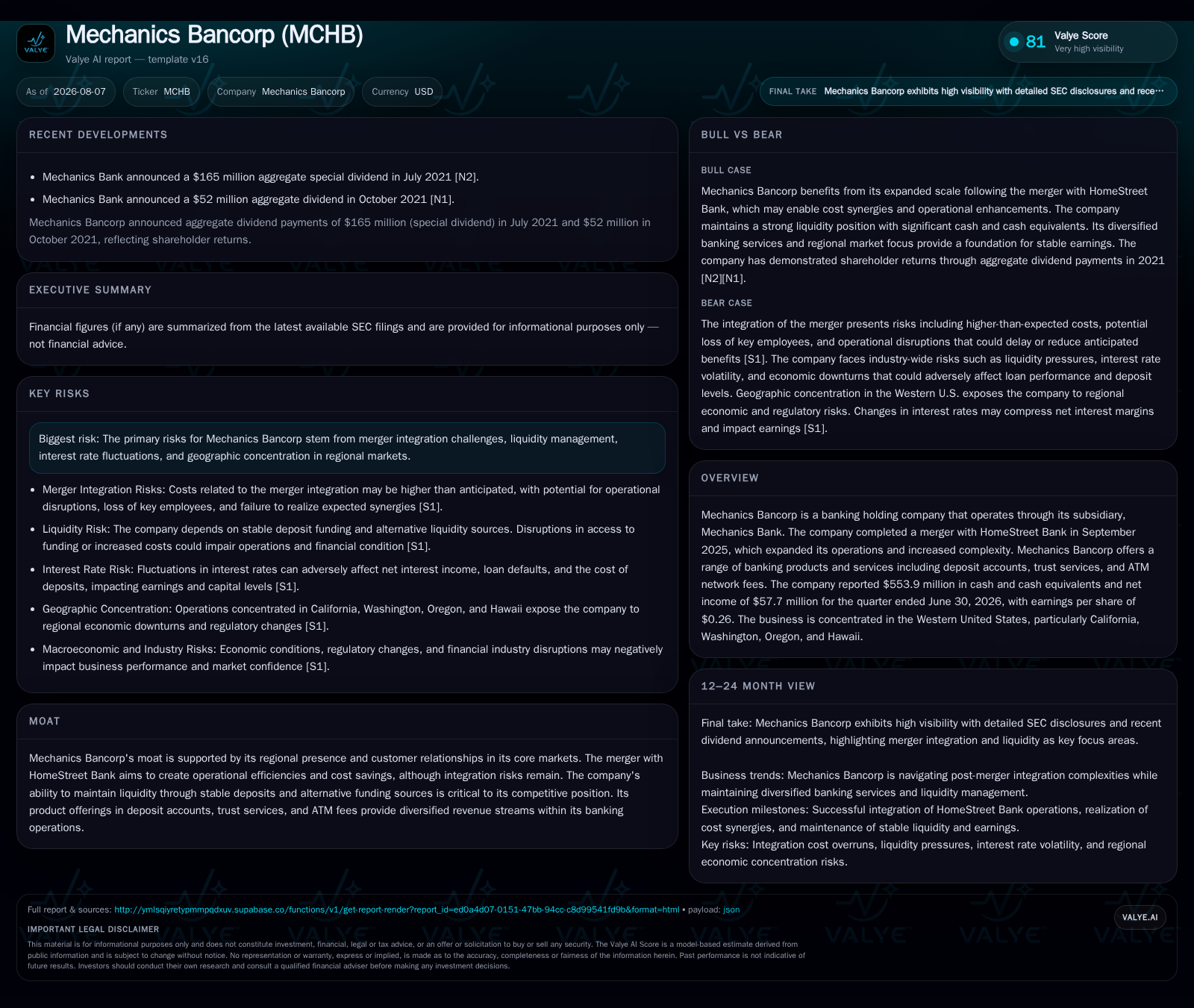
Mechanics Bancorp's Q2 2026 earnings reveal modest net income growth amid significant integration expenditures tied to the recent HomeStreet Bank merger, reflecting continued complexity in uniting systems and staff. The company maintains a strong liquidity position with $554 million in cash and equivalents against $130 million in debt as of June 30, 2026, supporting operational flexibility. Revenue composition shows a mix of net interest income from lending and deposits complemented by fee income from trust services and ATM fees, aiding resilience against interest rate swings. Geographic concentration in Western states remains both a moat via local customer relationships and a risk amid regulatory and economic regional sensitivities.
Q2 Performance Highlights Show Modest Earnings Growth Amid Merger Costs
Mechanics Bancorp reported net income of $57.7 million for the second quarter ended June 30, 2026, yielding earnings per share of $0.26 [S2][S3][F1]. This result reflects the dual reality of steady underlying banking operations combined with substantial integration expenses following the September 2025 merger with HomeStreet Bank. The company held cash and cash equivalents of approximately $554 million versus total debt near $130 million as of quarter-end, indicating a comfortable liquidity position that supports its operational needs during this complex transition phase [F1]. While earnings growth is modest relative to pre-merger baselines, the ongoing investment in combining legacy platforms and harmonizing policy frameworks weighs on current profitability.
Revenue for the quarter remains a blend of traditional net interest income—driven by lending spreads on deposit accounts—and non-interest income derived from trust services commissions and ATM network fees. This mix suggests deliberate diversification efforts to mitigate volatility inherent in net interest margin fluctuations amid changing interest rate environments [S2]. Identifying the balance between fee-derived resilience and dependence on lending margins is essential to understanding Mechanics Bancorp's evolving revenue profile.
Merger Integration: Operational Complexity and Cost Synergies Unfolding Gradually
Integration costs stemming from the merger continue as Mechanics Bancorp works through consolidating multiple business functions including purchasing, treasury management, compliance frameworks, and branch operations inherited from HomeStreet Bank [S1][S2]. These activities incur significant non-recurring costs encompassing severance packages, system consolidations, advisory fees, and regulatory filings – all challenging accurate estimation due to their scope and complexity.
Notably, successful realization of targeted cost synergies depends heavily on efficient integration without disrupting core banking service delivery or impairing customer relationships. The risk of lost key personnel or operational inconsistencies looms given the breadth of affected processes. Consequently, efficiency ratio metrics may see short-term degradation as fixed operating costs rise during this transitional period before anticipated long-term savings materialize.
By comparison to typical regional bank mergers—such as peer HomeStreet Bank’s prior acquisition dynamics or PacWest Bancorp’s scale expansions—the pace at which Mechanics Bancorp realizes these benefits will be a critical barometer for management effectiveness.
Evolving Business Model: Diversifying Revenue Beyond Interest Income Streams
Mechanics Bancorp leverages a traditional regional bank business model that combines margin-based lending income with supplementary fee-based products including trust services and ATM fees [S1][S2]. Trust services cater primarily to higher-net-worth regional clients seeking wealth management solutions, providing recurring commission revenues less sensitive to interest rate swings than loan spreads.
ATM network fees also represent a consistent revenue stream reflecting transaction volume across its footprint. Together these fee types reduce overall earnings volatility and may enhance customer retention by embedding additional service touchpoints beyond deposit-lending relationships.
This diversification strategy aligns well within the competitive paradigm for regional banks facing margin compression risks amidst rising funding costs or deposit beta increases. Maintaining balance between scaling loan portfolios—which directly drive net interest margin—and growing non-interest income streams will remain central to sustaining profitable growth.
Regional Bank Industry Structure Shapes Competitive and Regulatory Pressures
Mechanics Bancorp operates primarily across Western U.S. states: California, Washington, Oregon, and Hawaii—a geography known for robust economic activity but also regulatory variability [S1]. Such regional concentration strengthens local customer loyalty via relationship banking but simultaneously elevates exposure to localized economic downturns or regulatory shifts.
Within this context, capital adequacy requirements remain a regulatory priority post-merger given increased asset scale and complexity. Mechanics must sustain prudent capital ratios under Federal Reserve scrutiny to preserve funding options like brokered deposits or Federal Home Loan Bank advances without attracting constraints.
Competition emerges not only from similarly positioned regional peers like Regions Financial Corporation or KeyCorp but also from fintech lenders reshaping deposit growth channels and consumer banking preferences. Although less direct than national super-regional megabanks or specialized community banks, these dynamics influence pricing power over deposit accounts (deposit beta) and loan underwriting standards.
Growth Outlook Supported by Core Market Loan Expansion and Fee Income Cross-Selling
Loan portfolio expansion in Mechanics’s core markets underpins expected growth trajectories despite macroeconomic headwinds [S1][S2]. Incremental deposit base enlargement provides stable funding conducive to expanding commercial real estate financing—a historically significant segment for Western regional banks.
Cross-selling opportunity arises notably through trust services that augment client wallet share within established banking relationships. Fee revenues' contribution as a percentage of total revenue hints at increasing reliance on these streams to bolster margins amid fluctuating net interest margins.
While broader economic uncertainties persist, localized economic strength within California’s technology hubs or Pacific Northwest industries offers tailwinds supporting lending demand. Continued organic growth will depend on balancing credit quality vigilance with disciplined risk management policies enacted during merger integration.
Key Risks: Geographic Concentration and Interest Rate Sensitivity Remain Relevant Constraints
Primary risk factors articulated include sensitivity of net interest margin to prevailing interest rates—where rising rates can compress margins if deposit beta outpaces loan repricing—and inherent risks tied to credit quality within regionally concentrated loan portfolios [S1]
Merger execution delays present an operational risk that could exacerbate expense run-rates beyond planned budgets while potentially distracting management focus from ongoing credit monitoring efforts. Additionally, geographic concentration exposes mechanics Bancorp to event-driven deposit withdrawals or sector-specific borrower stresses limiting portfolio performance consistency.
These risks manifest through potential upticks in provision for credit losses or increased loan delinquency ratios—critical metrics for near-term surveillance—alongside deposit stability indicators signaling costlier wholesale funding substitution if prolonged outflows occur.
Near-Term Milestones to Track Merger Success and Margin Stability
Investors should monitor forthcoming quarterly disclosures for confirmation around timing and magnitude of reported merger cost synergies highlighted during recent webcasts post-July 29 earnings release [S3]. Clear signals include downward trajectory in integration expenses transitioning cost structure toward improved efficiency ratio outcomes.
Tracking quarterly net interest margin trends will reveal if lending yield improvements or enhanced deposit mix management successfully offset rising funding costs. Shifts in deposit base composition towards lower-cost core deposits versus volatile brokered deposits remain essential funding cost determinants.
Observing retention rates among key commercial clients during integration phases provides indirect evidence regarding disruption risk mitigation effectiveness—potentially presaging longer-term revenue stability or vulnerability.
Financial Profile Discussion: Liquidity Strengths Cushion Ongoing Integration Investments
As of June 30, 2026, Mechanics Bancorp maintained robust liquidity with cash and equivalents totaling approximately $554 million against total debt near $130 million—resulting in a negative net debt position near $424 million that affords substantial financial flexibility during ongoing merger-related expenditures [F1][S2][S3]
This liquidity reserve is instrumental given heightened cash needs tied to severance payments, technology platform consolidations, advisory fees, and other structural investments necessary for integrating HomeStreet Bank operations seamlessly while sustaining day-to-day banking services.
Capital position remains compliant with regulatory requirements related to tangible common equity ratios providing buffer capacity against potential credit losses or market stress scenarios specific to their Western U.S.-centric footprint [S1]. These financial attributes collectively support confidence in managing near-term operating challenges without materially compromising balance sheet strength or dividend policies.
Disclaimer: This analysis is based solely on publicly available information from SEC filings up to August 7, 2026. It is intended for informational purposes only without any investment research view or solicitation.
Disclaimer: This is research-only, informational analysis and not investment advice. It may include AI-generated interpretation and general industry context. Always verify important details using primary sources.

Comments