
Amplify Energy's Q2 Focus: Concentrated Assets and Commodity Price Sensitivity in Upstream Operations
Amplify Energy's latest quarterly filing underscores its strategic asset consolidation in the Rockies and offshore California, emphasizing heightened exposure to commodity price dynamics within a capital-intensive upstream E&P framework.
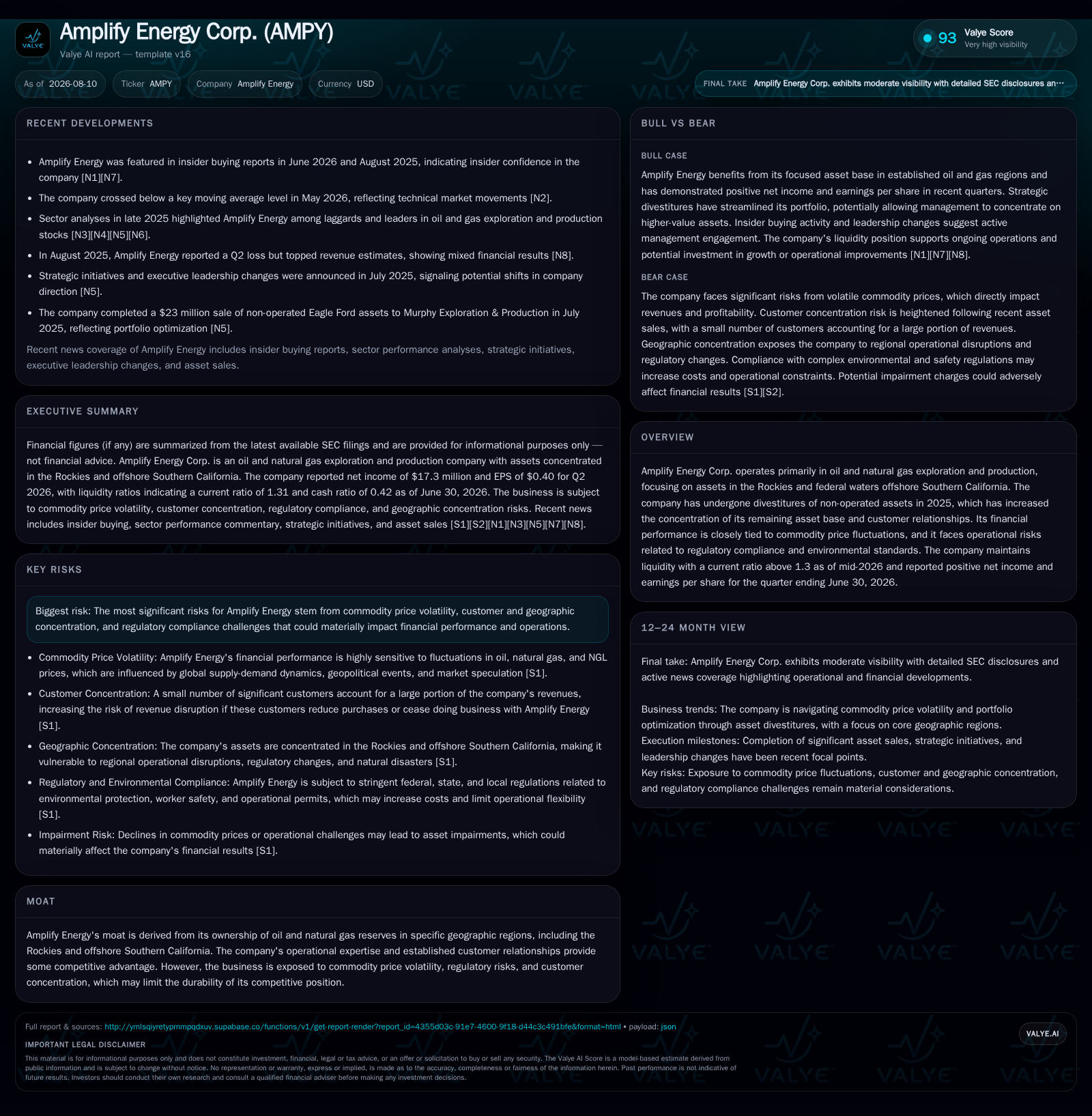
In its Q2 2026 results, Amplify Energy completed portfolio consolidation after 2025 divestitures, intensifying geographic and customer concentration risks while reaffirming exposure to crude oil and natural gas price fluctuations. Operating primarily in the Rockies and offshore Southern California, profitability depends on production volumes, lifting costs, and realized commodity prices. Regulatory compliance in offshore operations remains a critical challenge. Liquidity is adequate as of June 2026, but significant leverage influences capital allocation amid market volatility. Key near-term monitoring points include production levels, reserve replacement progress, and regulatory developments.
Recent Operational Update Highlights Portfolio Consolidation and Market Exposure
Amplify Energy's Q2 2026 filing confirms completion of its strategic divestiture plan finalized during 2025, resulting in a concentrated upstream asset base focused in the Rockies region and federal offshore waters of Southern California [S2], [S8]. This consolidation sharpens the company's exposure to regional commodity price dynamics and infrastructure limitations inherent to these geographies.
The company’s revenue streams are directly influenced by the realized prices of West Texas Intermediate (WTI) crude oil, Henry Hub natural gas, and natural gas liquids (NGLs), all of which have demonstrated significant volatility historically [S1]. Such concentration intensifies financial sensitivity to commodity cycles; while stable or rising prices can leverage earnings growth through steady production volumes (measured in barrels of oil equivalent per day - BOE/d), downturns amplify margin pressure due to fixed operating costs.
Business Model Anchored in Upstream Exploration & Production with Geographic Focus
Operating exclusively in these two geographies post-divestiture [S8], Amplify manages both onshore (Rockies) and offshore (Southern California) operations. Offshore assets entail higher capital intensity due to drilling rigs, subsea infrastructure maintenance, and stringent environmental regulations compared to more mature onshore fields [S1], [S6]. Managing lifting costs per BOE is critical given their direct impact on operating margins amid volatile commodity pricing.
Production volumes depend heavily on operational uptime constrained by regulatory inspections and weather-related challenges typical of offshore environments [S2]. Onshore operations benefit from established infrastructure but face competitive pressures for skilled labor and equipment availability that influence drilling success rates and reserve development efficiency.
Customer Concentration Presents Credit Risk Amid Market Volatility
Amplify's filings highlight a concentrated customer base for hydrocarbon sales, which increases credit risk exposure should purchasers experience financial distress due to fluctuating commodity markets [S1], [S8], [S18]. This dynamic complicates working capital management as delayed payments during price downturns could strain liquidity despite a current ratio of approximately 1.31 reported at June 30, 2026 [F1], [S2]. Monitoring receivable aging and counterparty creditworthiness remains essential for anticipating cash flow variability.
Regulatory Compliance Challenges Impact Offshore Operations Cost Structure
Ongoing government investigations and litigation related to environmental compliance underscore the complexity of Amplify's offshore operations [S6], [S15]. These regulatory pressures necessitate capital expenditures aimed at mitigation measures that reduce discretionary investment capacity but are vital to avoid sanctions or operational interruptions. Increasingly stringent standards governing marine discharges elevate long-term operational risks relative to peers with more diversified asset portfolios.
Growth Drivers Tied to Reserve Replacement Under Capital Constraints
Amplify’s ability to sustain growth hinges on successful reserve replacement through exploration or acquisitions within its focused geographic footprint. Limited geographic diversification exposes the company disproportionately to localized economic downturns or weather events affecting production continuity.
Additionally, evolving climate-related regulations present transition risks including potential demand reductions stemming from conservation efforts. Legal proceedings disclosed pose potential liabilities impacting margin stability unless proactively managed through compliance programs [S6]. The revolving credit facility’s covenants impose borrowing capacity constraints that could tighten under adverse price scenarios or reserve revaluations.
Near-Term Monitoring: Production Performance, Reserve Metrics, Regulatory Decisions
Upcoming quarters will reveal critical KPIs such as achieved production volumes relative to guidance disclosed in investor communications [S3]. Reserve replacement ratios following drilling outcomes will inform sustainable growth assessments alongside capital expenditure pacing aligned with cash flow realities amid debt servicing demands.
Regulatory agency rulings on ongoing investigations or permit renewals hold material implications for offshore production continuity. Tracking these alongside cost trends will be important for analysts assessing operational resilience.
Financial Profile Discussion: Adequate Liquidity Amid High Leverage
As of June 30, 2026, Amplify held $21.2 million in cash equivalents against approximately $50.3 million in current liabilities, yielding a current ratio near 1.31 that indicates reasonable short-term liquidity coverage supported by $65.7 million in current assets [F1]
This leverage necessitates disciplined capital allocation prioritizing cost control given exposure to variable interest rates on floating-rate borrowings under the revolving credit facility [S4].
This analysis synthesizes publicly disclosed data up to August 10, 2026, offering a detailed perspective on Amplify Energy Corp.’s operational stance within the upstream oil & gas sector while integrating industry-relevant KPIs central to evaluating exploration-production companies facing commodity price volatility and regulatory complexities. It is intended for investment research purposes only.
Disclaimer: This is research-only, informational analysis and not investment advice. It may include AI-generated interpretation and general industry context. Always verify important details using primary sources.

Comments