
Lincoln Educational Advances Through Hybrid Training Despite Regulatory Pressures
Lincoln Educational Services reports enrollment gains and program expansion while managing regulatory risks tied to Title IV funding dependency.
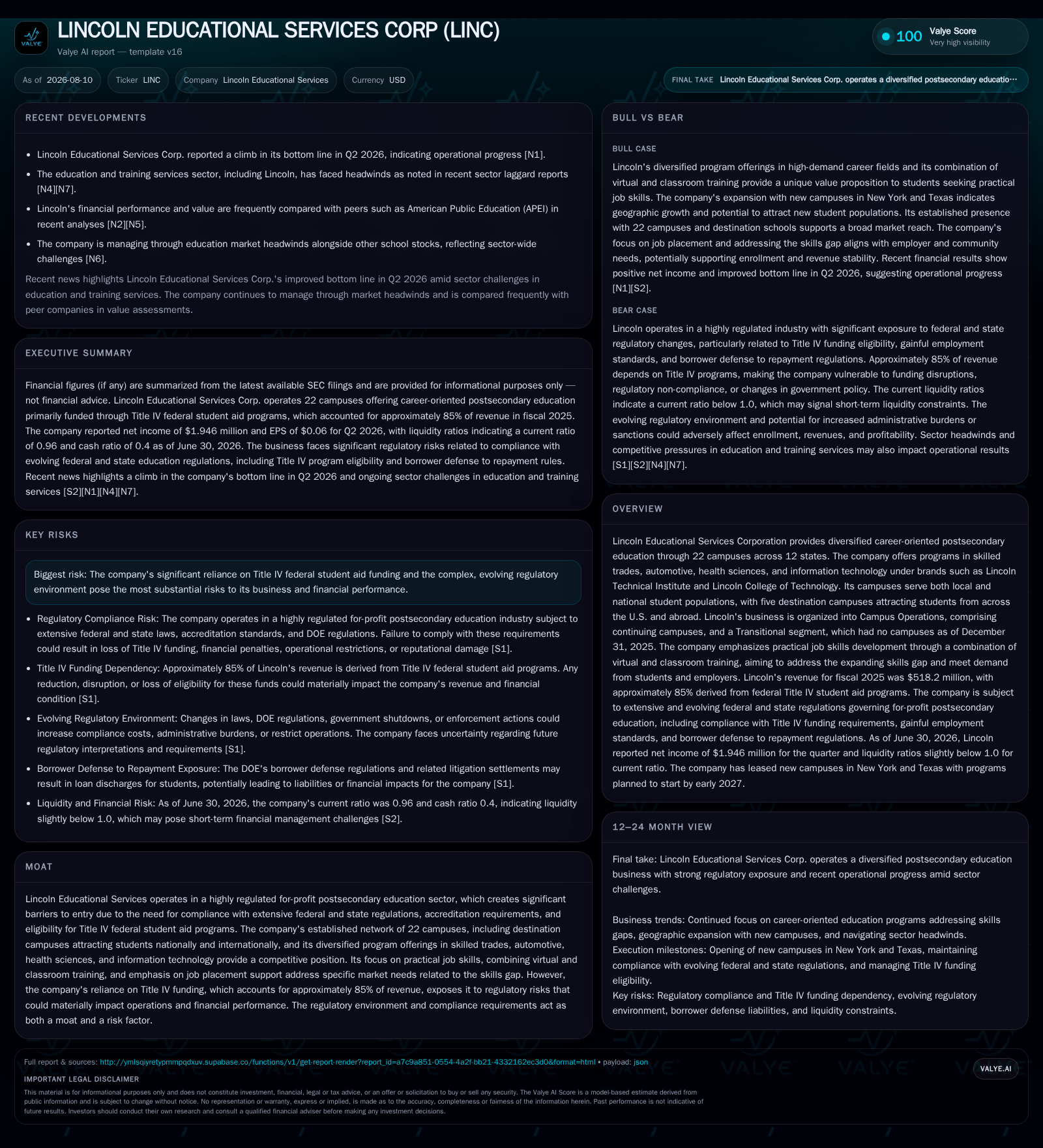
In its second quarter ended June 30, 2026, Lincoln Educational Services Corporation showed operational momentum through increased student enrollment and ongoing expansion of its hybrid virtual and classroom training model. The company reinforced its strategic presence with 22 campuses across 12 states and has committed to new campus openings in New York and Texas to capture growing demand for career-oriented education, particularly in skilled trades and health sciences. Despite these advances, Lincoln faces ongoing risks from regulatory scrutiny due to its heavy reliance on Title IV federal student aid, which accounts for approximately 85% of revenue. Monitoring compliance metrics and borrower defense litigation remains critical for assessing financial stability.
Enrollment Expansion and Hybrid Delivery Fuel Near-Term Growth
t hands-on skill development [S1].
Operationally, Lincoln continues to expand capacity via two newly leased campuses: one in Hicksville, New York expected to launch programs by late 2026 and another in Rowlett, Texas with offerings slated for early 2027 [S1]. These moves indicate deliberate geographic expansion targeting key metropolitan labor markets aligned with demand for skilled trades and technical education.
Program Diversification Meets Market Skills Gaps Under Compliance Constraints
Lincoln’s educational offerings span skilled trades (including HVAC and welding), automotive technology through Nashville Auto Diesel College, health sciences such as nursing programs, and information technology sectors [S1]. This multi-sector program portfolio addresses persistent labor market shortages exacerbated by shifting demographics and accelerating technological change. The company positions itself as a solution provider bridging the skills gap via career-focused curricula designed for rapid job market integration. All campuses maintain national accreditation enabling participation in federal financial aid programs—the primary revenue source—and certify that programs meet employer expectations [S1].
The value proposition emphasizes practical competencies gained through combined virtual instruction modules paired with hands-on classroom engagement led by experienced instructors. This blend aims to improve program completion rates and facilitate higher post-graduation job placement ratios—critical KPIs within the sector signaling success in aligning student outcomes with employer needs.
Navigating Title IV Reliance Amid Regulatory Headwinds
Despite operational progress, Lincoln’s business remains heavily dependent on Title IV federal student aid programs which accounted for approximately 85% of all revenue cash receipts during fiscal year 2025 [S1]. This reliance exposes the company to significant regulatory risk stemming from evolving U.S. Department of Education (DOE) requirements around accreditation standards, financial responsibility metrics, and administrative capability assessments necessary for continued participation in federally funded aid programs [S1][S24][S29].
A major overhang relates to borrower defense to repayment claims tied to historical investigations alleging institutional misconduct affecting students’ loan repayment obligations. Lincoln is listed among institutions subject to loan discharge settlements involving approximately 196,000 borrowers nationwide [S24]. Although the company believes pending litigation will not materially impair results short-term, uncertainty persists regarding future DOE enforcement actions or tightened eligibility conditions that could restrict access to essential Title IV funding streams.
It is noteworthy that as of Q2 2026 filings no new risk factors were added beyond those described earlier this year [S2], suggesting management’s ongoing commitment to compliance strategies. Continued monitoring of regulatory developments alongside internal audit measures will remain paramount.
Competitive Positioning Across For-Profit and Public Education Alternatives
Within the broader postsecondary education sector dominated by public community colleges and nonprofit vocational schools, Lincoln distinguishes itself via nationally accredited private campuses offering destination campuses that attract regional as well as national/international students [S1]. This geographic diversification coupled with a diverse curriculum helps mitigate some localized enrollment volatility.
Compared with peers like American Public Education Inc. (APEI) or specialized vocational institutions such as Nashville Auto Diesel College itself operated under Lincoln’s umbrella brand structure, Lincoln’s hybrid model presents competitive advantages in terms of accessibility without sacrificing classroom rigor—a balance difficult for public institutions constrained by bureaucratic structures.
Pricing power derives primarily from the company's ability to access Title IV funds supporting most tuition fees rather than direct out-of-pocket payments by students. Accreditation ensures continued eligibility—a critical moat protecting against new entrants given stringent compliance costs—while emphasis on job placement services aids retention and brand reputation among prospective students.
Growth Catalysts - New Campuses and Employer Partnerships
The planned openings of campuses in Hicksville NY (end-2026) and Rowlett TX (early-2027) signal cautious but strategic physical capacity growth aligned with recognized labor market clusters demanding skilled trade workers [S1]. By expanding physical footprint selectively rather than broadly scaling existing locations alone, Lincoln positions itself for regionally tailored program delivery responding to employer needs.
Employer partnerships play an increasingly important role in bridging training completion with employment outcomes by facilitating internships or direct hiring pipelines—an area where Lincoln underscores efforts though specific contract details or partner names are not disclosed publicly [S1]. These collaborations are essential levers enhancing overall program attractiveness amid crowded competitive landscapes.
Watchpoints - Borrower Defense Claims and Regulatory Compliance Failures
Key risks continue centering on evolving borrower defense claim resolution processes. While recent judicial affirmations have upheld settlement frameworks relieving certain borrowers’ debts linked to attendance at specific schools including Lincoln campuses [S24], potential downstream litigation or policy amendments pose earnings volatility risks. Failure to maintain accreditation or meet DOE financial responsibility regulations can lead to suspension or revocation of Title IV eligibility—a scenario that would substantially curtail revenues given funding concentration [S24][S29].
Institutional reputation also hinges on transparent compliance reporting along parameters such as program completion rates, placement metrics post-graduation, retention effectiveness all closely scrutinized by regulators. Any adverse findings could amplify reputational damage impacting future student recruitment within an intensely competitive environment.
Financial Health Overview Supports Operational Agility
As of June 30, 2026, Lincoln reported cash and cash equivalents totaling approximately $44.2 million against current liabilities near $111 million resulting in a current ratio just under one at about 0.96 [F1]. Total debt was effectively zero based on last available data from late 2021 consolidated reporting periods [F1], indicating a clean balance sheet absent material leverage.
It does not constitute investment advice or a research view regarding any securities issued by Lincoln Educational Services Corporation.
Disclaimer: This is research-only, informational analysis and not investment advice. It may include AI-generated interpretation and general industry context. Always verify important details using primary sources.

Comments