
Green Planet Bio Engineering as a Public Shell Faces Financing and Execution Challenges
Operating as a reorganized shell, Green Planet Bio Engineering’s viability hinges on securing capital and completing business combinations.
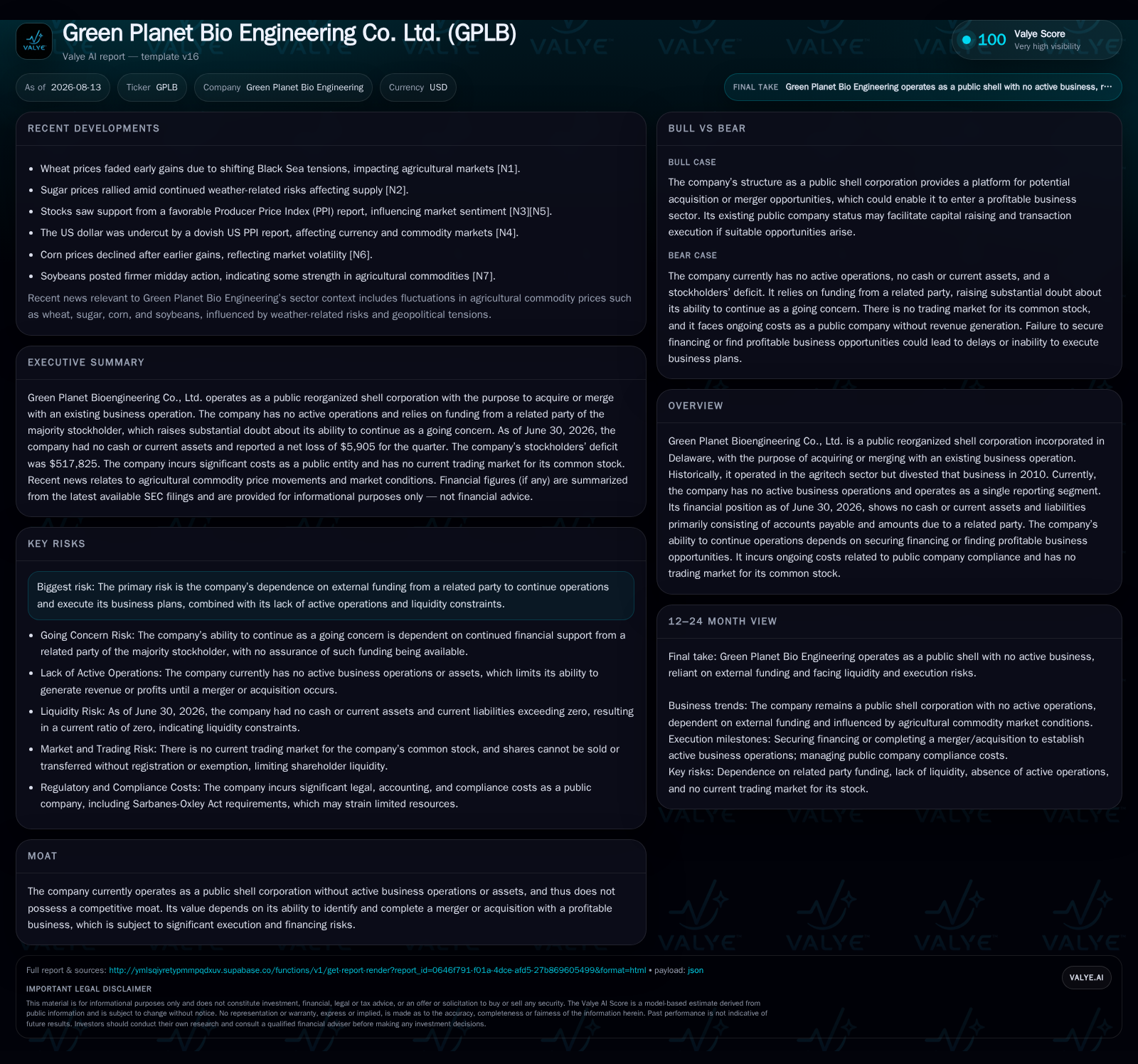
Green Planet Bio Engineering Co. Ltd. currently functions as a Delaware-incorporated public shell corporation with no active business operations. Since divesting its agritech segment in 2010, the company’s core purpose has been to find suitable acquisition or merger targets to restart operations via a de-SPAC transaction. Its recent quarterly filings confirm ongoing liquidity constraints, dependence on related-party funding, and the absence of cash or current assets. This places significant execution risk on its ability to secure financing and complete acquisitions within regulatory and market timelines. Given these limitations, shareholder returns remain uncertain and highly contingent on orchestrating a timely and well-capitalized business combination.
Recent Operating Update: No Active Operations, Severe Liquidity Constraints
Green Planet Bio Engineering Co., Ltd., formerly an agritech operator until its divestiture in 2010, has fully transitioned into a public reorganized shell corporation primarily tasked with acquiring or merging with existing business operations [S1]. In its latest quarterly report for Q2 2026, the company reiterates it maintains no operating business or recurring revenues; expenses consist solely of accounting and filing fees associated with maintaining public status [S2][S23]. The firm operated one reporting segment reflecting its unifying shell status.
Notably, the company's balance sheet as of June 30, 2026 shows zero current assets and cash equivalents versus $517,825 in current liabilities — mostly accounts payable and amounts due to related parties — yielding a working capital deficit [F1][S23]. This dire liquidity position is sustained only through unsecured interest-free advances by a related party affiliated with Global Funds, its majority stockholder. Management acknowledges this reliance constitutes substantial doubt about Green Planet’s ability to continue as a going concern absent additional funding or consummation of an acquisition [S23].
No equity issuances such as common stock or warrants occurred during the first half of 2026, indicating that the company did not raise external capital through public offerings or private placements recently [S17]. The absence of cash reserves combined with minimal asset base reflects severe constraints on resource deployment ahead of any meaningful business combination activity.
Business Model: Pure Public Shell Awaiting De-SPAC Transaction
Green Planet operates exclusively as a shell company, having shed its prior agritech businesses over a decade ago. In SPAC industry terms, it occupies the initial capital structure vehicle designed to raise funds through an IPO (historically) to enable subsequent acquisition of private companies. The goal is facilitating those private companies' transition into publicly traded entities via mergers – commonly referred to as de-SPAC transactions.
By definition, such entities generate little to no revenue pre-merger; their value proposition hinges on successfully sourcing acquisition targets with viable business prospects and negotiation of merger agreements that satisfy shareholders and regulatory standards.
Revenue mechanics post-acquisition would involve monetizing acquired businesses’ products or services with typical drivers including volume growth, pricing strategies, customer retention, and operational efficiencies. Pre-acquisition however, revenue is negligible outside reimbursements/advances from sponsors or related parties covering legal/accounting/public reporting costs. This cost structure creates negative net income profiles until transactions are consummated.
Industry Structure and Competitive Positioning: Elevated Execution Risk Without Capital Buffer
As a SPAC shell without capital held in trust or independent cash reserves (unlike many recently formed SPACs that maintain IPO proceeds in trust accounts), Green Planet’s situation aligns with older special-purpose vehicles struggling amid increased market scrutiny post-2021 SPAC boom. Without dedicated PIPE financing arrangements or fresh equity infusions documented, it lacks lane-space among peers better positioned financially to identify credible target pipelines.
Moreover, the parentage by Global Funds—a Canadian investment entity controlling majority shares—signals some aligned sponsor equity support but also concentration risk dependent on continued related-party funding. The combined effects expose GPLB facing heightened dilution risk if future financing triggers steep sponsor promotes or complex warrant structures common in SPAC deals.
Against other shell corporations aiming for mergers in similarly competitive subsectors (often technology or biotech), Green Planet lacks disclosed strategic differentiation regarding deal sourcing capability or sector focus at this stage. Its absence of trading markets for common stock further limits liquidity options for public investors awaiting meaningful developments.
Growth Drivers: Dependent Entirely on Acquisition Opportunities and Capital Raising Success
Future growth levers for Green Planet will center almost exclusively around:
- Identification of Suitable Acquisition Targets: The availability of attractive private companies seeking public listing alternatives is crucial. However, GPLB offers no disclosed sector or strategic focus narrowing deal flow.
- Capital Raising Capabilities: Securing external investor financing through PIPE deals or secondary offerings will determine capacity to close negotiated mergers amid shareholder redemptions typical in SPACs.
- Sponsor Engagement: Sponsor willingness to fund bridge loans or additional equity injections could provide temporary runway for due diligence efforts and legal costs while negotiating mergers.
- Regulatory Environment Stability: Ability to comply with SEC disclosure demands and governance rules without material control weaknesses avoids delays impacting deal timing.
These drivers interlink with key operating KPIs such as time to complete business combination, redemption rates by existing shareholders reducing available deal financing, quality of deal pipeline evaluated during due diligence phases, and effective management of legal/compliance spend.
Risks and Watchpoints: Financing Reliance Amid No Operating Cushion
The primary risk for Green Planet remains its fragile financial footing characterized by zero cash reserves paired with ongoing obligations as a listed company incurring administrative costs without revenues or assets generating earnings capabilities [S23][F1]. This condition places extraordinary importance on:
- Continued financial support from related parties; cessation would jeopardize existence imminently.
- Delays or failure to identify viable acquisition targets within mandated regulatory timeframes leading potentially to liquidation scenarios.
- Dilution effects from issuance of shares/warrants necessary for raising new capital impacting shareholder value.
- Regulatory scrutiny regarding internal controls compliance adding unforeseen expenses or obstruction.
- Market volatility affecting investor appetite for PIPE placements critical for successful mergers.
Given these vulnerabilities highlighted in risk factor disclosures, tangible milestones such as announcement of signed merger agreements, closing dates within SEC windows (typically two years from IPO date), and capital raises would serve as critical execution markers.
What to Watch Next: Milestones Indicative of Strategic Progress
Investors and observers should monitor:
- Announcements Regarding Acquisition Target Identifications: Legal filings disclosing letters of intent (LOIs) or definitive merger agreements signaling active deal pipeline development.
- Capital Raising Activities: Any new registered securities issuances via prospectus supplements signaling refreshed liquidity inflows.
- Sponsor Funding Advances: Related-party funding disclosures indicating bridge financing continuity amid absence of independent cash balances.
- Regulatory Feedback: SEC comment letters addressing internal control adequacy affecting transaction timelines.
- Time Remaining Until Mandated Acquisition Deadlines: Often defined through certificates-of-incorporation clarifying dissolution triggers absent combination closure.
Absence of these developments over prolonged periods typically presages increased uncertainty regarding viability beyond continuation costs coverage.
Disclaimer: This is research-only, informational analysis and not investment advice. It may include AI-generated interpretation and general industry context. Always verify important details using primary sources.

Comments