
Hallmark Venture’s IP Licensing Strategy Faces Geographic and Financial Hurdles
The company’s Korean-centric drone patent portfolio and joint venture model underpin growth but entail significant execution and capital risks.
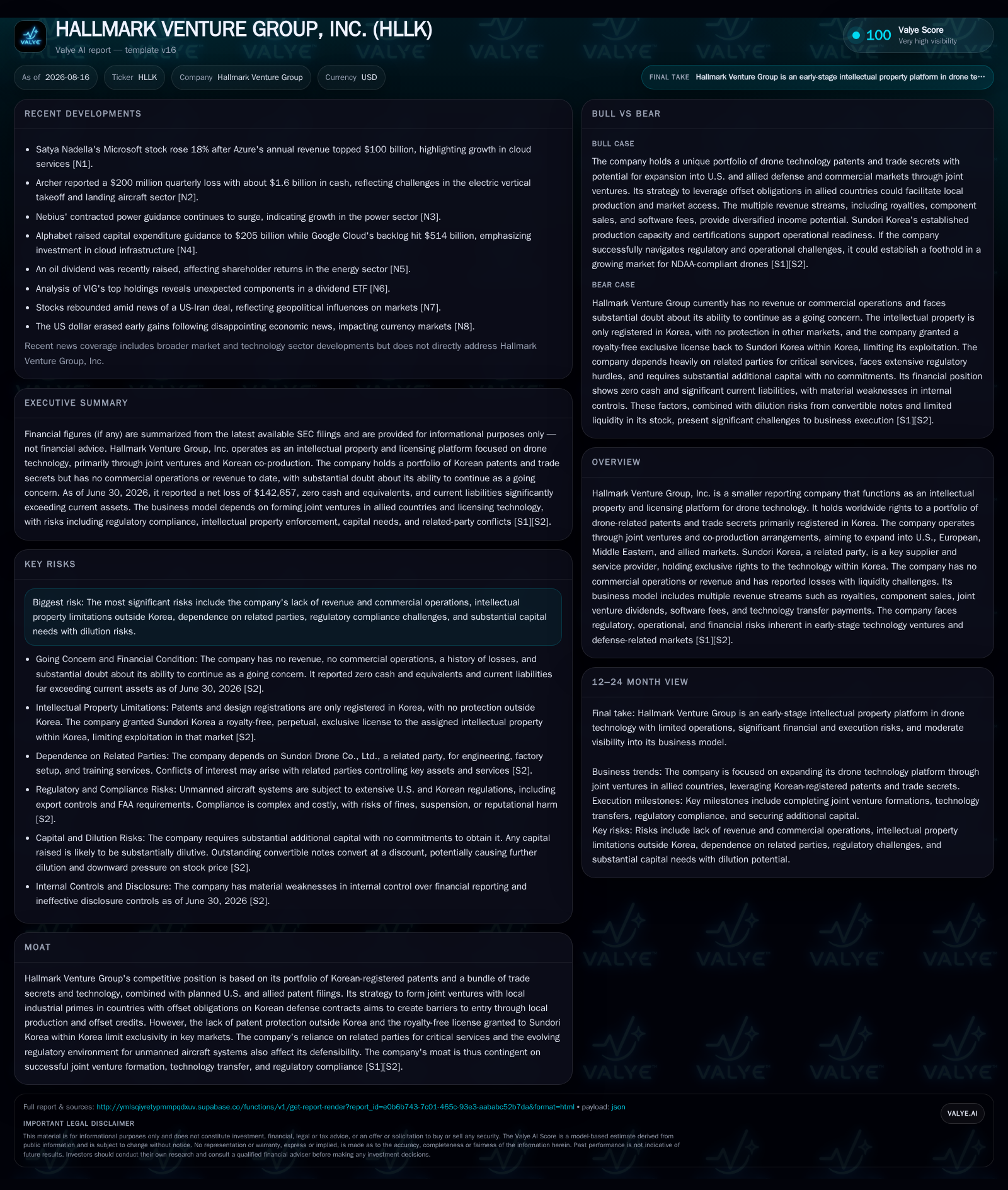
Hallmark Venture Group, Inc. recently transitioned from a shell company to an operational IP licensing platform focused on drone technology, acquiring a portfolio of Korean-registered patents and trade secrets. The business model relies heavily on joint ventures and licensing arrangements outside Korea, yet the lack of patent protection in key international markets and dependency on related-party Sundori Korea constrains exclusivity and commercial scalability. The company remains unprofitable with no revenue, facing material liquidity shortfalls, convertible note dilution risks, and regulatory challenges inherent to unmanned aerial systems. Its strategic moat hinges on successfully filing U.S./allied patents, expanding joint ventures, and securing additional capital.
Recent Operating Update
Hallmark Venture Group’s latest quarterly filing dated August 14, 2026 reveals significant changes reflecting the company’s pivot from a dormant public shell into an active intellectual property (IP) owner within the drone technology sector [S2]. The quarter saw a change of control agreement consummated earlier in June 2026 alongside acquisition of a portfolio of drone-related patents from related parties. These patents cover drone technologies primarily registered in South Korea but lack patent protection abroad. The company disclosed no commercial operations or revenue generation so far but outlined plans for generating multi-stream licensing income through joint ventures outside Korea. However, it concurrently flagged substantial doubt about its ability to continue as a going concern given its financial position and absence of committed funding [S2].
This represents an early-stage technology licensing platform still working through necessary legal formalities such as registration of IP assignments with Korean authorities. The company also granted Sundori Drone Co., Ltd., a related party operator domiciled in Korea that held previous ownership stakes in the IP bundle, a perpetual royalty-free exclusive license back for Korean territory operations. This materially limits Hallmark Venture’s ability to monetize the core patents domestically while it targets growth markets abroad through partnerships [S2][S21].
Business Model: IP Licensing via Joint Ventures
Hallmark Venture positions itself as an upstream intellectual property holding entity specializing in unmanned aerial systems (UAS) technology. The firm’s competitive asset base consists of twelve Korean-registered patents covering innovations such as modular drone control boards (SDR-ONE), multi-vehicle swarm control software (MFS Swarm operating system), hybrid wired/wireless systems including hydrogen-fueled drones, cable fall-retardation devices for safety landings, specialized drone applications like search-and-rescue operations and agricultural monitoring, along with six industrial design registrations and extensive trade secrets encompassing firmware codebases, AI models relevant to flight control, detailed bills of materials (BOM), supplier qualifications, manufacturing processes documentation and test procedures [S24][S21].
Despite this substantive patent portfolio domestically secured in Korea, Hallmark Venture currently lacks comparable patent protection in major target markets such as the United States or Europe — an important limitation since patents publish after grant leading to entry into the public domain outside Korea absent timely foreign patent filings [S2][S24]. To address this gap, the company's strategy centers around newly filing U.S. Patent Cooperation Treaty (PCT) applications covering next-generation improvements plus trade-secret-derived innovations combined with future enhancements created alongside joint venture manufacturing partners. This layered IP approach relies on combining registration-based exclusivity where available with robust trade secret protections enforced contractually within alliances.
From a monetization standpoint, revenues are expected principally from five sources:
- IP royalties: targeted at roughly 10% of each airframe's sales revenue produced by joint ventures outside Korea.
- Component sales margin: Sundori Korea supplies drone components to joint ventures generating direct gross margin.
- Software licensing fees: linked to proprietary swarm operation software provided to operators.
- Technology transfer fees: milestones linked to engineering support and transfer of production know-how.
- Joint venture dividends: profit shares from equity stakes held in local manufacturing entities.
Notably absent are direct manufacturing or end-user sales by Hallmark itself; it operates upstream focusing exclusively on IP ownership/licensing administered via third-party joint ventures structured around industrial partners fulfilling offset requirements commonly present in defense procurement markets [S24][S21]
Industry Structure & Competitive Position
The drone market features several large incumbent tiers: integrated manufacturers like AeroVironment who combine R&D with production; pure-play OEM component suppliers; software providers specializing in autonomous control systems; defense contractors integrating UAS capabilities; and intellectual property licensors holding specialized patents with commercial-opportunity leverage. Within this ecosystem, Hallmark occupies an upstream niche akin to an IP platform leveraging patents/trade secrets without direct end-product manufacture.
Peers such as Parrot SA provide useful comparative context due to their focus on drone technology development accompanied by meaningful patent portfolios globally protecting their innovations. AeroVironment straddles manufacturing alongside IP licensure whereas Hallmark’s model is closer to a pure-IP licensor reliant upon partnership execution.
Unlike peers with established global IP coverage and diversified product lines across defense/public/commercial verticals supported by robust sales channels, Hallmark faces acute geographic limitations: its core patents’ sole registration in South Korea reduces geographic exclusivity where third parties may freely practice similar technology absent ongoing U.S./allied filings [S2]. Additionally, granting a royalty-free perpetual license within Korea constrains domestic monetization potential despite Sundori Korea's strong market footprint locally. Consequently, the firm's defensibility leans heavily on:
- Successful filings underpinning enforceable international patent barriers,
- Effective formation of international JVs ensuring local market access compliance with offset rules,
- Execution capability in managing complex cross-border regulatory approvals around unmanned aircraft systems,
- Maintaining exclusive know-how through protected trade secrets beyond registered patents,
- Mitigating reliance risks stemming from related-party service providers acting simultaneously as suppliers and management stakeholders.
Hallmark's competitive moat is thus fundamentally contingent on navigating multi-jurisdictional IP landscapes while cementing operational footholds through JV arrangements in politically sensitive export-controlled environments such as U.S., NATO allies (Poland specifically mentioned), Middle East (UAE focus), which could collectively erect switching costs for competitors while enabling royalty capture beyond front-end manufacturing margins [S24][S25].
Growth Drivers
Hallmark’s growth thesis hinges predominantly upon broader market trends—namely increased global adoption of drones for defense training missions, logistics surveillance expansion across public safety agencies internationally, and corresponding regulatory frameworks progressively integrating UAVs into controlled airspace.
Key demand enablers include:
- Expansion of regulatory approval regimes permitting wider commercial/deployment scopes under FAA jurisdiction or equivalent bodies abroad,
- Rising offset obligations favoring local production using technology provided under license from Tier 1 Korean defense contractors,
- Formation of strategic joint ventures anchored by governmental contracts requiring domestic assembly/manufacturing content,
- Advancement of next-generation drone technologies enhancing performance via integrated AI/swarm operational protocols embedding Hallmark’s licensed stack,
- Increasing monetization opportunities related to software subscriptions/services layered atop hardware delivery.
Tracking progress against these requires observing tangible indicators such as JV agreements signed reflecting partner scale/capacity commitments; patent prosecution success rate internationally expanding geographic protection; initiation of software licensing revenue recognized post-commercial deployment; milestone-triggered technology transfer payments achieved through documented deployment scenarios; incremental royalty income visibility signaled by production ramp-ups at partnered facilities [S24][F1]
Risks and Watchpoints
The company faces pronounced structural challenges:
- IP Protection Gaps: Currently no registered international patents beyond Korea exposes the portfolio to infringement risk without recourse outside home market where free-riding competitors may operate unhindered [S2].
- Dependency on Related Parties: Sundori Drone Co., Ltd.’s role as essential supplier/operator licensed perpetually royalty-free within Korea creates conflict-of-interest risks given overlap between its control persons who also serve executive director roles within Hallmark Venture Group [S2][S25].
- Financial Fragility: Total cash reported at zero by mid-2026 juxtaposed against current liabilities exceeding one hundred thousand USD indicates urgent liquidity pressure exacerbated by lack of committed additional capital which is expected to be highly dilutive if raised. Convertible notes issued carry unfavorable conversion discounts increasing downside equity dilution risk depressing share value further [F1][S16][S2].
- Regulatory Compliance Complexity: Navigating comprehensive UAV regulatory frameworks across multiple jurisdictions—especially defense procurements restricted under elevated standards—increases execution risk potentially delaying or derailing commercialization timelines [S2][S24].
- Limited Operating History: Absence of any recorded revenue or operating presence beyond R&D/IP acquisition means the business model remains largely unproven requiring demonstration of commercial traction before sustaining investment case.
- Corporate Governance Concerns: Concentration of voting power held by Equorix LLC controlling roughly three quarters of common stock may deter independent oversight raising structural concerns over minority shareholder protections amid controlling party conflicts [S25].
Monitoring how these risk factors evolve relative to planned milestones is critical for assessing viability prospects.
What To Watch Next
Investors following Hallmark Venture should prioritize verification against these upcoming operational milestones:
- Completion of patent assignments registrations fully concluded at the Korean Intellectual Property Office establishing clear legal title;
- Progress updates regarding U.S./PCT/allied jurisdiction patent filings evidencing expanding enforceable protection coverage;
- Formal announcements of joint venture formations signed targeting identified target geographies including initial capacity commitments;
- Startup receipts or contractual evidence indicating initial royalty flows or licensing fees realized;
- Regulatory approval disclosures clarifying compliance achievements across relevant aviation authorities governing unmanned aerial operations;
- Capital raising events detailing amounts committed along with terms addressing onerous conversion discounts/dilution limits;
- Clarifications or disclosures addressing related-party transaction governance structures mitigating conflicts.
Each serves as a signal point either validating incremental de-risking or reaffirming sustainability challenges embedded within this nascent enterprise model.
Financial Profile Discussion
As reported for the quarter ending June 30, 2026, Hallmark Venture shows constrained liquidity metrics revealing financial stress typical for early-stage tech licensors transitioning out of shell status. Cash resources stand at zero USD against symbolic current assets totaling only $1,036 versus current liabilities approximating $255,765 yielding a negligible current ratio effectively below 0.01—indicating potential near-term solvency strains unless capital infusions occur promptly [F1]. Total debt reported previously at nearly $217k without corresponding cash reserves underscores net leverage exposing creditors alongside investors.
Net income trends historically negative with losses reported over prior years validate ongoing burn without earnings offsetting overhead or development costs [F1][S16][S2]. The recent issuance of convertible promissory notes bearing aggressive discount rates compounds dilution risks particularly since conversion prices reflect significant markdowns relative to market valuations at issuance dates
This precarious financial footing demands focus on securing committed funding lines at commercially viable terms aligned tightly with achieving strategic development milestones including JV operationalization driving revenue inflows reducing cash burn dependency.
Disclaimer: This analysis is based solely on information available from SEC filings dated through August 14, 2026 ([S1]-[S29]) supplemented by FactSet Companyfacts data ([F1]). It does not constitute investment advice or research views.
Disclaimer: This is research-only, informational analysis and not investment advice. It may include AI-generated interpretation and general industry context. Always verify important details using primary sources.

Comments