
Aldabra 4 Liquidity Opportunity Vehicle Advances Within SPAC Timeline Amid Stable Financial Position
The SPAC maintains its $300 million trust account raised in January 2026 IPO while progressing toward a business combination targeting mid-market private companies valued between $500 million and $2 billion.
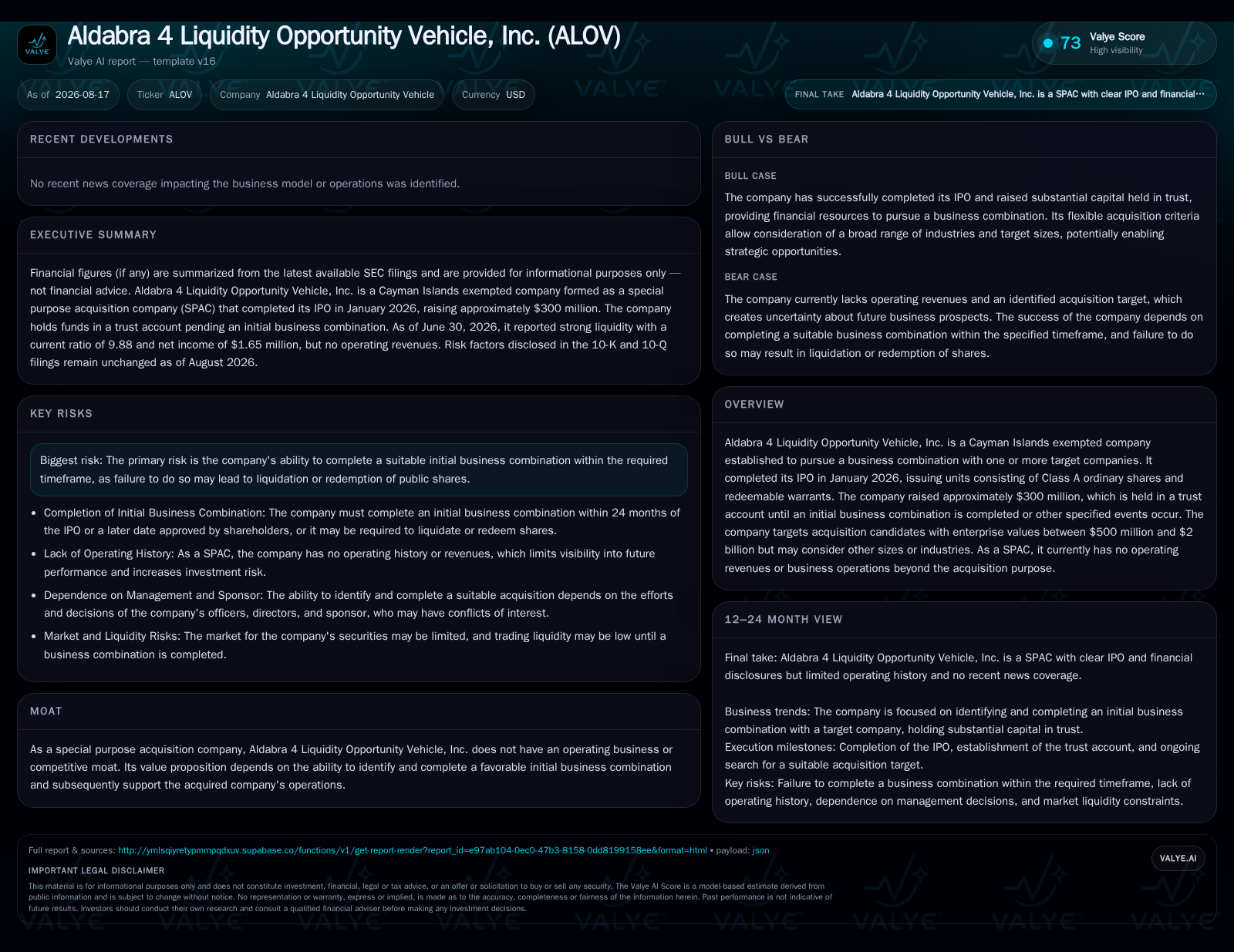
Aldabra 4 Liquidity Opportunity Vehicle, Inc. (ALOV) continues its pursuit of a qualifying business combination within the typical SPAC timeframe following its January 2026 IPO that raised approximately $300 million held in trust. The latest quarterly filing dated August 14, 2026, indicates no operational revenues or material changes to risk factors, with operating losses consistent with pre-combination administrative costs. Aldabra’s financial position remains strong with minimal debt and a current ratio near 10, supporting ongoing deal sourcing and due diligence activities. Key challenges include completing a transaction before liquidation deadlines while managing shareholder redemptions and warrant dilution that impact deal viability.
Recent Operating Update
Financially, as of June 30, 2026, non-trust current assets stood at about $993 thousand against current liabilities of roughly $100 thousand, resulting in a robust current ratio near 9.88x [F1]. The company recorded an operating loss of approximately $204 thousand for the quarter ending June 2026, consistent with typical pre-combination administrative expenses such as legal and compliance costs [F1]. Total debt is minimal at around $200 thousand as of December 31, 2025, likely reflecting working capital loans from sponsors rather than leverage concerns [F1].
Business Model Overview
Aldabra operates as a Cayman Islands–incorporated SPAC that raises capital through an initial public offering by issuing units comprised of Class A ordinary shares combined with redeemable warrants. The funds raised are placed into a trust account until Aldabra completes a business combination or liquidates if unable to do so within the mandated timeframe [S1]. Unlike traditional companies, Aldabra generates no operating revenue before consummating a de-SPAC transaction; its value derives entirely from successfully identifying and merging with one or more private companies.
The company targets acquisition candidates with enterprise values between $500 million and $2 billion but maintains flexibility to pursue opportunities aligned with broader socio-economic themes such as emerging market consumer growth and aging populations in developed markets [S1]. The anticipated monetization pathway involves public equity appreciation post-merger based on the acquired entity’s operational performance.
Critical KPIs influencing potential returns include shareholder redemption rates—which can reduce net deal proceeds—warrant exercise rates impacting dilution, and successful shareholder vote outcomes required to finalize transactions. The sponsor team’s expertise in due diligence and negotiation directly affects Aldabra’s ability to secure targets that meet these strategic criteria.
Industry Context and Competitive Positioning
Aldabra participates in the crowded global SPAC market where hundreds of similar vehicles compete for attractive private company acquisitions as alternative public listing routes. Its Cayman Islands domicile offers regulatory advantages common among offshore-listed entities [S1]. With approximately $300 million raised at IPO, Aldabra aligns with mid-sized SPAC peers historically exemplified by firms such as Churchill Capital and Social Capital Hedosophia targeting comparable enterprise value ranges.
Competitive differentiation hinges on sponsor experience and proprietary deal sourcing capabilities amid intensifying competition for quality targets. While Aldabra’s General Counsel has notable experience with alternative investments through Terrapin Partners, the company has yet to establish a track record of completed de-SPAC transactions [S1]. Additionally, evolving SEC scrutiny on SPAC disclosures introduces execution risks shared industry-wide.
Growth Drivers
Demand for expedited public market access alternatives sustains interest in SPAC-sponsored acquisitions. Aldabra’s substantial trust account provides credible capital to pursue deals within its targeted valuation band. Recent regulatory clarifications have improved investor confidence by reducing disclosure uncertainties surrounding SPAC structures.
Macro trends including sector consolidation driven by technological shifts and demographic changes create thematic opportunities consistent with Aldabra’s stated strategic focus areas [S1]. Access to PIPE financing alongside sponsor promote structures may further augment deal funding capacity post-announcement if required.
Investor appetite for speculative growth vehicles supports continued demand despite cyclical variations in redemptions or issuance volumes. Successful deal execution could unlock organic growth through integration synergies and enhanced governance under public ownership scrutiny.
Risks and Watchpoints
The foremost risk remains failing to consummate an initial business combination within the prescribed timeframe—generally around two years post-IPO—which triggers mandatory liquidation and fund return to shareholders less underwriting fees [S1][S2]. This outcome would impair sponsor credibility and limit future fundraising prospects.
Secondary risks include potential overvaluation or insufficient due diligence leading to suboptimal post-merger performance. Shareholder redemption behavior critically impacts available deal capital; elevated redemptions constrain transaction scope and may necessitate dilutive renegotiations.
Warrant exercises introduce dilution complexities affecting share count and earnings accretion post-close. Market volatility outside management’s control may also influence transaction timing or approval outcomes.
Regulatory uncertainty persists despite recent SEC guidance improvements; ongoing evolution in disclosure requirements around sponsor conflicts, warrant accounting, and post-merger reporting poses compliance challenges.
What to Watch Next
Key upcoming milestones include target identification aligned with enterprise value guidelines followed by merger agreement announcements subject to regulatory filings and shareholder votes. Definitive agreement disclosures will clarify capital structure impacts including redemption levels.
PIPE funding commitments post-announcement will indicate deal financing robustness while sponsor warrant exercises and promote deployments will signal confidence levels.
Subsequent quarterly filings should be monitored for expense trajectory shifts reflecting transition from shell status toward operational integration upon transaction close.
Financial Profile Discussion
As of June 30, 2026, Aldabra maintains strong liquidity with current assets near $993 thousand comfortably covering current liabilities around $100 thousand for a current ratio close to 9.88x [F1]. Operating losses approximated $204 thousand for Q2 2026 due primarily to administrative expenses related to legal, accounting, and compliance functions typical of pre-combination SPACs [F1].
Total debt remains limited at roughly $200 thousand as of December 31, 2025, consistent with working capital loan arrangements rather than substantive leverage [F1]. This financial posture supports ongoing preparatory activities while preserving principal trust funds intact pending successful business combination execution.
This analysis synthesizes publicly available SEC filings without forecasting future events or issuing investment research views. SPAC-specific risks merit cautious evaluation given the dependency on timely transaction completion and market conditions beyond management control.
Disclaimer: This is research-only, informational analysis and not investment advice. It may include AI-generated interpretation and general industry context. Always verify important details using primary sources.

Comments