
Healthier Choices Management Corp. Q2 2026: Intellectual Property Monetization and Liquidity Position Amid Patent Enforcement Challenges
HCMC’s Q2 2026 update highlights ongoing patent enforcement efforts and licensing activities amid working capital deficits and regulatory pressures.
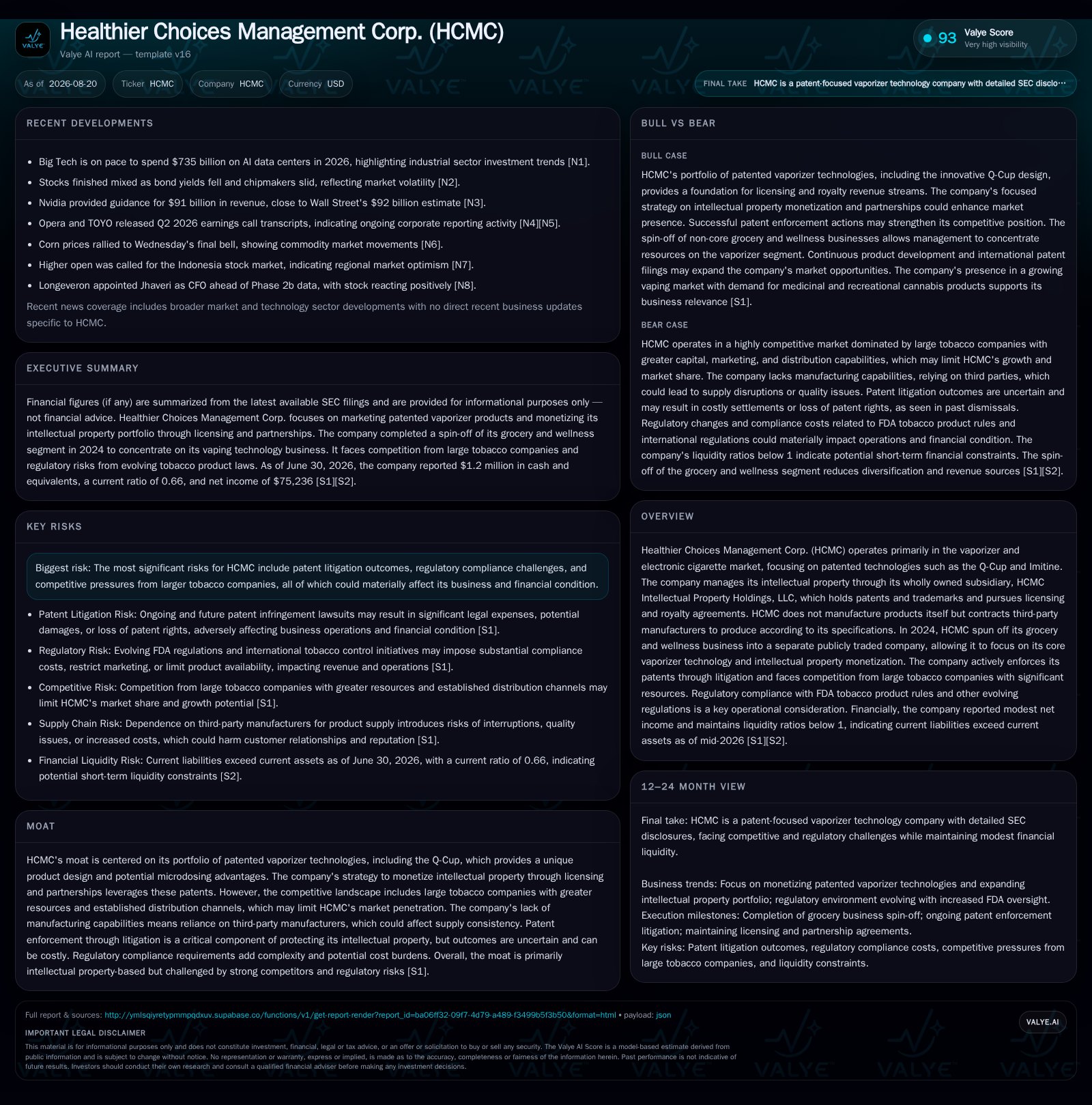
Healthier Choices Management Corp. (HCMC) reported its Q2 2026 financial and operating results emphasizing continued monetization of its patented vaporizer technologies through licensing and patent enforcement. The company’s balance sheet as of June 30, 2026, shows a working capital deficit with a current ratio of 0.66, reflecting current liabilities exceeding current assets. Despite improved liquidity from a prior debt-for-equity transaction and an available $5 million credit facility, HCMC faces ongoing challenges from patent litigation outcomes and regulatory compliance costs that influence its near-term financial flexibility and growth prospects.
Q2 2026 Operating and Financial Update
Healthier Choices Management Corp. (HCMC) provided its latest quarterly update for the period ended June 30, 2026, revealing ongoing efforts to monetize its intellectual property portfolio centered on patented vaporizer technologies. The company reported cash and cash equivalents of approximately $1.2 million and current assets of about $1.4 million against current liabilities exceeding $2.1 million, resulting in a current ratio of 0.66 and a working capital deficit as of the quarter-end [F1]. This liquidity position highlights the company’s constrained short-term financial flexibility despite prior balance sheet improvements.
Business Model and Intellectual Property Strategy
HCMC’s core business model revolves around intellectual property monetization. The company owns patents related to innovative vaporizer products, including the Q-Cup and Imitine technologies, which it licenses to third parties through its wholly owned subsidiary, HCMC Intellectual Property Holdings, LLC [S1][S2]. Licensing agreements and royalty payments form the primary revenue streams, while the company also markets patented vaporizer products directly to consumers via its subsidiary The Vape Store, Inc. This approach allows HCMC to leverage its patented technology without incurring manufacturing overhead, outsourcing production to third-party manufacturers [S6][S14].
Margins and cash flow generation in this model depend heavily on the structure of licensing fees and the outcomes of patent enforcement activities. Legal and commercialization expenses, including ongoing product development investments, influence cash conversion dynamics. Thus, successful patent enforcement and licensing growth are critical to sustaining the company’s revenue base and operational viability.
Patent Litigation and Competitive Landscape
HCMC actively enforces its patent portfolio through litigation to protect its intellectual property rights. Recent lawsuits have targeted major tobacco companies such as Philip Morris and R.J. Reynolds, alleging infringement of HCMC’s vaporizer patents [S9][S13]. However, some patent claims have been invalidated by the U.S. Patent Trial and Appeal Board, resulting in dismissal of certain cases, including a notable lawsuit against Philip Morris dismissed at the end of 2024 [S9].
The company operates in a highly competitive environment dominated by large tobacco firms with extensive resources and established distribution channels [S14][S17]. These competitors pose significant challenges to HCMC’s licensing and enforcement efforts. Additionally, regulatory compliance costs under FDA tobacco product rules and other regulations add complexity and potential financial burden to the business.
Liquidity and Capital Structure
HCMC’s balance sheet reflects a working capital deficit as of June 30, 2026, with current liabilities of $2.1 million exceeding current assets of $1.4 million, leading to a current ratio of 0.66 [F1]. This shortfall indicates ongoing liquidity constraints that could limit near-term operational and growth initiatives.
The company’s financial position was materially strengthened by a December 2025 debt-for-equity transaction that eliminated $4 million of intercompany debt, improving the balance sheet and preserving cash resources [S3][S4]. Furthermore, HCMC has access to a $5 million revolving credit facility available through December 31, 2026, which remained undrawn as of December 31, 2025, providing a potential liquidity buffer for working capital needs [S3][S4].
Despite these measures, the company’s historical net losses and cash outflows from operations underscore persistent challenges in achieving positive operating cash flow [S1]. Management continues to explore additional financing options, including potential equity offerings, to support working capital and growth strategies [S3].
Risks and Regulatory Environment
The vaporizer technology sector is subject to extensive regulatory oversight, primarily by the U.S. Food and Drug Administration (FDA) under the Tobacco Control Act. HCMC’s products are regulated as tobacco products, requiring compliance with marketing, packaging, and sales restrictions [S15]. Compliance costs are uncertain but could be substantial, potentially impacting the company’s financial condition and ability to commercialize products effectively.
Patent litigation outcomes remain uncertain, with some cases dismissed and others ongoing, creating risk around the enforceability and exclusivity of HCMC’s intellectual property [S9][S13]. Competitive pressures from larger tobacco companies with greater capital and market presence also pose challenges to licensing growth and market penetration [S14][S17].
Conclusion and Watchpoints
HCMC’s strategic focus on intellectual property monetization through licensing and patent enforcement reflects a structural approach to leveraging its patented vaporizer technologies without engaging in manufacturing. This model depends critically on the strength and enforceability of its patent portfolio and the ability to secure and expand licensing agreements [S1][S9][S13].
However, despite improvements in balance sheet strength from the 2025 debt-for-equity transaction and access to a revolving credit facility, the company’s negative working capital and historical operating losses indicate ongoing liquidity constraints that may limit near-term growth and operational flexibility [F1][S2][S3][S4]. Key watchpoints for investors and stakeholders include quarterly disclosures of licensing revenue to gauge monetization progress, updates on patent litigation outcomes and any new enforcement actions, changes in liquidity and working capital metrics in subsequent filings, and announcements of new licensing agreements or strategic partnerships. Monitoring regulatory developments and compliance costs will also be critical given their potential impact on HCMC’s business model and financial condition.
Disclaimer: This is research-only, informational analysis and not investment advice. It may include AI-generated interpretation and general industry context. Always verify important details using primary sources.

Comments