
FG Merger II Corp. 2026 Q2: Business Combination Progress and Trust Account Status
FG Merger II Corp. remains a blank check company pending its merger with Boxabl Inc., with its trust account intact but current liabilities exceeding current assets as of mid-2026.
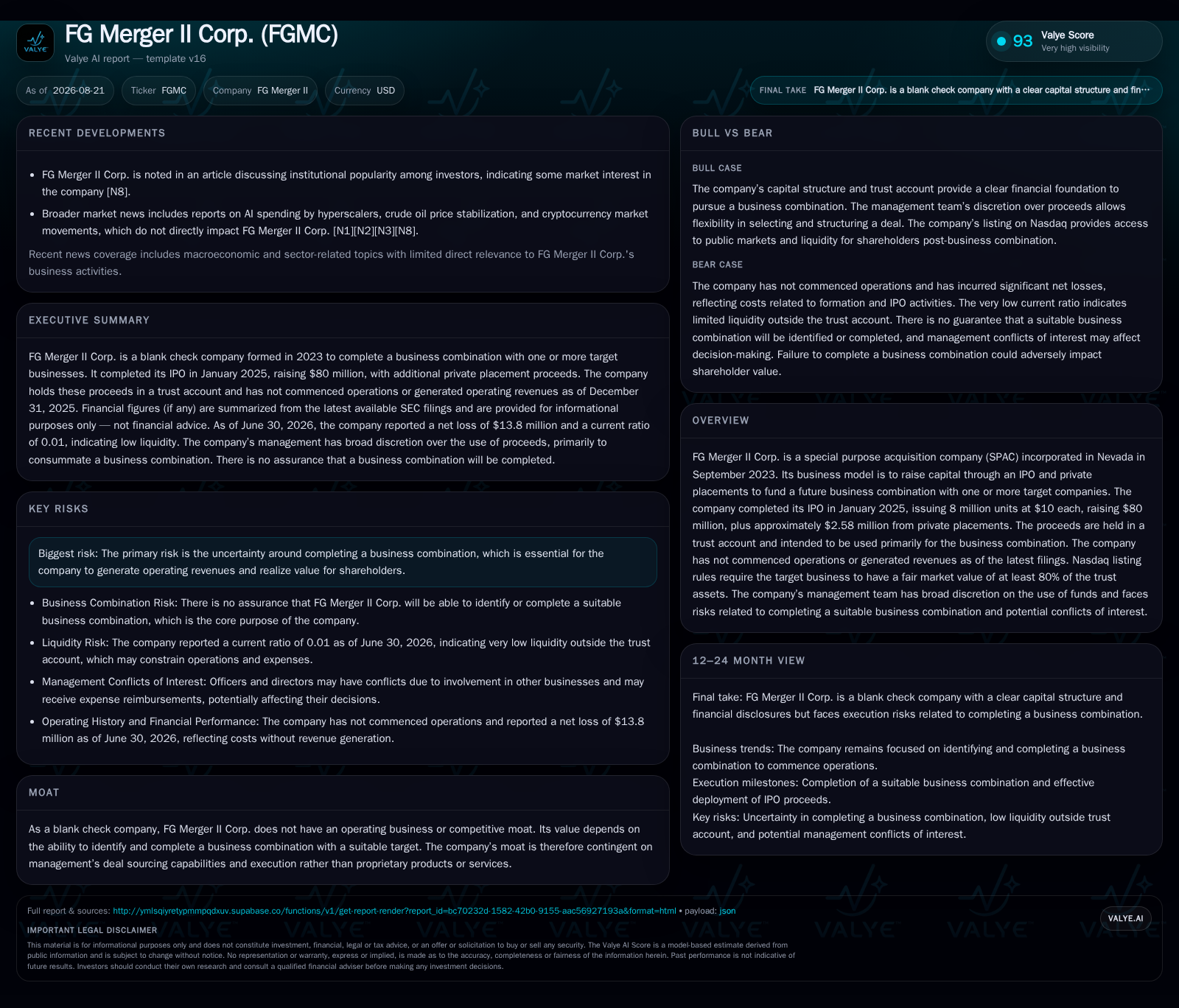
As of June 30, 2026, FG Merger II Corp. has not commenced operations or generated revenues, maintaining its status as a special purpose acquisition company (SPAC) awaiting completion of a business combination with Boxabl Inc. The company’s trust account holds approximately $82.58 million from its January 2025 IPO proceeds, intended primarily to fund the merger. However, its balance sheet shows current liabilities vastly exceeding current assets, reflecting the SPAC structure and lack of operating cash flow. The key investor focus remains on whether and when the merger will close, which will fundamentally transform FGMC’s financial profile and shareholder value.
Latest Quarterly Filing and Business Combination Status
FG Merger II Corp. (FGMC) filed its latest quarterly 10-Q on August 21, 2026, covering the period ended June 30, 2026. The filing confirms that FGMC remains a special purpose acquisition company without any operating revenues or commenced business activities as of that date [S2]. The company’s primary development is its pending business combination with Boxabl Inc., announced in August 2025. This transaction is structured as a two-step merger whereby Boxabl will first merge into a FGMC subsidiary and then into FGMC itself, resulting in a combined public entity named Boxabl Inc. [S1][S12].
The merger agreement has received unanimous board approval from FGMC, Boxabl, and the merger subsidiary, but the business combination has not yet closed as of mid-2026 [S1][S12]. Completion of this merger is essential for FGMC to transition from a blank check company into an operating entity, which will fundamentally alter its economics and shareholder value. Until closing, FGMC remains a shell company with no revenues or operating cash flow.
SPAC Business Model and Financial Position
FGMC’s business model as a SPAC involves raising capital through an IPO and private placements, issuing units that include common stock and warrants to public investors. The proceeds from its January 2025 IPO, approximately $80 million from 8 million units at $10 each plus about $2.58 million from private placements, are held in a trust account [S1][S2]. This trust account is restricted and intended primarily to fund the business combination with Boxabl Inc.
As of June 30, 2026, FGMC’s balance sheet shows current assets of $139,507 against current liabilities of $14,373,346, resulting in a current ratio of 0.01 [F1]. The current liabilities include deferred underwriting fees and other obligations related to the SPAC structure [F1].
Risks and Scenarios Around Business Combination Completion
The key risk for FGMC investors is whether the business combination with Boxabl Inc. will successfully close. The base case scenario is that FGMC completes the merger within the expected timeframe, transforming into an operating company and unlocking shareholder value. This scenario is supported by the existing merger agreement, unanimous board approvals, and the trust account funds reserved for the transaction [S1][S12]. Confirmation would come from announcements of merger closing, post-merger operating results, and updated financial disclosures.
Conversely, the bear case is that the merger fails to close due to regulatory, shareholder, or operational obstacles. This risk is inherent in the SPAC model, where deal completion is critical. Confirmation of this downside would be merger termination announcements, disclosures of liquidity shortfalls, or significant shareholder redemptions reducing trust account balances.
Investors should monitor regulatory and shareholder approval progress, any announcements regarding merger closing or delays, changes in trust account balance or redemption activity, and subsequent quarterly filings for operating results after the merger closes. These developments will provide clearer signals about FGMC’s transformation prospects and financial outlook.
Business Economics and Implications
FGMC’s economics before the business combination are essentially those of a blank check company: it raises capital from public investors who buy units expecting a future merger that creates an operating business. The company itself generates no revenues or profits and incurs expenses related to maintaining the SPAC structure and completing the merger [S1].
The trust account funds raised in the IPO and private placements are held in escrow to protect investors and ensure capital availability for the merger. However, these funds are restricted and cannot be used for general corporate purposes, which explains the stark imbalance between current assets and liabilities on the balance sheet [F1]. Upon successful completion of the business combination, FGMC will cease to be a shell and will inherit the operating business and economics of Boxabl Inc. This transition is critical because it will introduce revenue generation, operating margins, and cash flow dynamics that currently do not exist. Until then, shareholder value depends entirely on the merger’s successful execution and the fair market value of the combined company post-transaction.
Conclusion and What to Watch
FG Merger II Corp. remains a special purpose acquisition company as of Q2 2026, with no operating revenues and a financial position dominated by a trust account holding IPO proceeds intended for a pending business combination with Boxabl Inc. The company’s current liabilities far exceed current assets, reflecting the SPAC structure and lack of operating cash flow.
The company’s future value and operating economics hinge entirely on completing the business combination. Investors should closely watch for regulatory and shareholder approval developments, merger closing announcements, changes in the trust account balance or shareholder redemption rates, and subsequent operating results after the merger closes. These factors will determine whether FGMC transitions successfully into an operating public company or faces liquidity and valuation risks associated with a failed merger.
This analysis underscores the event-driven nature of SPAC investments, where value realization depends on discrete merger outcomes rather than ongoing operations prior to combination.
Disclaimer: This is research-only, informational analysis and not investment advice. It may include AI-generated interpretation and general industry context. Always verify important details using primary sources.

Comments