
Chicago Atlantic BDC Q2 2026: Merger Progress and Floating-Rate Loan Portfolio Update
Chicago Atlantic BDC reports Q2 2026 results highlighting merger developments with REFI and portfolio exposure to floating-rate loans with interest rate floors.
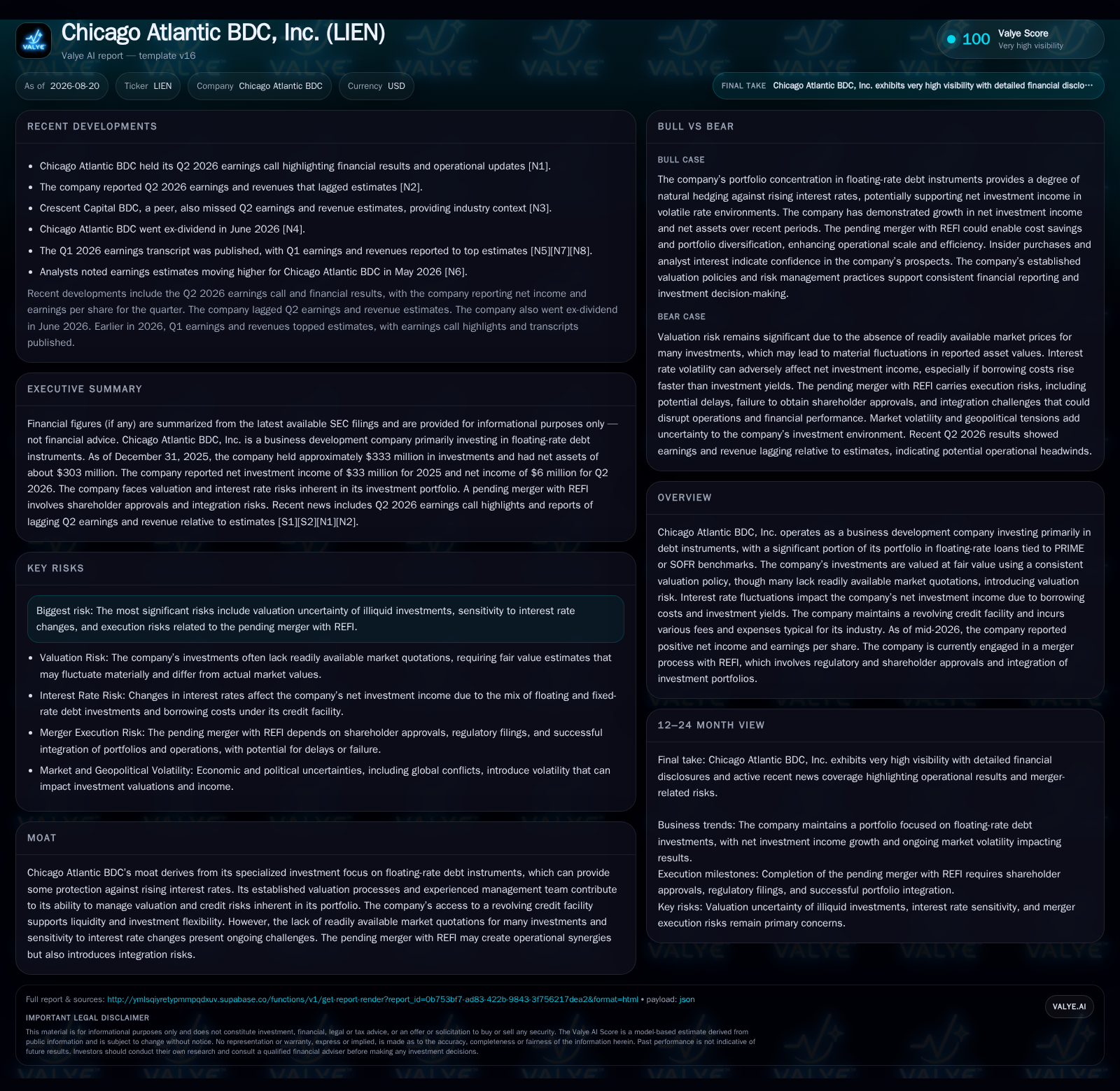
Chicago Atlantic BDC’s Q2 2026 financial results reflect a portfolio largely composed of floating-rate loans tied to PRIME or SOFR benchmarks, with a significant portion subject to interest rate floors. The company is progressing with a transformational merger with REFI, involving share exchange and lock-up agreements that may affect shareholder dilution and share price volatility. Valuation risk persists due to illiquid investments requiring fair value estimates. The company’s liquidity remains limited with reliance on a revolving credit facility to fund investment activities.
Q2 2026 Operating and Financial Results
Chicago Atlantic BDC, Inc. reported its financial results for the quarter ended June 30, 2026, showing continued operational activity amid a significant corporate transaction [S2][S3]. The company’s portfolio remains largely composed of floating-rate loans tied to U.S. Prime Rate (PRIME) or Secured Overnight Financing Rate (SOFR) benchmarks, with a notable portion of these loans subject to interest rate floors. This portfolio composition influences the company’s net investment income (NII) sensitivity to interest rate fluctuations. While specific quarterly net income and earnings per share figures are not detailed in the available summary evidence, the company reported positive results for the period.
Liquidity at quarter-end was limited, with cash and cash equivalents totaling approximately $925,534 [S2][F1]. Chicago Atlantic BDC continues to rely on its revolving credit facility to fund investment activities and manage working capital needs.
Merger with REFI: Progress and Risks
Chicago Atlantic BDC is actively engaged in a merger transaction with REFI, which represents a transformational development for the company. Under the merger agreement, each outstanding share of REFI common stock will be converted into a number of Chicago Atlantic BDC shares based on a predetermined Exchange Ratio, with fractional shares settled in cash [S2][S3]. Shareholders of REFI will experience a change in ownership structure, and Chicago Atlantic BDC’s existing shareholders will face dilution of their percentage ownership and voting power.
Certain shares issued to former REFI shareholders, including those from a private placement involving Koach Capital investors, are subject to lock-up agreements restricting sales for three to six months following the transaction closing [S2][S3]. After these lock-up periods expire, the potential for significant share sales exists, which could create market overhang and exert downward pressure on Chicago Atlantic BDC’s stock price. This risk is compounded by the possibility that both former REFI shareholders and current Chicago Atlantic BDC shareholders may decide to sell shares post-merger.
The merger also introduces operational integration risks as the combined entity seeks to align portfolios, management, and strategic objectives. These factors collectively represent material uncertainties affecting shareholder value and market perception.
Portfolio Composition and Interest Rate Sensitivity
Chicago Atlantic BDC’s investment portfolio as of June 30, 2026, remains heavily weighted toward floating-rate loans indexed to PRIME or SOFR. A significant portion of these loans carry interest rate floors, which limit the downside adjustment of interest income if benchmark rates decline. This structure creates a nuanced sensitivity profile for net investment income: while floating rates provide some protection against rising interest rates, floors can restrict income declines but also cap potential benefits if rates fall.
Additionally, the company’s borrowing costs under its revolving credit facility are subject to interest rate fluctuations, affecting the net interest margin [S1][S2]. If borrowing costs increase disproportionately relative to loan yields, net investment income could compress, impacting earnings stability.
Valuation Risk and Liquidity Position
A considerable proportion of Chicago Atlantic BDC’s portfolio investments lack readily available market quotations, necessitating fair value estimation using valuation models and judgment. The company employs methodologies such as the market approach and Black-Scholes pricing for warrants, applying customary pricing multiples based on enterprise value assessments [S1]. This approach introduces valuation risk, as estimated fair values may materially differ from realizable values, potentially affecting net asset value (NAV) and investor returns.
The company’s liquidity position at the end of Q2 2026 shows limited cash reserves, with $925,534 in cash and equivalents [S2][F1]. Chicago Atlantic BDC relies on its revolving credit facility to support investment purchases and operational needs. The adequacy of liquidity and availability of credit lines are critical for maintaining investment activity and meeting obligations, particularly in the context of merger-related expenditures and portfolio management.
Scenario Analysis and Investment Implications
The merger with REFI constitutes a transformational event with significant implications for Chicago Atlantic BDC’s shareholder base and operational scale. One possible positive outcome is a smooth merger completion with regulatory and shareholder approvals, leading to operational synergies, enhanced scale, and improved earnings stability. Such a scenario would be supported by effective integration of portfolios and management teams, stable or rising interest rates supporting net investment income, and controlled share price volatility post-merger [S2][S3]. Conversely, merger execution risks could materialize, including shareholder dilution and market overhang from post-merger share sales, combined with declining interest rates compressing net investment income and valuation write-downs on illiquid investments [S1][S2][S3]. Lock-up expirations could trigger significant share sales, while interest rate floors limit income protection. Material valuation adjustments could lead to NAV declines and share price weakness.
Conclusion and Watchpoints
Chicago Atlantic BDC’s Q2 2026 results underscore the centrality of the ongoing merger with REFI and the company’s floating-rate loan portfolio in shaping future earnings, valuation risk, and shareholder value. The merger will materially alter ownership structure and operational scale but introduces integration and market risks that warrant close monitoring. The portfolio’s interest rate sensitivity, particularly due to floors on floating-rate loans and borrowing costs, poses potential volatility in net investment income.
Key watchpoints for investors include the completion status and regulatory approvals of the REFI merger, the timing and volume of share sales following lock-up expirations, trends in quarterly net investment income and interest rate spreads, valuation adjustments on illiquid portfolio investments, and liquidity levels including revolver borrowing capacity. These factors will be critical in assessing the company’s ability to sustain earnings and manage risks in the evolving post-merger environment.
Disclaimer: This is research-only, informational analysis and not investment advice. It may include AI-generated interpretation and general industry context. Always verify important details using primary sources.

Comments