
Gulf Resources Extends Nasdaq Compliance Plan While Expanding Bromine Production Capacity
Gulf Resources received an extension from Nasdaq to regain listing compliance amid delayed filings while advancing bromine capacity expansion in China.
Gulf Resources, Inc. was granted an extension by Nasdaq on June 25, 2026, to regain compliance with Listing Rule 5250(c)(1) following delayed filings of its 2025 annual and 2026 Q1 reports. Concurrently, the company is expanding its bromine chemical production capacity to meet growing demand in its China-based operations. Despite significant revenue growth, Gulf Resources continues to report operational losses, and its business faces material regulatory risks inherent to the Chinese market. The company’s liquidity remains strong as of December 31, 2025, providing a buffer to support ongoing operations and compliance efforts. Investors should monitor timely SEC filings, capacity utilization, and regulatory developments to assess Gulf Resources’ path to sustainable profitability and Nasdaq compliance.
Gulf Resources, Inc. received an extension from Nasdaq on June 25, 2026, to regain compliance with Listing Rule 5250(c)(1) after failing to timely file its 2025 annual report and 2026 first quarter report [S3]. This extension postpones the risk of delisting, which is crucial for maintaining investor access and capital market presence. Nasdaq requires timely filings to ensure transparency and protect investors; failure risks removal from the exchange, limiting Gulf Resources’ ability to raise capital and reducing share liquidity. The extension provides a defined timeframe to complete overdue filings and signals ongoing regulatory engagement [S3].
Gulf Resources operates primarily in China, producing bromine chemicals and related salt field resources for industrial and chemical customers domestically [S1]. Revenue is generated from sales of bromine chemical products produced at its facilities in Shandong Province. The company is expanding its bromine production capacity to meet anticipated demand growth, leveraging its established production infrastructure and salt field assets [S1]. Efficient utilization of this expanded capacity is essential to improving operating margins and achieving profitability, given the capital-intensive nature of chemical manufacturing.
While Gulf Resources benefits from its operational infrastructure and resource base in China, it faces significant regulatory and geopolitical risks inherent to the region. These risks include foreign investment approvals, currency controls, dividend distribution restrictions, and evolving regulatory requirements that may affect operational continuity and capital flows [S1]. As of August 2026, the company and its PRC subsidiaries have not been subject to investigations or sanctions by Chinese regulatory authorities and believe they are not currently required to obtain approvals from the China Securities Regulatory Commission (CSRC) or other entities for their operations or offshore securities offerings. However, changes in regulatory interpretation or enforcement could impose new compliance burdens or restrictions, potentially impacting business continuity and investor returns [S1].
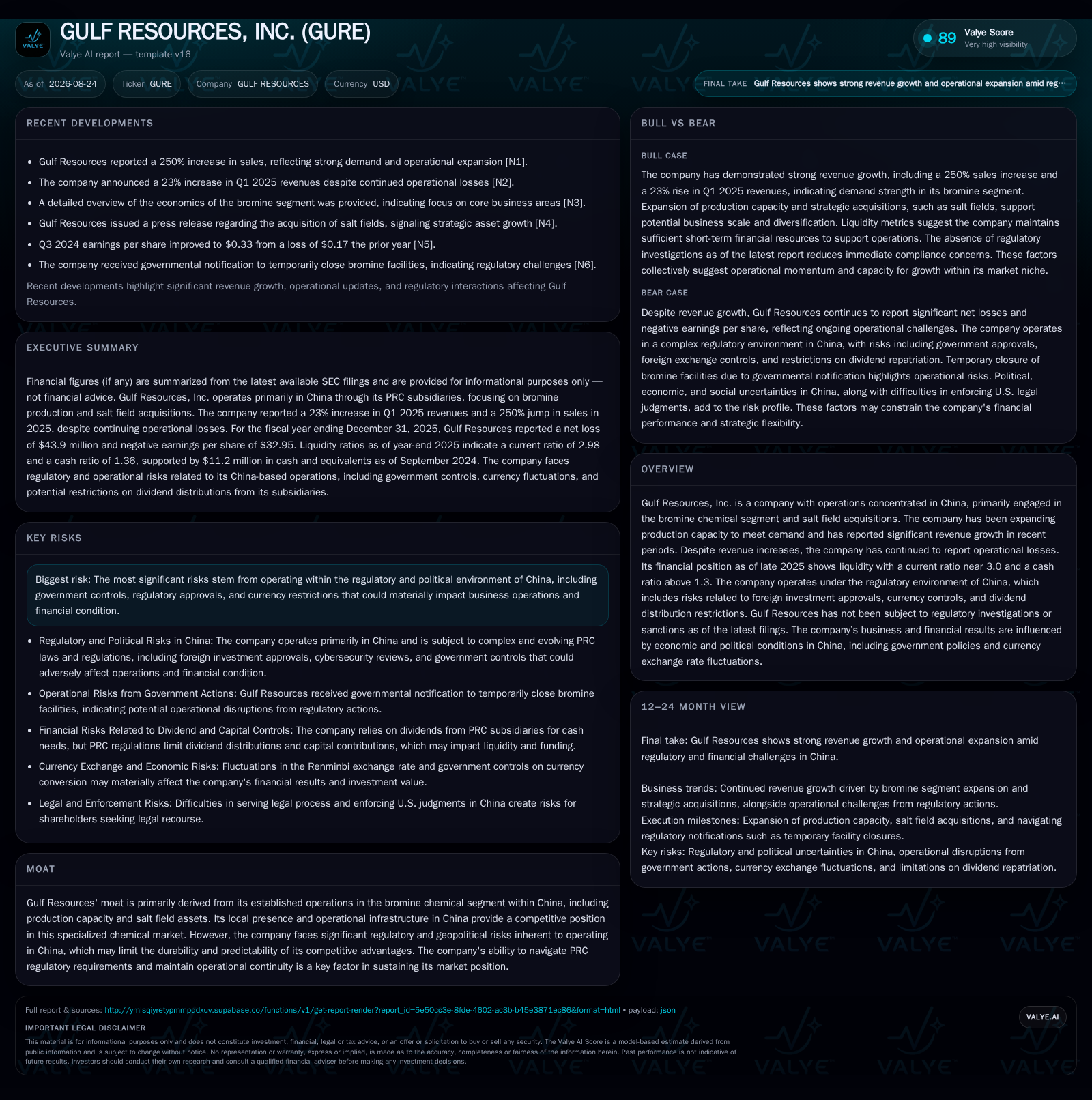
Financially, despite revenue growth, Gulf Resources continues to report operational losses, indicating challenges in converting top-line growth into profitability [S1]. These losses could reflect ongoing cost pressures, pricing competition, or inefficiencies during capacity ramp-up. As of December 31, 2025, the company reported current assets of approximately $24.57 million against current liabilities of $8.24 million, yielding a current ratio of 2.98 [F1]. This liquidity level may provide some financial flexibility to support ongoing operations and compliance efforts amid regulatory and operational challenges.
The Chinese government’s significant role in regulating industry development and economic growth introduces uncertainty. Controls over foreign investment approvals, currency exchange, dividend payments, and industrial policy can materially affect Gulf Resources’ operations and capital flows. Any adverse regulatory developments could materially and adversely affect the company’s financial condition, results of operations, and stock price [S1].
Two primary scenarios emerge for Gulf Resources’ near-term outlook:
Bull Scenario: The company regains Nasdaq compliance by timely filing overdue reports, completes bromine capacity expansion efficiently, and benefits from stable or improving market demand and pricing [S1][S3][F1]. This would likely improve operating margins and lead toward profitability. Confirmation would include timely filings, improved financial results, and absence of adverse regulatory actions.
Bear Scenario: Failure to regain Nasdaq compliance results in delisting and reduced investor access to capital markets. Capacity expansion costs strain liquidity, and adverse regulatory or market developments exacerbate operational losses [S3][S1][F1]. Indicators include missed filing deadlines, further financial deterioration, and regulatory sanctions or restrictions.
Investors should monitor filing of overdue SEC reports, Nasdaq listing status announcements, bromine production capacity utilization and profitability updates, regulatory developments in China affecting foreign-listed companies, and cash flow and liquidity metrics in future filings.
In conclusion, Gulf Resources’ Nasdaq compliance extension provides additional time to address filing deficiencies and maintain listing status, which is important for investor access and capital raising. Its bromine production capacity expansion could enable the company to capitalize on market demand, but ongoing operational losses and regulatory risks may temper near-term profitability prospects. The company’s liquidity position as of the end of 2025, with current assets of $24.57 million and current liabilities of $8.24 million yielding a current ratio of 2.98, may offer a financial buffer to support operations and compliance efforts [F1]. Timely filings and regulatory developments will be key to assessing whether Gulf Resources can stabilize its regulatory standing and translate capacity expansion into sustainable profitable growth amid China’s complex regulatory environment.

Comments