
Bridgford Foods Q3 2026: Price Increases Offset Volume Declines in Frozen and Snack Segments
Bridgford Foods’ Q3 2026 update highlights mixed sales trends with inflationary cost pressures impacting margins despite operational adjustments.
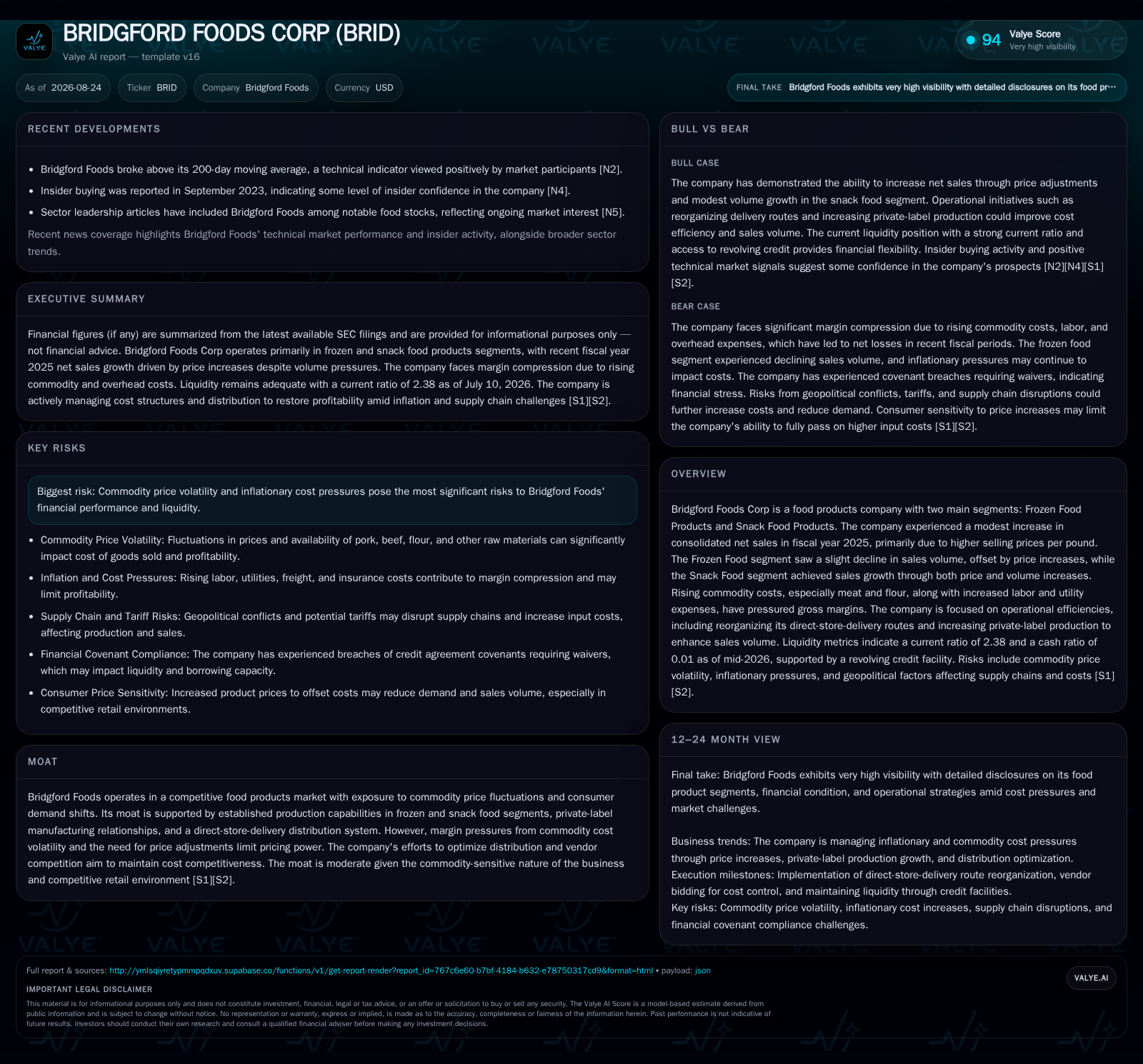
Bridgford Foods reported mixed segment performance in its latest quarterly filing dated August 24, 2026. The Frozen Food segment experienced volume declines partially offset by price increases, while the Snack Food segment showed modest volume and price growth. Inflationary pressures on commodity costs, labor, and utilities continue to weigh on gross margins. The company maintains adequate liquidity with a current ratio of 2.38 and moderate net debt. Bridgford’s near-term margin sustainability depends on balancing price adjustments against volume fluctuations amid ongoing commodity cost volatility.
To address these mixed sales trends amid ongoing inflationary cost pressures, the company implemented price increases across its product lines [S2]. These developments are significant as they impact Bridgford Foods' revenue growth, margin sustainability, and liquidity, which are critical factors for evaluating the company's near-term financial health and operational resilience.
In fiscal year 2025, the Frozen Food Products segment saw net sales decrease by 0.6%, primarily due to a 2.7% decline in unit sales volume [S1]. This volume reduction was partially offset by a 2.2% increase in selling price per pound. Additionally, production disruptions occurred due to temporary repairs on a spiral freezer, which constrained output during the period.
Conversely, the Snack Food Products segment reported a 4.7% increase in net sales for fiscal 2025 [S1]. Commodity costs, notably meat and flour, have fluctuated and generally risen due to geopolitical tensions involving the United States and countries such as Iran, Ukraine, Russia, Israel, and Palestine. These geopolitical factors, combined with increased tariffs and fuel costs, have contributed to ongoing volatility in raw material pricing. Labor and utility expenses have also increased, further pressuring gross margins.
To address these challenges, Bridgford is pursuing operational efficiencies, including reorganizing its direct-store-delivery (DSD) routes and expanding private-label production [S2]. These initiatives aim to enhance sales volume and improve cost competitiveness, which could help mitigate margin compression if successfully executed.
Annual Business Model and Risk Context
Bridgford Foods operates primarily in the food manufacturing and distribution sector, producing frozen food products such as sheet dough and rolls, alongside snack food products sold under both private-label and branded arrangements. The company generates revenue through unit sales volume multiplied by selling price per pound, with occasional promotional adjustments [S1]. Retailers and institutional customers are the primary purchasers of Bridgford’s products.
Margins in this sector are highly sensitive to commodity input costs, including meat and flour, as well as labor and utility expenses. Bridgford’s ability to sustain profitability depends on its capacity to manage these input cost fluctuations and operational efficiencies while maintaining competitive pricing. However, pricing power is limited due to the competitive retail environment and the lag in passing through commodity cost changes to customers.
Commodity price volatility is a structural risk in Bridgford’s business model, driven by factors such as geopolitical conflicts, tariffs, and weather-related disruptions impacting agricultural supply. Inflationary pressures on labor and utilities add further cost challenges. The company’s cash and cash equivalents stood at $333,000, while total debt was $8.7 million, resulting in a net debt position of approximately $8.4 million [F1]. This moderate leverage level suggests Bridgford maintains financial flexibility to manage working capital needs and operational investments amid ongoing cost pressures.
However, sustained margin pressure from inflation could challenge cash flow generation if cost increases outpace price adjustments or volume declines accelerate.
Analytical Conclusions and Scenarios
Bridgford Foods’ ability to sustain revenue growth and margin stability depends on balancing price increases against volume fluctuations, particularly in the Frozen Food segment [S1]. The segment’s 2.7% volume decline in fiscal 2025, despite a 2.2% price increase per pound, highlights limited volume resilience amid consumer shifts from foodservice to retail and production disruptions. Commodity costs, including meat and flour, have fluctuated due to geopolitical tensions and tariffs, while inflationary labor and utility costs continue to weigh on gross margins. Without effective operational efficiencies and timely price adjustments, profitability may be constrained.
One possible positive scenario is that Bridgford’s ongoing operational efficiency initiatives, such as DSD route reorganization and increased private-label production, succeed in reducing costs and enhancing sales volume [S2]. If the company can also pass through commodity cost increases via price adjustments without significant volume loss, gross margins could stabilize or improve. Given the competitive food products market and price sensitivity, Bridgford could face sustained margin erosion and liquidity pressure if operational efficiencies fail to offset cost pressures. Evidence supporting this scenario would include declining gross margins, reduced sales volumes, and deteriorating liquidity ratios.
Watchpoints
Investors should monitor Bridgford’s upcoming quarterly gross margin trends to assess the effectiveness of cost pass-through and operational efficiency measures. Changes in unit sales volume in both Frozen and Snack Food segments will indicate demand resilience or softness. Commodity price movements, especially for meat and flour, remain critical given their impact on cost of goods sold. Progress on operational initiatives, including DSD route optimization and private-label production volumes, will be key to margin management. Finally, liquidity ratios and net debt levels in subsequent filings will provide insight into the company’s financial flexibility amid ongoing inflationary pressures.
In summary, Bridgford Foods faces a challenging operating environment characterized by commodity cost volatility and inflationary labor and utility expenses. The company’s near-term financial health and margin sustainability will depend on its ability to navigate these pressures through pricing strategies and operational improvements while maintaining adequate liquidity.

Comments