
Regen BioPharma Q2 2026: Early-Stage Regenerative Therapy Development Amid Severe Liquidity Constraints
Regen BioPharma remains in early-stage regenerative medicine development without FDA approvals or clinical trials, constrained by severe liquidity shortages as of June 30, 2026.
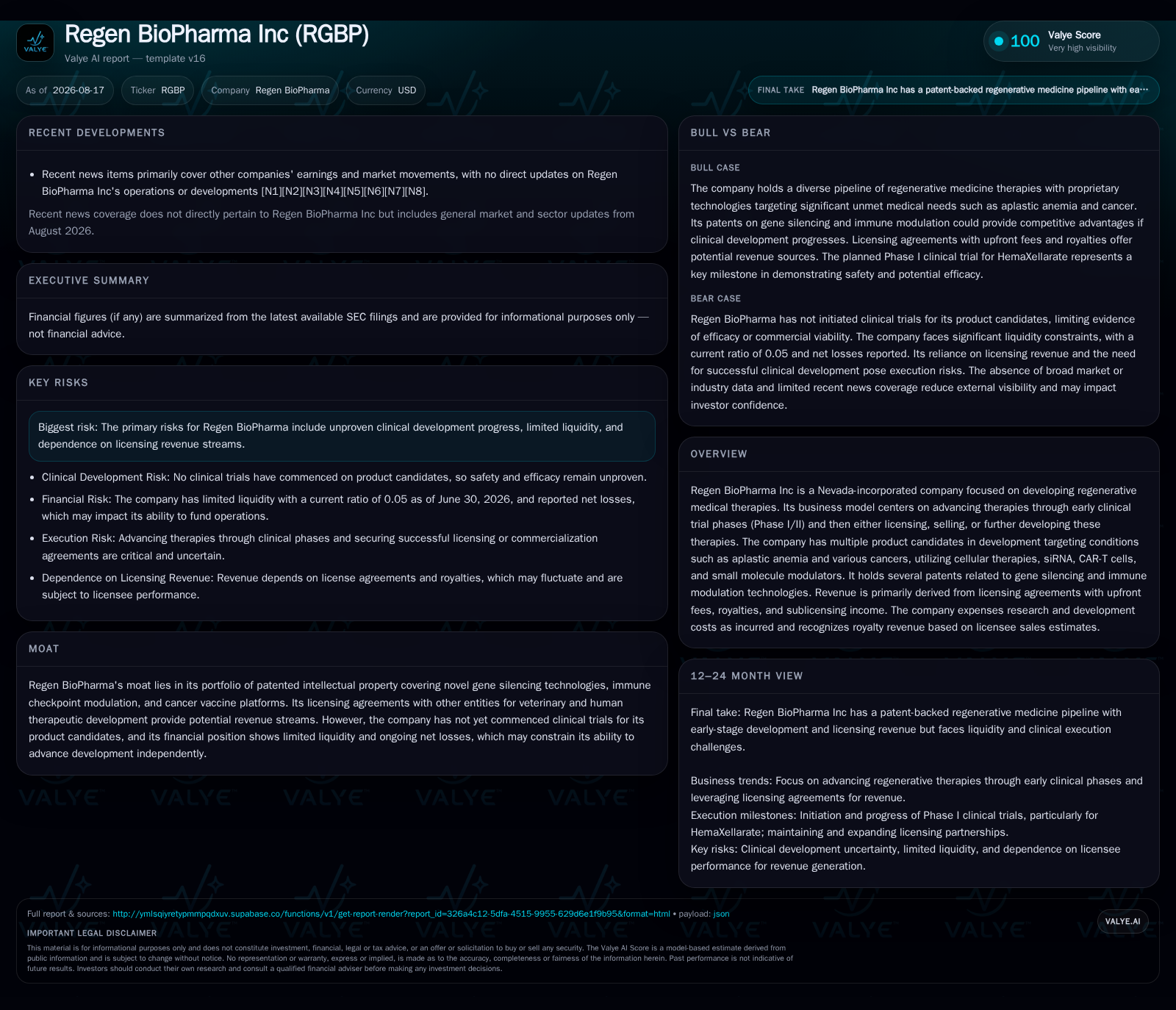
Regen BioPharma continues to focus on developing regenerative therapies but has not initiated clinical trials or received FDA approvals as of Q2 2026. The company’s financial position reveals critical liquidity challenges, with a current ratio of 0.05 and only $239 in cash at quarter-end, severely limiting its ability to fund operations independently. Its business model centers on licensing patented technologies, yet near-term revenue generation remains uncertain. Securing additional capital or partnerships is essential for advancing its pipeline and sustaining operations.
Latest Operating and Regulatory Status
Regen BioPharma Inc remains in the early stages of developing regenerative medical applications as of the quarter ended June 30, 2026. The company has not received any approvals from the U.S. Food and Drug Administration (FDA) nor initiated clinical trials for its product candidates during this period [S2]. This lack of regulatory progress means that the company’s pipeline remains unproven, limiting near-term value creation and maintaining high development risk. Clinical milestones such as Investigational New Drug (IND) application approvals and Phase I/II trial initiations are critical in the biotechnology sector for validating therapeutic potential and attracting partner interest.
Regen BioPharma reported cash and cash equivalents of only $239 and current assets totaling $287,587 against current liabilities of $6,165,793, resulting in a critically low current ratio of 0.05 [F1]. This severe liquidity constraint highlights the company's inability to cover its short-term obligations with available assets, signaling significant financial distress.
Without sufficient cash runway or access to external capital, Regen BioPharma’s capacity to advance its regenerative medicine pipeline is severely constrained. The absence of disclosed capital raises or financing events in the latest quarter further highlights the company’s precarious funding situation [S2]. The current ratio of 0.05 indicates that for every dollar of current liabilities, the company holds only five cents in current assets, a level far below the generally accepted threshold of 1.0 for financial health [F1].
This minimal cash balance, combined with ongoing research and development expenditures typical of early-stage biotech firms, suggests that the company is reliant on external financing or partnership agreements to continue operations [S2]. No capital expenditures or financing events were disclosed in the latest quarter, indicating that Regen BioPharma has not yet secured new funding sources to alleviate its liquidity pressures [S2]. The company's ability to meet its short-term obligations and invest in advancing its pipeline is therefore materially impaired, increasing the risk of operational disruptions or forced asset sales.
Business Model and Revenue Drivers
Regen BioPharma’s business model centers on developing regenerative medical therapies through early clinical phases, with the intent to generate revenue primarily via licensing agreements [S1]. These agreements typically involve upfront fees, milestone payments, and royalties from partners who acquire rights to the company’s technologies after successful early-stage trials.
The company holds a portfolio of patented gene silencing and immune modulation technologies, including investigational new drug applications for cellular therapies such as HemaXellarate, dCellVax, and tCellVax. HemaXellarate, for example, is a cellular composition derived from adipose tissue believed to promote bone marrow regeneration, with an IND filed in 2013 and a Phase I clinical trial approved by the FDA in 2015 [S1]. However, as of Q2 2026, no clinical trials have been initiated, and no FDA approvals have been granted [S2].
Licensing revenue remains potential but is not evidenced as material in the latest quarter [S2]. Without clinical trial initiation or FDA approvals, the company’s ability to monetize its intellectual property remains limited. Margins and cash conversion are currently negative due to ongoing R&D expenses and lack of commercial products. Future profitability will depend on successful licensing deals or advancing candidates to later-stage trials, which require substantial capital and regulatory progress.
The company holds a patent portfolio and investigational new drug applications; however, the absence of clinical progress and regulatory milestones as of Q2 2026 may limit its attractiveness to potential partners or licensees. The licensing model could depend on demonstrating therapeutic efficacy and safety in early clinical trials, which Regen BioPharma has not yet achieved, potentially affecting future partner interest.
Legal and Other Developments
In mid-2026, Regen BioPharma settled a legal claim involving $398,740 of claims filed against the company [S3]. The complaint was filed in April 2026 and resolved by May 2026 through a Settlement and Mutual Release Agreement. While this settlement resolves the immediate legal matter, it does not materially alter the company’s core development challenges or liquidity constraints.
Legal proceedings can divert management attention and resources, but the resolution suggests no ongoing material litigation risk at this time. The settlement amount, while significant relative to the company's cash position, does not fundamentally change the financial outlook or operational capacity.
Investment Scenarios and Risks
The company’s future trajectory hinges on its ability to secure additional financing or partnership agreements. One plausible base scenario is that Regen BioPharma obtains new capital or licensing deals within the next 12 months, enabling it to initiate clinical trials and advance its regenerative medicine pipeline. This scenario is plausible given the company’s patent portfolio and licensing model, which provide a foundation for partner interest. Successful capital raises or licensing deals, along with regulatory clearance to initiate trials, would confirm this positive outlook [S1][S2].
Conversely, a bear scenario involves the company failing to secure necessary funding or partnerships, leading to operational disruptions, inability to advance clinical development, and potential insolvency risks. The severe liquidity constraints and lack of clinical progress increase the risk of operational failure absent external capital.
Key watchpoints for investors include announcements of new financing rounds or partnership agreements, FDA clearance or IND approvals enabling clinical trial starts, subsequent quarterly filings showing changes in cash and working capital, and updates on product candidate development or patent monetization efforts. Monitoring these indicators will be critical to assessing whether Regen BioPharma can overcome its current constraints and progress toward value creation.
Conclusion
Regen BioPharma’s inability to initiate clinical trials or secure FDA approvals as of Q2 2026 maintains high development risk and limits near-term value creation potential [S2]. Clinical progress and regulatory milestones are critical value inflection points in biotech; absence of these indicates the pipeline remains unproven and speculative.
The licensing-focused business model offers potential revenue streams but remains contingent on clinical and regulatory progress that has yet to materialize. The recent legal settlement does not significantly affect the core financial or operational outlook. Near-term survival and progress depend heavily on securing new capital or partnership agreements to alleviate liquidity pressures and enable clinical advancement.
Investors should closely monitor financing activities, regulatory milestones, and operational updates to gauge the company’s ability to navigate its current challenges and realize its regenerative medicine development goals.

Comments