
Guided Therapeutics Q2 2026: Ongoing Operating Losses Amid Severe Liquidity Constraints
Q2 2026 results reveal ongoing operating losses and a severe liquidity shortfall that raise significant financial risks for Guided Therapeutics’ commercialization of its LuViva device.
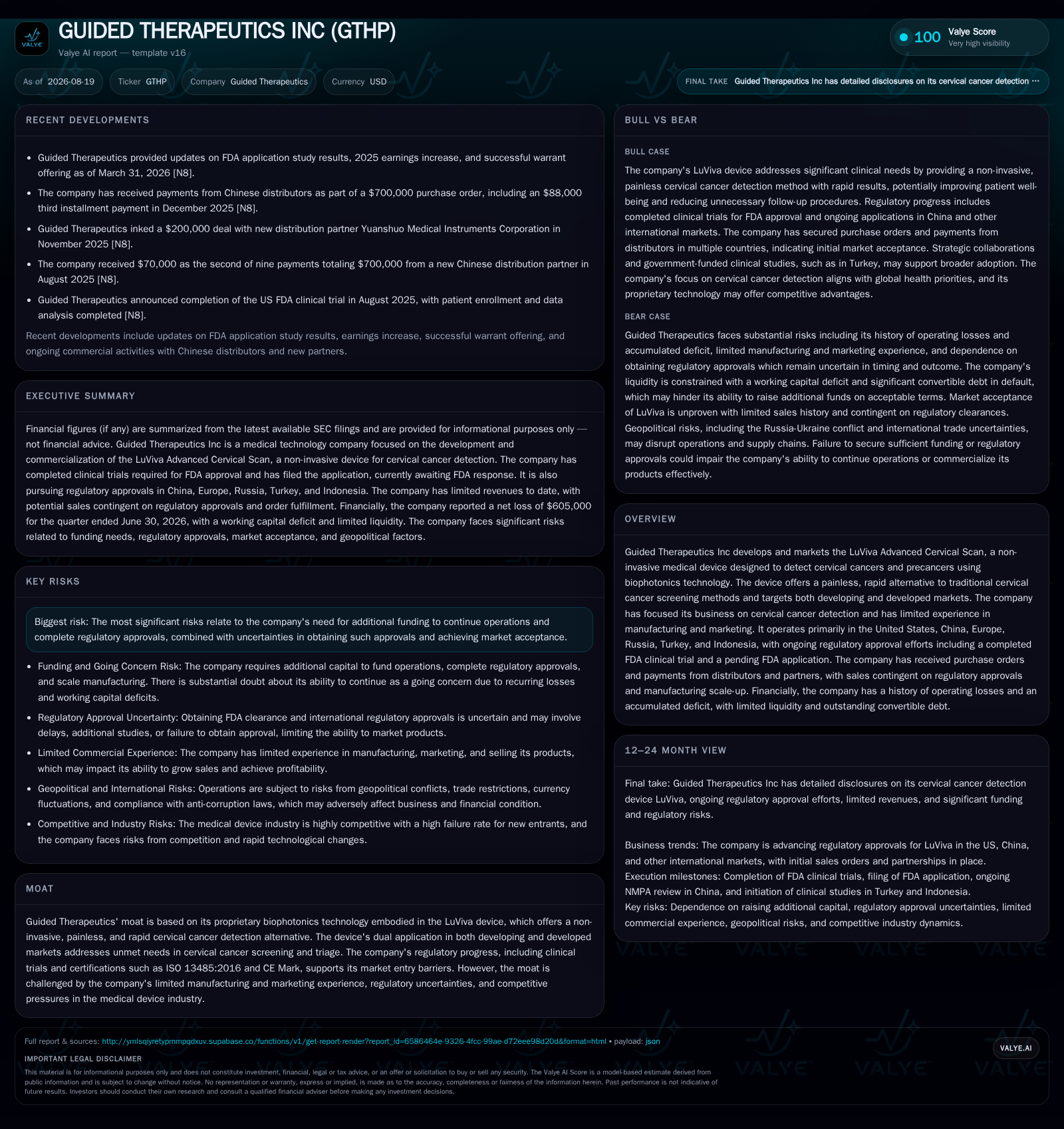
Guided Therapeutics reported a working capital deficit of approximately $5.6 million as of June 30, 2026, with convertible notes in default and classified as short-term debt. The company continues to incur operating losses, with a net loss attributable to common stockholders increasing to $1.6 million in the first half of 2026. Despite regulatory progress and a near-term sales pipeline of about $1.0 million, the company faces substantial going concern risks due to its liquidity constraints and elevated burn rate driven by commercialization efforts for its LuViva cervical cancer detection device. Securing additional financing is critical to sustaining operations and advancing manufacturing scale-up.
Q2 2026 Financial and Liquidity Update
Guided Therapeutics reported a significant working capital deficit as of June 30, 2026, with current assets totaling $527,000 and current liabilities at $6,169,000 [F1]. Compounding this challenge, the company's convertible notes are in default and have been reclassified as short-term debt [S2]. These notes include provisions that could accelerate repayment or increase amounts due, heightening the risk of liquidity disruption and potential dilution for existing stockholders.
The net loss attributable to common stockholders increased to $1.6 million for the first half of 2026, compared to $1.3 million in the same period of 2025 [S2]. This ongoing operating loss reflects the company's continued expenditure on commercialization efforts, including scaling manufacturing and expanding its workforce to meet anticipated demand.
Commercialization Progress and Revenue Outlook
Guided Therapeutics’ revenues to date have been limited and primarily stem from sales of its LuViva cervical cancer detection device and related disposable components [S2]. Although product sales have not yet reached a scale sufficient to offset operating losses, the company has identified potential near-term revenue opportunities. Based on existing purchase orders and ongoing discussions with distributors and partners, Guided Therapeutics expects potential sales of approximately $1.0 million in the near term [S2].
This early commercial traction, while modest relative to the company's operating costs, indicates some market interest in LuViva. Regulatory approval is a critical milestone for market entry and revenue generation in the medical device sector, particularly for diagnostic technologies like LuViva that require stringent validation. The company's progress in clinical trials represents an important step, but the absence of final FDA clearance means commercial expansion remains contingent on regulatory outcomes.
Operationally, the company faces the challenge of scaling manufacturing capacity to meet anticipated demand. Guided Therapeutics expects its burn rate to increase over the next 12 months as it ramps up headcount and production-related expenditures to support manufacturing scale-up [S2]. Efficient manufacturing scale-up is essential to improve margins and cash conversion, but it also requires upfront capital investment, adding to near-term financial pressures.
Capital Requirements and Funding Risks
The combination of a severe working capital deficit, defaulted convertible notes, and ongoing operating losses places Guided Therapeutics under substantial financial strain. The default status of convertible notes, with provisions that may trigger accelerated repayment, exacerbates liquidity risks and could force the company to prioritize debt servicing over operational investments [S2].
Business Model Economics and Industry Context.
Guided Therapeutics operates in the medical device manufacturing sector, generating revenue primarily through sales of its LuViva device and disposable components to healthcare providers and distributors [S1]. The company’s proprietary biophotonics technology enables non-invasive cervical cancer screening, positioning it within a niche diagnostic market that requires regulatory approvals and manufacturing scale-up before achieving sustainable profitability.
Margins and cash conversion in this industry depend heavily on manufacturing efficiency, regulatory clearance, and market acceptance. Guided Therapeutics currently incurs operating losses reflecting its early commercialization stage and the capital-intensive nature of scaling production and marketing capabilities. The limited revenue to date and the need for substantial additional capital highlight the structural challenges faced by early-stage medical device companies.
Analytical Conclusions and Watchpoints
The severe working capital deficit and the defaulted convertible notes raise significant financial risks for Guided Therapeutics. This liquidity pressure could impair the company’s ability to continue product development, manufacturing scale-up, and commercialization without successful capital raises.
The expected increase in burn rate due to headcount and production investments reflects the company’s efforts to build operational capacity necessary for commercialization.
Investors and stakeholders should closely monitor several key developments: announcements of new financing or capital raises, updates on FDA regulatory approval or clearance for LuViva, trends in quarterly operating cash flow and burn rate, changes in debt status or restructuring agreements, and actual order fulfillment and sales volume growth. These factors will be critical in assessing whether Guided Therapeutics can overcome its liquidity constraints and progress toward sustainable operations.
In summary, Guided Therapeutics faces a challenging financial and operational environment marked by significant liquidity shortfalls and ongoing losses. While regulatory and commercial milestones offer a foundation for potential growth, the company’s near-term viability hinges on its ability to secure additional capital and successfully scale manufacturing and sales of its LuViva device.

Comments