
Boost Run Inc. Q2 2026: Operating Losses Persist Amid Liquidity Shortfall
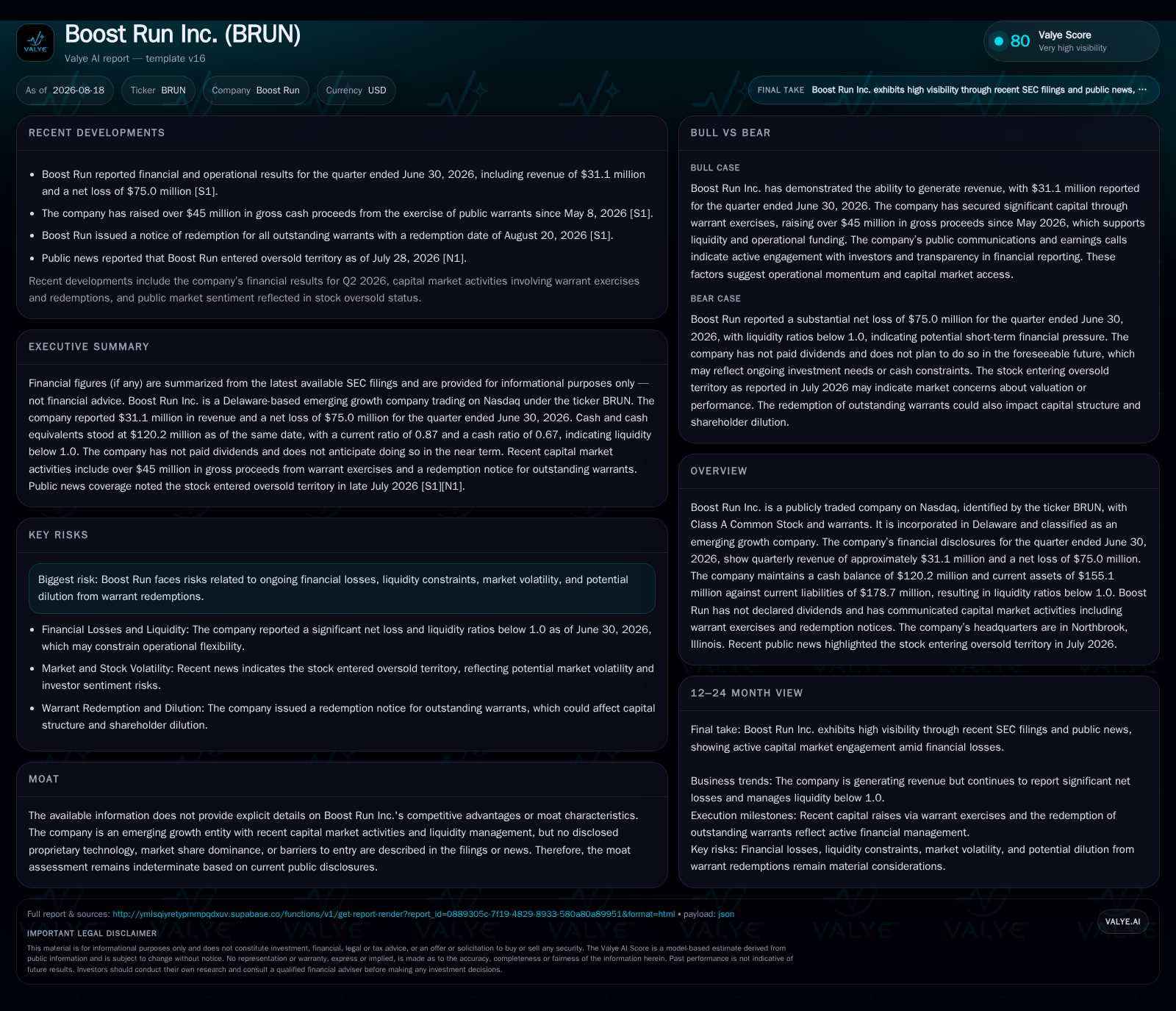
Boost Run reported $31.1 million in Q2 revenue but incurred a $75.0 million net loss, with liquidity pressures evident from a sub-1 current ratio.
Boost Run Inc.'s Q2 2026 financial results reveal ongoing operating losses and liquidity constraints. The company generated $31.1 million in revenue but posted a net loss of $75.0 million for the quarter ended June 30, 2026. Its current ratio stood at 0.87, reflecting current liabilities exceeding current assets and signaling potential short-term funding challenges. Recent capital market activities, including warrant exercises, may provide incremental financing but also raise dilution concerns. These factors underscore structural challenges in reaching profitability and sustaining financial stability in the near term.
Q2 2026 Operating Performance and Profitability
Boost Run Inc. reported quarterly revenue of approximately $31.1 million for Q2 2026, indicating ongoing top-line generation [S2]. However, the company incurred a net loss of $75.0 million during the same period, reflecting a significant operating deficit relative to revenue [S2]. This net loss underscores the company's continued challenges in achieving profitability, as expenses and operating costs substantially exceed income. The negative margin dynamics suggest that Boost Run's current business operations are not yet self-sustaining, and the company remains in a cash burn phase typical for emerging growth firms transitioning from development to commercialization.
Liquidity and Working Capital Analysis
As of June 30, 2026, Boost Run held cash and cash equivalents totaling $120.2 million, which provides a liquidity buffer to support ongoing operations [F1]. Despite this cash position, the company's current assets stood at $155.1 million against current liabilities of $178.7 million, yielding a current ratio of 0.87 [F1]. This working capital deficit reflects ongoing cash burn driven by operating losses and raises concerns about the sufficiency of existing liquidity to sustain operations without capital raises.
The modest total debt of approximately $6.3 million as of December 31, 2025, indicates limited leverage on the balance sheet, but this figure is not current and should be interpreted cautiously [F1]. The primary liquidity concern centers on the working capital deficit and the cash burn implied by the net loss, which together suggest that Boost Run will likely require additional financing to maintain operations beyond the near term.
Capital Market Activities and Financing Implications
Recent filings disclose capital market activities including warrant exercises and redemption notices that may influence the company's capital structure and dilution risk [S3]. Such activities are common among emerging growth companies operating post-SPAC merger, serving as mechanisms to raise incremental financing. While warrant exercises can provide necessary capital to alleviate liquidity pressures, they also carry the potential to dilute existing shareholders. The balance between securing financing and managing dilution will be a critical aspect of Boost Run's capital allocation strategy moving forward.
These capital market maneuvers suggest that the company is actively managing its financing sources to address liquidity constraints. However, reliance on equity instruments for funding underscores the absence of positive operating cash flow and the need to maintain investor confidence to support future capital raises.
Business Model and Competitive Positioning
The company's filings do not provide explicit details regarding its revenue sources, customer base, or product offerings [S2][S3]. As an emerging growth company transitioning from a SPAC merger, Boost Run faces structural challenges typical in this industry segment, including establishing sustainable revenue streams and managing operating costs. The persistent net losses and liquidity constraints suggest that the company has yet to achieve operational scale or positive cash flow conversion.
Without disclosed competitive advantages or detailed business model economics, the company’s near-term financial health will heavily depend on its ability to control cash burn and secure financing. The lack of transparency around who pays for the company's products or services, what is sold, and the revenue mechanics limits the ability to assess the sustainability of its business model or its competitive positioning within its industry.
Scenario Analysis and Investment Risks
One plausible base scenario is that Boost Run continues to operate with losses and a current ratio below 1.0 but manages to secure incremental financing through warrant exercises and equity issuances to fund operations [S3]. This scenario depends on sustained investor appetite for equity and stable operating losses. If these conditions hold, the company may maintain operations while working toward improving its financial metrics.
Conversely, a bear case envisions worsening liquidity constraints that force operational cutbacks or restructuring, potentially leading to distress financing or significant dilution [S2]. This scenario could materialize if the company fails to raise additional capital or if operating losses increase, accelerating cash depletion and risking solvency challenges.
The Q2 2026 net loss of $75.0 million significantly exceeds revenue of $31.1 million, while current liabilities exceed current assets, signaling ongoing cash burn and working capital deficits [S2][F1]. A current ratio of 0.87 and current liabilities of $178.7 million exceed current assets and cash reserves, implying potential shortfalls without additional capital [F1]. These financial realities highlight the critical importance of capital market activities and effective cash management for Boost Run’s near-term survival and long-term viability.

Comments