
T3 Defense Q2 2026: Continued Liquidity Challenges Amid Aerospace and Defense Transition
T3 Defense's Q2 2026 results reveal severe liquidity constraints and integration risks as it shifts from fintech to aerospace and defense.
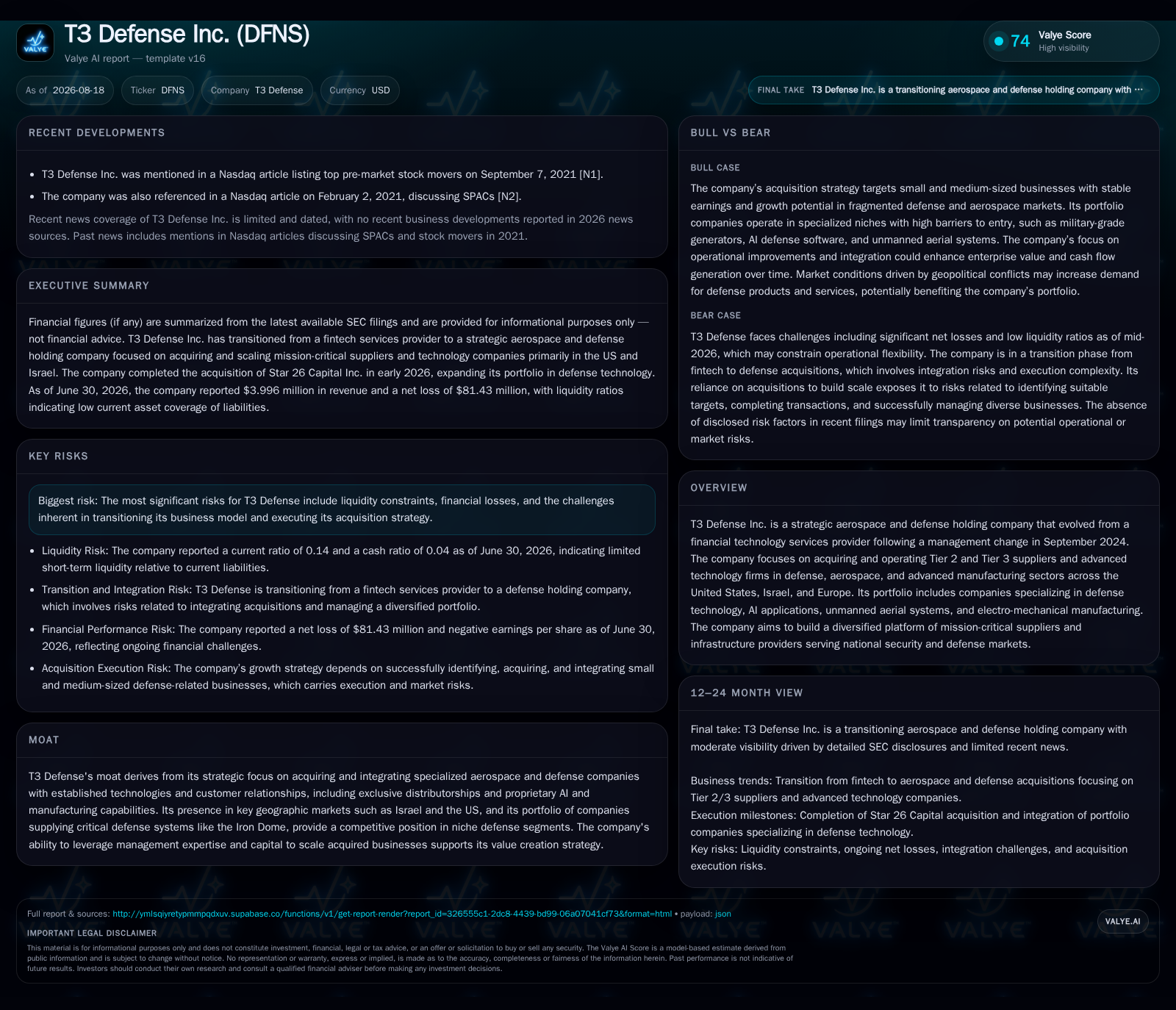
T3 Defense Inc.'s Q2 2026 financial filing discloses a critical liquidity shortfall with a current ratio of 0.14, reflecting current liabilities of $153 million vastly exceeding current assets of $21 million. This working capital deficit significantly limits the company's operational flexibility during its strategic transformation into an aerospace and defense holding company. Additionally, the company faces elevated integration risks due to its lack of prior aerospace experience and the complexity of managing multiple acquisitions across different regulatory jurisdictions. While recent Nasdaq stock price compliance reduces immediate delisting risk, fundamental financial and operational challenges remain unresolved.
T3 Defense Inc. reported a severe liquidity shortfall as of June 30, 2026, with current assets totaling $21.2 million against current liabilities of $153.2 million, resulting in a critically low current ratio of 0.14 [F1][S2]. This significant working capital deficit constrains the company's operational flexibility and threatens its ability to fund its ongoing transformation into the aerospace and defense sector, a strategic shift that involves divesting prior operations and acquiring multiple defense companies while establishing new regulatory compliance and security clearances [S1].
The limited cash reserves of $4.1 million provide a narrow operational runway relative to the scale of near-term obligations [F1]. Negative working capital persists, with current liabilities exceeding current assets by over $130 million, underscoring the company's liquidity constraints and financial stress during this transition [F1][S2]. This financial position limits T3 Defense's ability to support acquisition integration activities and meet contractual and regulatory demands inherent in the aerospace and defense industry.
In the aerospace and defense sector, working capital and liquidity ratios are critical due to the capital-intensive nature of contract fulfillment, long payment cycles, and regulatory compliance costs [S1]. This transformation involves acquiring multiple defense-related subsidiaries operating in the US, Israel, and Europe, offering products and services such as aerospace components, synthetic data generation platforms, real-time analytics, edge processing, unmanned aerial systems, and electro-mechanical manufacturing.
However, the company has no prior operational experience in aerospace and defense, has never managed defense contracts, nor held government security clearances. It faces the challenge of simultaneously integrating multiple acquisitions across different regulatory regimes without dedicated integration teams or proven playbooks [S1]. This elevates the risk of operational failure and value destruction. The complexity of managing acquisitions in multiple countries with varying currencies, regulations, and business models compounds integration challenges, increasing the likelihood of delays or cost overruns.
The aerospace and defense industry is heavily regulated, requiring compliance with ITAR, DFARS, and facility security clearances that typically take 12-18 months to obtain. T3 Defense must also recruit cleared personnel and establish relationships with prime contractors from scratch. These factors compound integration complexity and increase the likelihood of delays or setbacks [S1].
Successful integration and operational execution are essential for realizing synergies, securing contract wins, and generating sustainable cash flow. The lack of a defense industry track record and the compressed timeframe for acquisitions create significant uncertainty about the company's ability to achieve its strategic objectives [S1]. Historical data indicates that 70-90% of acquisitions fail to achieve projected synergies, and T3 Defense's lack of aerospace and defense experience significantly increases this risk.
Nasdaq Compliance and Market Access
A recent development reported in an August 17, 2026, 8-K filing shows that T3 Defense's common stock price recovered to meet Nasdaq's minimum bid price requirement of $1.00 for ten consecutive business days, thereby reducing the immediate risk of delisting [S3]. While maintaining listing status preserves access to capital markets, this stock price recovery does not address the company's fundamental liquidity and operational challenges. The recovery is a short-term market event and should not be interpreted as an improvement in the company's financial health or operational execution.
Scenario Analysis and Investor Implications
One plausible base scenario is that the company secures additional liquidity through equity lines or capital markets, stabilizes working capital, and gradually integrates its acquisitions. Some subsidiaries are cash-positive, and the company has a history of capital markets execution, which could provide a runway for operational improvements [S1][F1]. Confirmation of this scenario would include improved liquidity ratios in subsequent filings, positive cash flow reports from subsidiaries, and announcements of contract wins or integration milestones.
Conversely, the bear scenario involves worsening liquidity constraints forcing operational cutbacks or asset sales [S2]. Integration failures could lead to loss of customer contracts and value destruction, potentially culminating in restructuring or bankruptcy. Evidence supporting this downside would be negative cash flow trends, announcements of asset sales or restructuring, and deteriorating liquidity ratios [S1][S2][F1].
The company's lack of prior aerospace and defense experience combined with the challenges of integrating multiple acquisitions across diverse regulatory environments increases execution risk. While recent Nasdaq compliance reduces delisting threat, fundamental financial and operational pressures persist. Additionally, subsidiary cash flow and profitability disclosures, as well as contract awards or losses in defense markets, will provide critical signals on the company's trajectory.
The combination of a severe working capital deficit, lack of aerospace and defense operational experience, and the challenges of multi-jurisdictional acquisition integration create substantial execution risk. While Nasdaq compliance alleviates immediate market listing concerns, the company's near-term viability hinges on securing additional liquidity and successfully navigating integration complexities.

Comments