
Clean Energy Technologies Q2 2026: Operating Losses and Liquidity Constraints Amid Diversified Clean Energy Operations
Clean Energy Technologies reported ongoing net losses and a working capital deficit in Q2 2026 alongside new convertible note financing, highlighting liquidity challenges despite diversified clean energy segments.
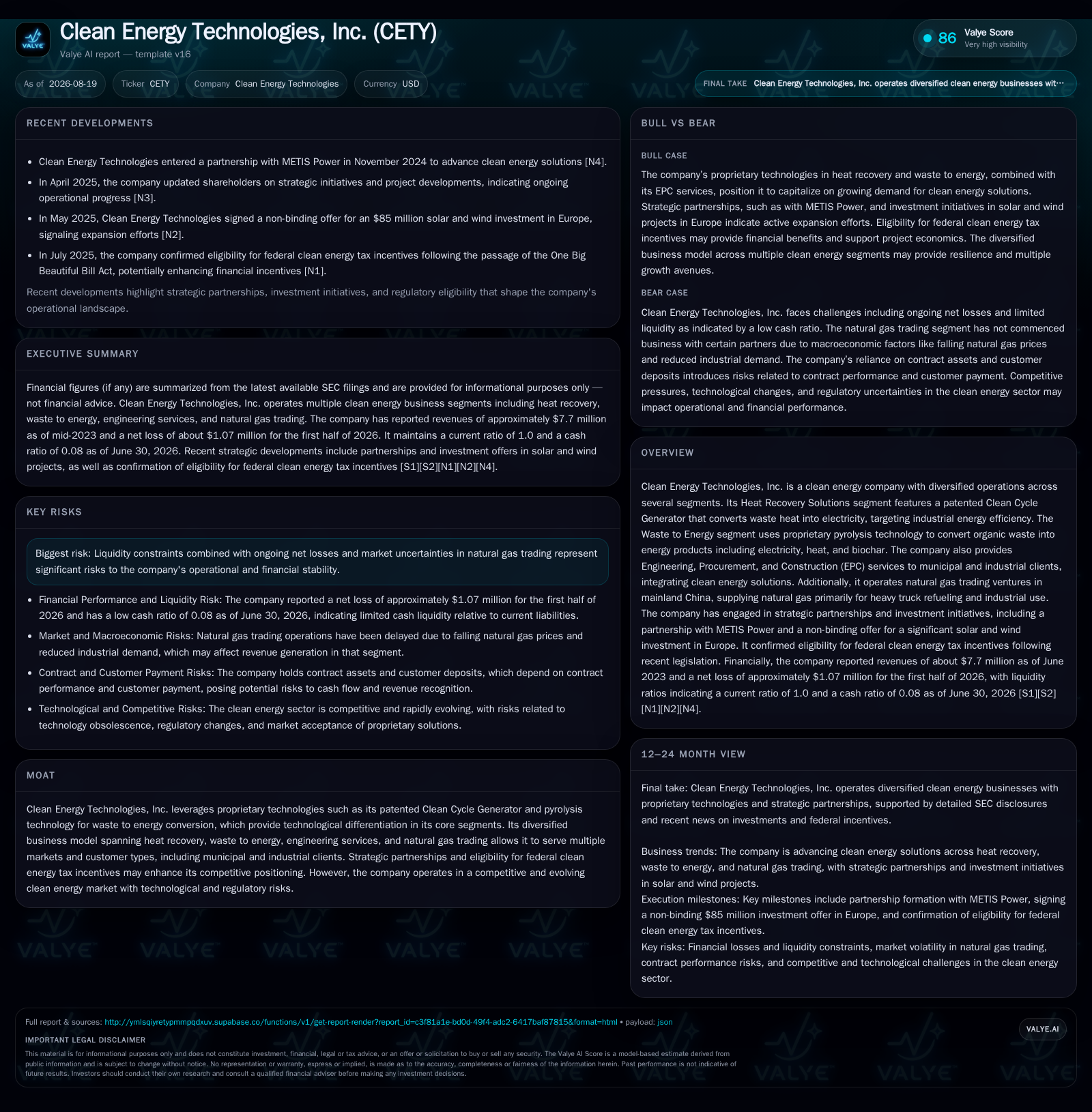
In the six months ended June 30, 2026, Clean Energy Technologies, Inc. continued to face operating losses and liquidity pressures, with net cash used in operations totaling $1.66 million and a working capital deficit of $37,355. The company operates four distinct segments—Heat Recovery Solutions, Waste to Energy, Natural Gas Trading, and Engineering and Manufacturing—offering a range of clean energy technologies and services. To address near-term capital needs, Clean Energy Technologies entered a convertible promissory note financing agreement in August 2026, providing incremental funds but not resolving structural cash flow deficits. These financial conditions underscore ongoing risks to the company’s operational sustainability and highlight the importance of future financing and segment performance improvements.
Clean Energy Technologies, Inc. reported continued operating losses and liquidity challenges in the second quarter of 2026, with net cash used in operating activities totaling $1.66 million and a working capital deficit of $37,355 as of June 30, 2026 [S2]. These financial conditions underscore ongoing negative cash flow pressures despite the company maintaining a current ratio near 1.0, supported by current assets of $7.79 million against current liabilities of $7.83 million [S2]. To address these constraints, the company secured new convertible note financing through a securities purchase agreement with Pacific Pier Capital II, LP, involving a convertible promissory note of $178,410 executed in August 2026 [S3]. These developments raise concerns about Clean Energy Technologies' ability to sustain operations without additional capital, impacting investor risk assessments.
The ongoing operating losses and cash burn highlight structural liquidity challenges [S2][F1]. This situation underscores the risk that the company may need to secure further financing or restructure operations to maintain continuity.
Convertible Note Financing and Capital Structure
In response to liquidity constraints, Clean Energy Technologies entered into a securities purchase agreement on August 10, 2026, with Pacific Pier Capital II, LP, issuing a convertible promissory note with a principal amount of $178,410 for a purchase price of $150,000.80 [S3]. The proceeds from this transaction are contractually restricted to be used for business development and payment of amounts owed to service providers. The agreement explicitly prohibits the use of funds for repayment of indebtedness to officers, directors, or employees, repayment of corporate finance transaction debt, or loans to insiders [S3].
While this financing provides incremental capital to support ongoing business activities, it does not address the underlying structural cash flow deficits or reduce existing debt obligations [S3]. The restricted use of proceeds limits the company's flexibility in managing its capital structure and alleviating financial leverage.
Business Model and Segment Overview
Clean Energy Technologies operates a diversified business model comprising four reportable segments: Heat Recovery Solutions, Waste to Energy, Natural Gas Trading, and Engineering and Manufacturing [S1][S2]. This segmentation reflects the company's broad approach to clean energy technology manufacturing and services.
The Heat Recovery Solutions segment focuses on technologies that capture and convert waste heat into usable energy, enhancing energy efficiency for industrial clients. The Waste to Energy segment develops and deploys pyrolysis technology and Clean Cycle Generator systems to convert waste materials into electricity and biochar, targeting municipal and industrial customers seeking renewable energy solutions. The Natural Gas Trading segment engages in the procurement and sale of natural gas, primarily serving customers in mainland China. Lastly, the Engineering and Manufacturing division provides engineering, procurement, and construction (EPC) services, supporting the implementation and maintenance of clean energy projects [S1][S2].
Revenue generation depends on the adoption of proprietary patented technologies, operational efficiency in manufacturing and service delivery, and commodity market conditions affecting natural gas trading [S2]. However, the company currently operates at a loss with negative cash flow, reflecting challenges in scaling these segments to profitability.
Financial Risks and Scenarios
The company's current financial profile, marked by ongoing operating losses, a working capital deficit, and significant accumulated deficit, indicates structural liquidity challenges [S2][F1]. These conditions necessitate continued reliance on external financing to sustain operations.
The recent convertible promissory note financing provides some incremental capital but does not resolve the fundamental cash flow deficits or reduce debt levels, given the restrictions on the use of proceeds [S3]. This situation suggests that Clean Energy Technologies must secure additional financing or achieve meaningful improvements in segment income and cash flow to stabilize its financial position.
One possible scenario is that the company continues to operate with negative cash flow but manages to raise incremental financing while gradually expanding its clean energy segments. This would depend on stable regulatory conditions, continued access to capital, and improvements in segment revenues [S2][S3]. Confirmation of this scenario would include future filings showing reduced cash burn, additional financing agreements, and improved segment income.
Conversely, if liquidity constraints worsen, the company could face operational cutbacks or restructuring, increasing the risk of dilution or bankruptcy [S2][F1]. The working capital deficit and net cash burn underscore structural liquidity risks that require continued external financing. The recent convertible note financing provides limited relief but does not address underlying cash flow deficits or debt obligations.
Investors and stakeholders should monitor upcoming quarterly filings for changes in operating cash flow and segment income, additional financing agreements, shifts in working capital and debt levels, and progress in the commercialization or adoption of the company’s proprietary clean energy technologies. These factors will be critical in assessing the company’s ability to stabilize liquidity and move toward sustainable profitability.

Comments