
La-Z-Boy Q1 2026: Retail Expansion and Digital Transformation Amid Quarterly Loss
La-Z-Boy’s Q1 2026 results highlight a net loss driven by investments in retail store acquisitions and digital initiatives, alongside rising contract liabilities signaling deferred revenue growth.
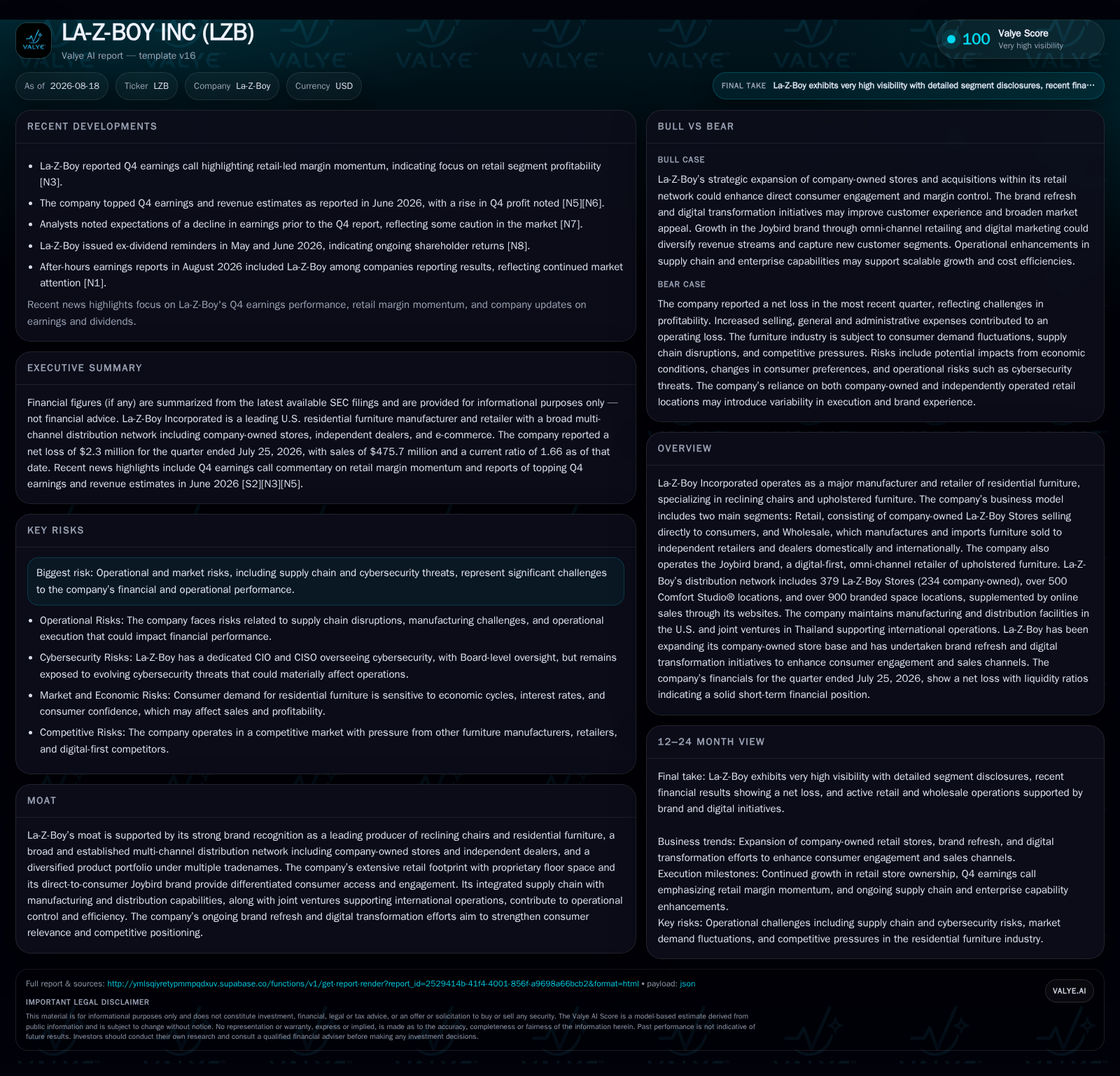
In the quarter ended July 25, 2026, La-Z-Boy reported a net loss of $1.98 million, a reversal from $18.3 million net income in the same period last year. This near-term margin pressure reflects the company’s strategic push to expand its company-owned retail footprint through acquisitions and new store openings, coupled with ongoing digital transformation efforts to enhance omni-channel sales. Contract liabilities increased by $22.5 million during the quarter, indicating higher customer deposits and deferred revenue that may support future revenue growth. While these developments pose short-term profitability challenges, they represent structural initiatives aimed at long-term integrated retail-wholesale growth.
Q1 2026 Operating Performance and Retail Expansion
La-Z-Boy Incorporated reported a net loss of $1.98 million for the quarter ended July 25, 2026, compared to net income of $18.3 million in the same quarter of the prior year [S2]. This operating loss reflects margin pressure likely related to the company's strategic investments in expanding its company-owned retail footprint and advancing digital transformation efforts. During Q1 2026, La-Z-Boy acquired existing La-Z-Boy retail stores and opened new company-owned locations, marking a material shift in the scale and dynamics of its Retail segment [S2]. These acquisitions and openings increase the company's direct access to consumers, which is central to its integrated retail-wholesale business model where profits are earned from both wholesale shipments and retail sales.
Contract liabilities—comprising customer deposits and deferred revenue—increased from $112.8 million as of April 25, 2026, to $135.3 million as of July 25, 2026 [S2]. This increase indicates growing customer commitments and a backlog of sales that have yet to be recognized as revenue, reflecting demand and future revenue recognition potential. In the same quarter, La-Z-Boy recognized $100.6 million in revenue related to its contract liability balance at April 25, 2026, demonstrating active revenue deferral and recognition dynamics tied to these customer deposits [S2].
Business Model and Revenue Mechanics
La-Z-Boy operates an integrated business model combining manufacturing, wholesale distribution, and retail sales of residential furniture products, including reclining chairs and upholstered furniture under the La-Z-Boy and Joybird brands [S1][S2]. Revenue is generated through direct sales at company-owned retail stores, wholesale shipments to independent La-Z-Boy retailers, and e-commerce sales via the Joybird brand. The company’s strategy emphasizes growing its company-owned retail stores to leverage combined wholesale and retail profits, enhancing margin potential through scale and product mix optimization.
The increase in contract liabilities aligns with this model, as customer deposits and deferred revenue represent prepayments for products that will be delivered and recognized as revenue in future periods. This mechanism supports working capital management and signals demand strength if the backlog converts into sales. Concurrently, La-Z-Boy is investing in digital transformation initiatives aimed at improving traffic both online and in physical retail locations, supporting omni-channel sales growth and consumer engagement [S2]. These efforts are intended to complement the retail expansion by driving customer acquisition and retention across channels.
Financial Position and Liquidity
Despite the quarterly net loss, La-Z-Boy maintains a liquidity position supportive of its ongoing operations and expansion initiatives. As of July 25, 2026, the company held $267.3 million in cash and cash equivalents and reported a current ratio of 1.66, with current assets of $746.4 million against current liabilities of $448.4 million [F1]. This liquidity provides a buffer to fund retail acquisitions, new store openings, and digital transformation investments without immediate financial distress.
Operating cash flow for the quarter includes adjustments for non-cash items such as depreciation and amortization, lease amortization, and impairment charges, which partially offset the net loss [S2]. The balance sheet reflects increased contract liabilities, consistent with higher customer deposits and deferred revenue, which are expected to support future revenue streams as the company fulfills these customer commitments.
Risks and Operational Challenges
La-Z-Boy faces operational risks inherent in retail expansion and digital transformation. The costs associated with acquiring and integrating new retail stores could exceed expectations, potentially prolonging margin pressure if synergies are delayed. Additionally, the success of digital initiatives depends on effective execution and consumer adoption; limited uptake could constrain the anticipated omni-channel sales growth.
Broader macroeconomic factors, including fluctuations in consumer discretionary spending and housing market trends, may also impact demand for residential furniture products. Supply chain disruptions and cybersecurity threats remain ongoing risks that could affect manufacturing, distribution, and e-commerce operations [S1]. Confirmation of this scenario would include improved same-store sales growth, reduction in net losses or return to profitability, and further increases in contract liabilities signaling robust demand.
Conversely, if retail acquisitions and digital investments fail to generate sufficient incremental sales or margin improvement, the company could face prolonged profitability challenges and cash flow pressures [S2]. The company’s acquisition and opening of company-owned retail stores, coupled with rising contract liabilities, indicate structural efforts to grow its integrated retail-wholesale business and build a backlog of committed sales. While these initiatives pressure margins in the short term, they position La-Z-Boy to potentially enhance revenue growth and profitability over time. Key watchpoints include same-store sales trends, contract liability movements, net income trajectory, operating cash flow, and progress in digital transformation execution. These indicators will be critical in evaluating whether the company's strategic investments translate into sustainable financial performance.

Comments