
Trutankless Q2 2026: Revenue Growth from Next-Gen Products Amid Liquidity and Going Concern Risks
Trutankless, Inc. reported increased revenue from next-generation tankless water heaters in Q2 2026 but faces significant liquidity challenges and internal control weaknesses.
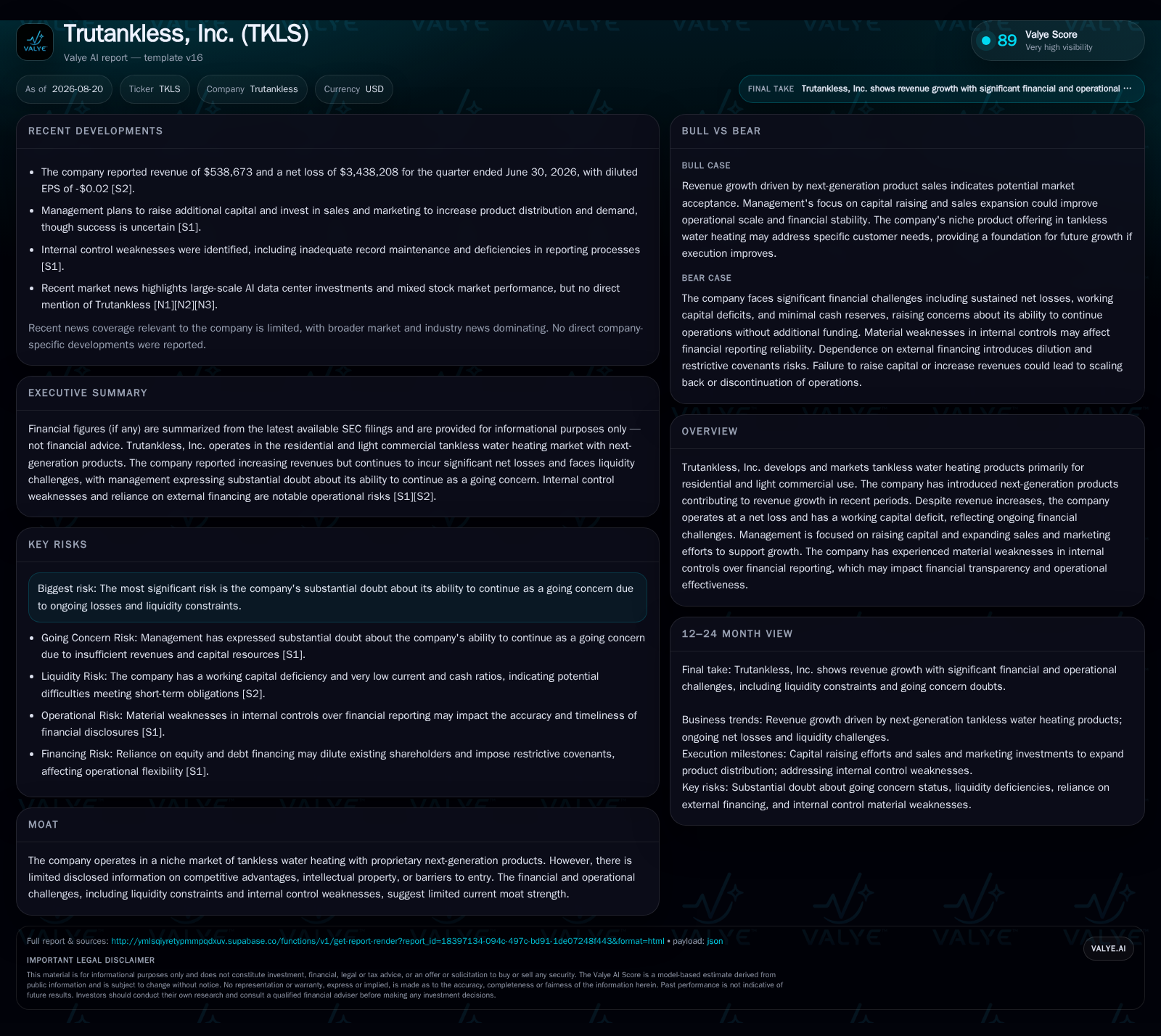
In Q2 2026, Trutankless, Inc. experienced revenue growth driven by its next-generation residential and light commercial tankless water heating products, signaling some market acceptance. However, the company remains unprofitable with a working capital deficit exceeding $9 million and a current ratio of 0.25 as of June 30, 2026, raising substantial doubt about its ability to continue as a going concern. Material weaknesses in internal controls over financial reporting further complicate operational transparency. Management is focused on raising additional capital and expanding sales efforts to support growth, but liquidity constraints and ongoing losses present significant risks.
Latest Operating Performance and Revenue Growth
Trutankless, Inc. reported revenue growth in the second quarter of 2026 driven by its next-generation residential and light commercial tankless water heating products [S2]. This increase in sales suggests some level of market acceptance for the company's newer product offerings, which are designed to provide on-demand water heating solutions that are more energy-efficient and space-saving compared to traditional tank-based systems. Revenue growth is a critical metric in this sector as it reflects the company's ability to scale sales and move toward profitability during intense competition from larger, well-funded incumbents.
Despite this growth, gross profit margins remain under pressure due to high costs of goods sold relative to revenue, consistent with the company's ongoing net losses and negative operating cash flow. These margin constraints are typical in the tankless water heating industry, where managing manufacturing costs and operating expenses is vital for achieving sustainable profitability.
Liquidity and Financial Condition
As of June 30, 2026, Trutankless reported a working capital deficit of approximately $9 million, with current liabilities significantly exceeding current assets—$11.9 million in current liabilities versus $2.9 million in current assets—resulting in a current ratio of 0.25 [F1][S2]. This severe liquidity shortfall raises substantial doubt about the company's ability to continue as a going concern, a status explicitly disclosed in its filings [S1][S2].
The liquidity constraints limit Trutankless's operational flexibility and its capacity to fund growth initiatives such as product development and sales expansion. Negative operating cash flow, driven by ongoing net losses and high operating expenses, exacerbates these challenges. Without successful capital raises, the company faces a heightened risk of insolvency or the need for restructuring.
Internal Controls and Operational Risks
Trutankless has disclosed material weaknesses in its internal controls over financial reporting, which may impair the reliability of its financial statements and operational effectiveness [S1][S2]. Such weaknesses increase execution risk by potentially hindering timely and accurate financial transparency, a critical factor for investor confidence and effective management decision-making.
These control issues, combined with the company's liquidity problems and net losses, contribute to the overall risk profile and complicate efforts to secure additional financing or strategic partnerships.
Capital Raising and Growth Strategy
Management is focused on raising additional capital and expanding sales and marketing efforts to support the scaling of next-generation product sales [S2]. Capital allocation priorities include product development and sales expansion, which are essential to improving revenue growth and moving toward profitability.
However, the company's ability to secure financing on favorable terms remains uncertain, and any capital raise could be dilutive to existing shareholders [S1]. The success of these efforts is pivotal to alleviating liquidity constraints and addressing the going concern risks.
Business Economics and Industry Context
Trutankless operates in a highly competitive tankless water heating market characterized by rapid technological advancements and significant competition from larger, well-funded companies. Its business model relies primarily on direct product sales to residential and light commercial customers.
The company's working capital deficit and internal control weaknesses further constrain its ability to compete effectively and invest in growth initiatives.
Scenarios and Watchpoints
One possible positive scenario is that Trutankless successfully raises additional capital and sustains or accelerates sales growth of its next-generation products. This would improve liquidity ratios, reduce net losses, and potentially lead to operational improvements, including remediation of internal control issues [S2][F1]. Confirmation would come from subsequent filings showing improved liquidity, quarterly revenue acceleration, and reduced losses.
Conversely, failure to secure financing or improve operational efficiency could lead to further liquidity deterioration, continued negative cash flow, and potential insolvency or restructuring [S2][F1]. Indicators would include worsening liquidity ratios, persistent operating losses, and disclosures of defaults or restructuring events.
Key watchpoints for investors include quarterly revenue and gross margin trends, changes in the current ratio and working capital position, announcements related to capital raising, updates on internal control remediation, and trends in operating expenses, particularly sales and marketing spend.
Conclusion
Trutankless's Q2 2026 revenue growth from next-generation tankless water heating products demonstrates some market traction and potential for scaling sales, which is essential for improving its financial position [S2]. However, the company's substantial working capital deficit, low current ratio of 0.25, ongoing net losses, and material weaknesses in internal controls create significant liquidity and operational risks that threaten its ability to continue as a going concern [F1][S1][S2].
The company's future depends heavily on its ability to raise additional capital and improve operational efficiency. Investors should closely monitor liquidity metrics, capital raising progress, revenue growth, margin trends, and internal control remediation efforts to assess whether Trutankless can overcome these challenges and achieve sustainable profitability and growth.

Comments