
Polar Power Q2 2026: Continued Revenue Variability Amid Customer Concentration Risks
Polar Power’s Q2 2026 results highlight ongoing revenue volatility driven by dependence on a single Tier-1 telecommunications customer and absence of long-term contracts.
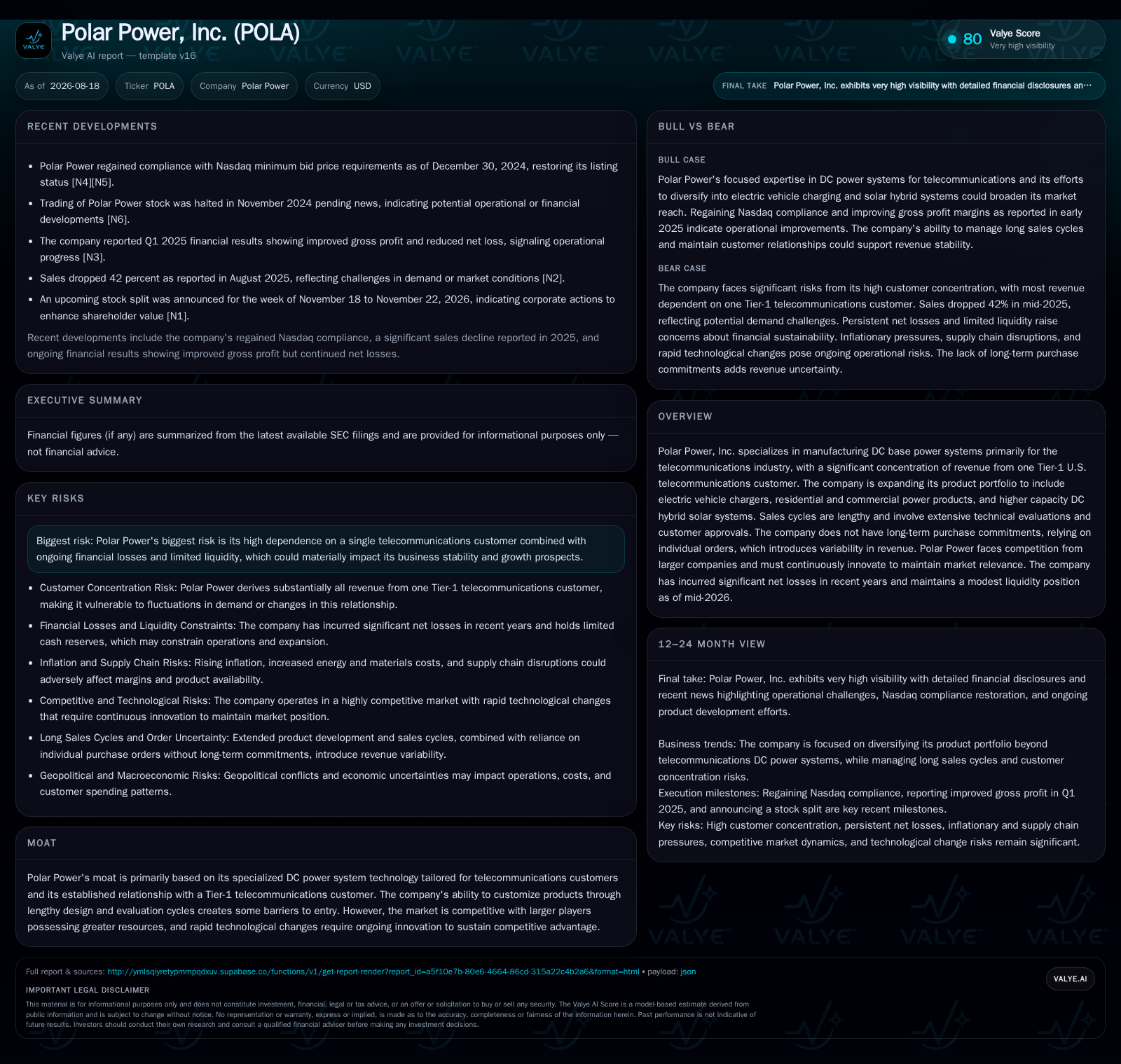
Polar Power, Inc. reported Q2 2026 operating results that continue to reflect significant revenue variability due to high customer concentration on one Tier-1 U.S. telecommunications client, which accounted for approximately 65% of net sales in 2025 and into 2026. The company lacks long-term purchase commitments, relying on individual orders that introduce unpredictability in quarterly revenue. While Polar Power is expanding its product portfolio to include electric vehicle chargers and hybrid solar systems to diversify revenue streams, these efforts remain early-stage. Modest liquidity and working capital relative to liabilities constrain operational flexibility and heighten going concern risks. The appointment of two new board members with telecommunications and technology backgrounds may provide strategic oversight, but execution risks remain substantial.
Polar Power, Inc. reported continued revenue variability in its Q2 2026 operating results, primarily driven by a high concentration of sales to a single Tier-1 telecommunications customer and the absence of long-term purchase commitments, as disclosed in its August 18, 2026 10-Q filing [S2]. This dominant customer accounted for approximately 65% of total net sales in 2025 and remains the primary revenue source into 2026, with sales dependent on individual orders subject to lengthy approval cycles rather than firm contracts [S1][S2]. This reliance on a concentrated customer base and unpredictable order timing increases revenue unpredictability and operational risk, complicating financial planning and potentially impacting the company's growth prospects and investor confidence.
In this industrial manufacturing sector focused on DC power systems for telecommunications and related markets, customer concentration is a critical KPI because it directly affects revenue stability. Polar Power’s dependence on one major customer without contract visibility exposes the company to sudden revenue declines if orders slow or cease. This risk is heightened by the lengthy sales cycles typical in customized DC power system manufacturing, where technical evaluations and approvals are required before orders finalize.
Product Portfolio Expansion and Market Diversification
To mitigate customer concentration risk and revenue volatility, Polar Power has expanded its product portfolio beyond telecommunications-focused DC base power systems. The company is developing electric vehicle (EV) chargers, residential and commercial power products, and higher capacity DC hybrid solar systems [S1][S2]. These new offerings aim to diversify revenue sources and tap into growing markets such as EV infrastructure and renewable energy integration.
Polar Power’s DC power systems integrate diesel, natural gas, propane, and renewable fuel formats, with hybrid and solar hybrid configurations incorporating lithium-ion battery storage and proprietary battery management systems [S1]. The company’s strategy to broaden product applications aligns with industry trends favoring off-grid and backup power solutions, as well as cleaner energy sources. However, success in these new markets depends on execution and market acceptance, which remain uncertain at this stage.
Liquidity and Financial Condition Assessment
As of June 30, 2026, Polar Power held $183,000 in cash and equivalents, with total current assets of $10.04 million against current liabilities of $9.06 million as of March 31, 2026 [F1]. This modest liquidity position provides only a limited cushion to absorb operational shocks or invest aggressively in growth initiatives. Prior filings have noted rent payment delinquencies and ongoing negotiations with landlords, underscoring cash flow pressures [S1].
Operating cash flow has been negative in recent years, consistent with sustained net losses and working capital demands [S2]. Inflationary pressures on energy, materials, and labor costs have further compressed margins, with limited ability to pass these costs to customers due to competitive constraints [S2]. The combination of revenue variability, modest liquidity, and margin pressure heightens going concern risks, indicating that the company’s financial flexibility is constrained [F1][S2][S1].
Governance Update and Strategic Oversight
In August 2026, Polar Power appointed two new board members with backgrounds in telecommunications and technology industries [S3]. One appointee, Jim Ahern, brings over 40 years of global corporate leadership and executive consulting experience, including management roles in technology and telecommunications sectors. These additions may enhance the board’s strategic oversight and support the company’s diversification efforts.
However, the impact of these governance changes on operational execution and risk mitigation will likely be longer term and remains to be seen.
Business Economics and Risk Considerations
Polar Power’s business model centers on designing and manufacturing customized DC power systems primarily for telecommunications customers, with growing exposure to military, EV, marine, and industrial markets [S1]. Revenue is generated from individual orders without long-term contracts, leading to inherent variability. The sales cycle is lengthy and technical, requiring customer approvals that introduce timing uncertainty.
Margins are pressured by inflationary input costs, including energy and materials, and labor market wage increases. The company’s limited pricing power and competitive environment constrain margin expansion. Working capital intensity and inventory management are critical given the variability in orders and production scheduling.
The high customer concentration on one Tier-1 telecommunications client without long-term purchase commitments creates a significant operational risk. A sudden reduction in orders from this customer could materially impact revenue and cash flow. While product diversification and board enhancements offer potential pathways to stabilize revenue and reduce operational risk, execution uncertainty and modest liquidity constrain near-term outlook. The company’s reliance on individual orders from a dominant telecommunications customer without long-term contracts remains the primary risk factor affecting revenue predictability and financial stability.

Comments