
Selectis Health Enters Merger Agreement with Black Pearl Equities II
Selectis Health has agreed to merge with Black Pearl Equities II, marking a significant potential shift in ownership and strategy while maintaining stable liquidity and an owner-operator business model.
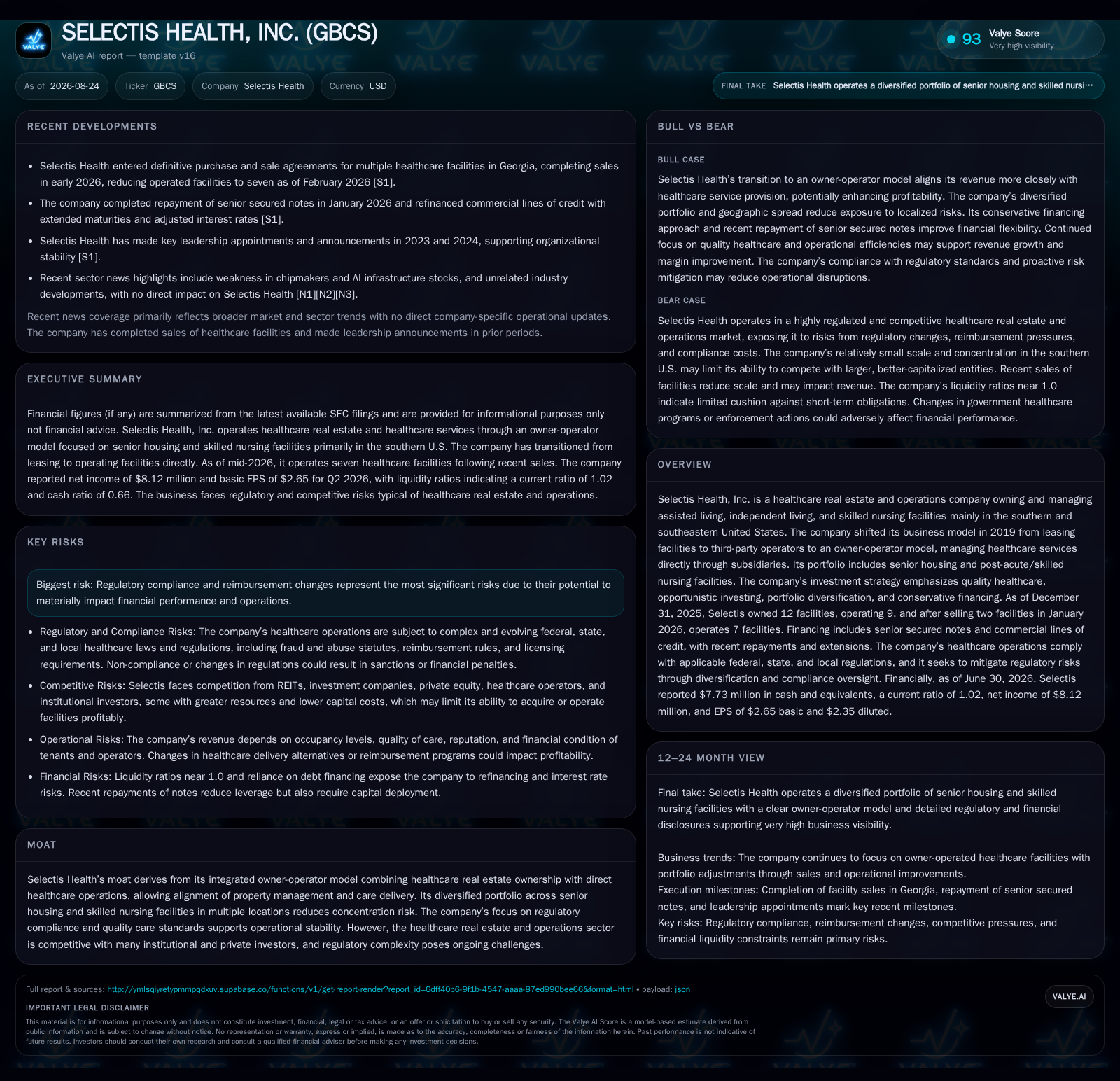
On June 22, 2026, Selectis Health, Inc. entered into a definitive merger agreement with Black Pearl Equities II, signaling a potential change in ownership and strategic direction. The company continues to operate under an owner-operator model with seven healthcare facilities following asset sales earlier in 2026. As of June 30, 2026, Selectis Health reported stable liquidity with cash and equivalents of approximately $7.7 million and a current ratio of 1.02. This merger could materially reshape the company’s capital structure and operational focus, while the owner-operator model aligns property ownership with healthcare delivery but concentrates operational risks.
Selectis Health, Inc. announced on June 22, 2026, that it entered into a definitive merger agreement with Black Pearl Equities II, LLC. This agreement outlines a cash tender offer to acquire all outstanding common stock of Selectis Health, signaling a potentially transformative event that could alter the company’s ownership structure and strategic direction [S3]. The merger agreement includes customary representations, warranties, and covenants, including a non-solicitation clause with exceptions for fiduciary duties, and provisions allowing termination in the event of superior proposals. These terms suggest a high likelihood of transaction completion or competitive bidding, marking a material potential shift in ownership that could enable strategic repositioning or capital restructuring [S3].
Since shifting its business model in 2019, Selectis Health has operated as an owner-operator of healthcare facilities, directly managing care delivery alongside real estate ownership. This integrated approach combines ownership of assisted living, independent living, and skilled nursing facilities with direct healthcare operations through wholly-owned subsidiaries. Following the sale of two facilities in January 2026, the company currently manages seven healthcare facilities [S1]. This model aligns property management incentives with healthcare delivery, potentially improving operational control and revenue integration but also concentrating operational and regulatory risks inherent in healthcare service provision.
The owner-operator business model shapes Selectis Health’s revenue mechanics and operational risks [S1]. Revenue is generated primarily from resident fees and healthcare reimbursements tied to occupancy and care services, integrated with ownership of healthcare real estate. Key margin and cash flow drivers include occupancy rates, regulatory reimbursement levels such as CMS payment models, operational efficiency, and cost management. However, this model exposes the company to risks related to tenant and operator financial health, regulatory compliance, and operational costs, including labor and pandemic-related expenses. The company faces competitive pressures from REITs, investment firms, private equity, and healthcare operators, some of which may have greater resources and lower costs of capital. Additionally, the healthcare industry’s regulatory environment, including payment models like the Patient Driven Payment Model (PDPM), introduces reimbursement uncertainty that can affect revenue stability [S1].
Current assets stood at $11.98 million against current liabilities of $11.75 million, indicating the company’s capacity to meet short-term obligations amid ongoing operations and strategic transactions [F1]. Cash and equivalents of approximately $7.73 million as of June 30, 2026, provide operational liquidity supporting the company’s ability to sustain operations and execute the merger transaction [F1]. This liquidity profile is critical for maintaining operational continuity during the merger process and potential integration phase.
The merger agreement’s execution could enable strategic repositioning or capital restructuring, potentially enhancing the company’s operational and financial flexibility. The agreement’s provisions allowing termination for superior proposals and standard covenants suggest a high likelihood of transaction completion or competitive bidding, marking a material potential shift in ownership [S3]. This transaction could provide Selectis Health with access to additional capital resources or operational synergies, which may be necessary given the concentrated operational risks of the owner-operator model.
Looking ahead, the base case scenario assumes the merger completes as planned, with Selectis Health continuing to operate its owner-operator facilities while possibly benefiting from capital infusion or operational synergies. This scenario depends on no superior proposals emerging, obtaining regulatory approvals, and maintaining stable operational performance [S3][F1]. Confirmation of this scenario would be supported by subsequent SEC filings confirming merger completion and operational updates showing stable or improved occupancy and cash flow. Conversely, if the merger is terminated due to superior bids or regulatory challenges, the company would face navigating operational and financial pressures independently amid competitive and regulatory complexities [S3][S1]. This bear scenario would be confirmed by SEC filings announcing termination or negative operational or financial disclosures.
The owner-operator model provides Selectis Health with a competitive alignment of real estate ownership and healthcare operations, which may enhance operational control but also concentrates operational risk [S1]. Direct management of healthcare services integrates revenue and cost drivers but exposes the company to operational and regulatory risks inherent in healthcare delivery. These risks include potential decreases in occupancy due to mortality rates or pandemic-related restrictions, increased operational costs from health and safety measures, and the financial condition of tenants and operators. The company’s exposure to tenant bankruptcy or insolvency could adversely affect revenue and cash flow, as bankruptcy laws may limit rent collection or delay payments. Additionally, increased labor costs and regulatory compliance expenses could pressure margins.
From a business economics perspective, Selectis Health’s integrated model attempts to mitigate the misalignment often seen in triple-net lease arrangements by combining property ownership with direct healthcare operations. This integration can improve responsiveness to operational challenges and align incentives across real estate and care delivery functions. However, it also concentrates risk, as operational difficulties directly impact both healthcare service revenue and real estate income. The company’s competitive positioning depends on maintaining high occupancy rates, efficient operations, and favorable reimbursement levels, all within a complex regulatory environment.
Monitoring quarterly occupancy rates, reimbursement policy changes, and regulatory developments will be critical to assess ongoing operational performance and financial health. Additionally, the outcome of the merger agreement—whether it completes or is terminated—will materially influence Selectis Health’s strategic trajectory and risk profile.
In summary, Selectis Health’s merger agreement with Black Pearl Equities II represents a significant development that could reshape the company’s ownership and strategic trajectory. The ongoing owner-operator model integrates real estate ownership with healthcare delivery, offering operational control advantages but also concentrating risks. The company’s liquidity position as of June 30, 2026, with cash and equivalents of $7.73 million, supports its operational continuity and strategic flexibility during this transition period [F1]. The merger’s completion or termination will be pivotal in determining the company’s future operational and financial path, with the integrated business model and industry dynamics continuing to shape its competitive and economic environment [S1][S3][F1].

Comments