
Hyperion DeFi Q2 2026: Strengthened Liquidity and Expanded Blockchain Staking Operations
Hyperion DeFi's Q2 2026 results highlight growth in liquid staking assets and validator partnerships, supported by solid liquidity.
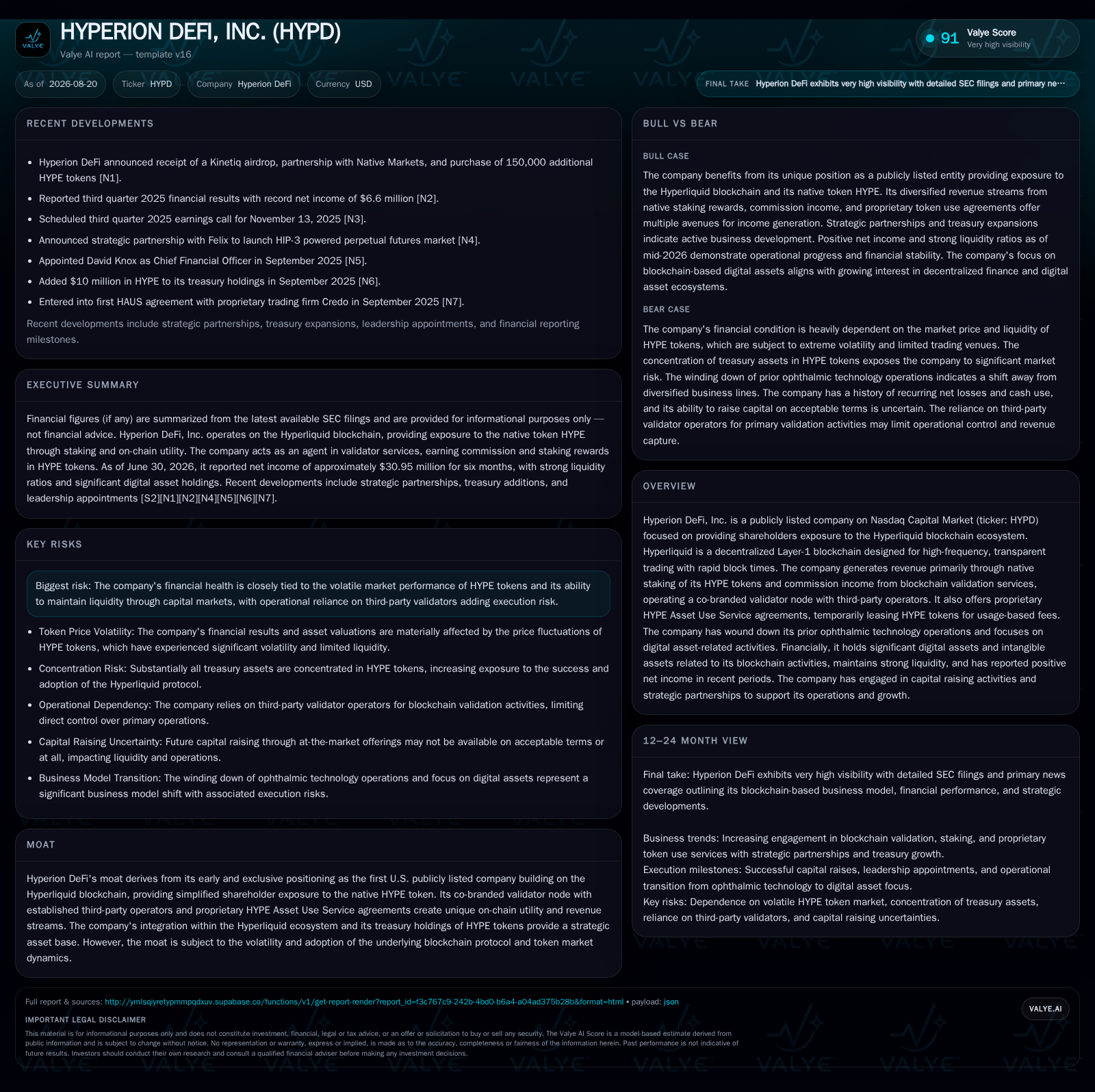
In Q2 2026, Hyperion DeFi expanded its blockchain staking operations by deploying 10 million HPL tokens into liquid staking pools, increasing its intangible digital assets and potential revenue streams. The company continues to operate a co-branded validator node with third-party partners, recognizing revenue on a net basis as an agent under ASC 606. Its balance sheet shows a current ratio of 2.34 and cash and equivalents of approximately $9.6 million, supporting operational stability and growth potential. These developments underpin evolving revenue prospects while exposing the company to token price volatility and blockchain adoption risks.
Q2 2026 Operating Update and Token Staking Activities
Hyperion DeFi, Inc. significantly expanded its blockchain staking operations in Q2 2026 by deploying 10 million HPL tokens received from HyperLend in March 2026 into liquid staking pools. By June 30, 2026, all these tokens were deposited in exchange for sHPL liquid staking tokens (LSTs), which represent staked positions within the blockchain ecosystem [S2]. This deployment materially increased the company's digital asset holdings, recorded on the balance sheet as intangible digital assets with indefinite lives. These assets, including the LSTs and Hyperion Rysk Vault Shares, are not amortized but are subject to periodic impairment testing, reflecting their fair value based on the underlying digital assets in staking pools or smart contracts [S2].
The liquid staking tokens generate ongoing blockchain rewards, which may contribute to commission income for Hyperion DeFi. The company recognizes any realized gains or losses on these tokens in accordance with ASC 610-20, operating income or expense, linking asset valuation closely to blockchain activity and token market conditions [S2]. This operational update reflects recent activity in liquid staking mechanisms, which could enhance on-chain utility and potential income streams.
Validator Operations and Revenue Model
Hyperion DeFi continues to operate a co-branded validator node known as "Kinetiq x Hyperion" in partnership with Kinetiq Research and Pier Two, institutional staking service providers. This arrangement, established in October 2025, involves sharing staking commissions and validator-level rewards among the parties, with Hyperion receiving 50% of the commissions, while Kinetiq Group and Pier Two each receive 25% [S1]. The validator node secures the Hyperliquid blockchain by processing transactions and maintaining consensus, a core function generating commission income.
The company’s performance obligation is limited to delegating and arranging validation, and revenue reflects the portion of blockchain rewards retained after paying third-party validator operators and token delegators [S2]. This revenue recognition approach indicates limited operational risk exposure since the company does not bear full principal risk but also limits revenue scale to commissions retained.
Balance Sheet and Liquidity Position
As of June 30, 2026, Hyperion DeFi reported a current ratio of 2.34, with current assets totaling approximately $12.9 million against current liabilities of about $5.5 million [F1]. These liquidity metrics provide a snapshot of the company's short-term financial position as of that date, without implying sufficiency for ongoing operations or growth initiatives in a volatile digital asset environment [F1].
This liquidity buffer is important given the cyclical and volatile nature of blockchain staking revenues, which depend on token price fluctuations and network activity. Adequate working capital helps the company manage operational costs, staking reward distributions, and potential capital allocation for expanding staking pools or validator infrastructure.
Business Model and Competitive Positioning
Hyperion DeFi’s business model centers on providing staking and validation services that secure the Hyperliquid blockchain. Customers include blockchain ecosystem participants who delegate tokens to validators and counterparties who lease HYPE tokens under proprietary Asset Use Service agreements [S1][S2]. The company generates revenue primarily from staking commissions retained after paying third-party validators and token delegators, as well as fees from leasing HYPE tokens.
The deployment of liquid staking tokens like sHPL enhances the company’s revenue base by generating ongoing blockchain rewards that contribute to commission income and increase intangible asset holdings [S1]. The co-branded validator partnership with Kinetiq Research and Pier Two creates a differentiated revenue stream supported by exclusive agreements and institutional infrastructure.
Margins and cash conversion depend on the share of blockchain rewards retained and the utilization rate of leased tokens, while the company’s early public listing on the Hyperliquid blockchain and proprietary token leasing agreements provide competitive positioning. However, these advantages are subject to blockchain adoption rates and token market volatility, which can impact revenue stability.
Risks and Scenario Analysis
Hyperion DeFi’s financial and operational prospects are influenced by several key risks. Token price volatility can affect the valuation of digital intangible assets and the magnitude of staking rewards, potentially leading to impairments or revenue fluctuations [S2]. The company’s reliance on third-party validator operators introduces operational dependencies that could disrupt commission income if partnerships weaken or infrastructure issues arise.
A bull scenario envisions successful scaling of liquid staking token holdings and validator partnerships, resulting in higher commission income, asset appreciation, and margin expansion [S1][S2]. Confirmation would come from quarterly increases in staking rewards, positive impairment testing outcomes, and growth in token leasing fees.
Conversely, a bear scenario involves sustained declines in HYPE or HPL token prices, reduced blockchain activity, or operational challenges with validators. Monitoring quarterly staking reward volumes, impairment results, validator partnership status, and liquidity trends will be critical to assessing these risks.
Conclusion
Hyperion DeFi’s Q2 2026 results include the deployment of 10 million HPL tokens into liquid staking pools and continued operation of a co-branded validator node with third-party partners [S2]. The company reported a current ratio of 2.34 and cash and equivalents of approximately $9.6 million as of June 30, 2026 [F1], indicating available liquidity at that point in time.
The company’s agent-based revenue recognition model limits operational risk but constrains revenue scale to commissions retained after third-party payouts. Future performance will depend on blockchain adoption, token price stability, and the maintenance of validator partnerships. Investors should watch for quarterly staking reward disclosures, impairment testing outcomes, and liquidity trends to evaluate Hyperion DeFi’s evolving revenue prospects and operational sustainability.
Disclaimer: This is research-only, informational analysis and not investment advice. It may include AI-generated interpretation and general industry context. Always verify important details using primary sources.

Comments