
Rockwell Medical Q2 2026: Hemodialysis Concentrates Revenue Decline and Liquidity Position
Rockwell Medical’s Q2 2026 results show a decline in hemodialysis concentrates revenue amid competitive pressures, while maintaining a moderate liquidity cushion.
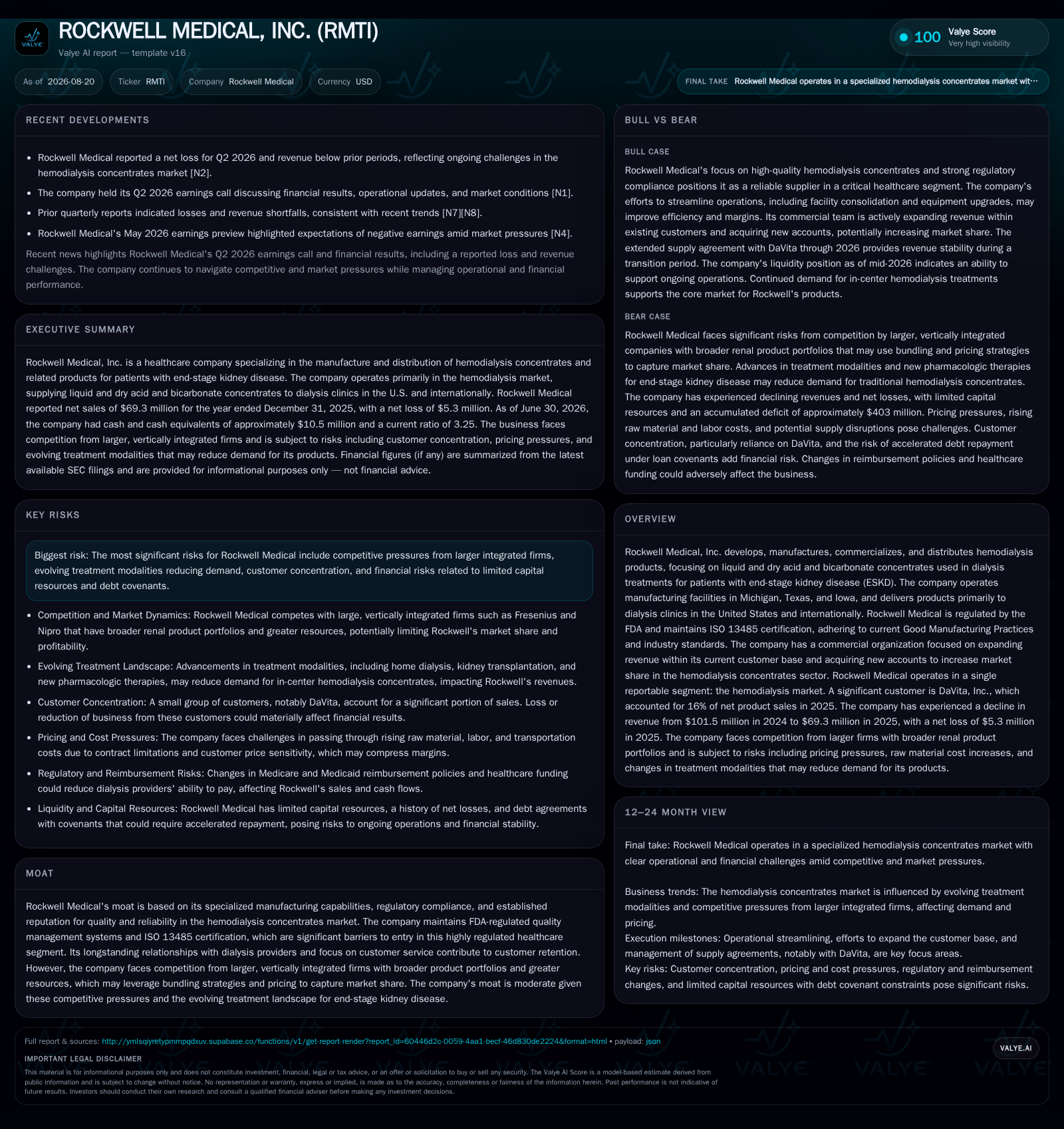
Rockwell Medical reported a revenue decline in its hemodialysis concentrates segment for Q2 2026 compared to the prior year, reflecting ongoing competitive challenges and customer dynamics. The company’s balance sheet as of June 30, 2026, shows a current ratio of 3.25 and a net cash position of approximately $1.5 million, indicating moderate liquidity to support near-term operations. Risk factors remain consistent with prior disclosures, highlighting structural market pressures and capital constraints. Investors will watch subsequent revenue trends and covenant compliance to assess the company’s ability to stabilize growth and sustain operations.
Q2 2026 Operating Performance and Revenue Trends
Rockwell Medical, Inc. reported a decline in revenue from its hemodialysis concentrates segment in the second quarter of 2026 compared to the same period in 2025 [S2]. This segment constitutes the company’s sole reportable business and includes the manufacture and sale of liquid and dry acid and bicarbonate concentrates used in hemodialysis treatments for patients with end-stage kidney disease (ESKD) [S1]. The revenue decline reflects ongoing competitive pressures from larger, vertically integrated firms with broader renal product portfolios, such as Fresenius and Nipro, which leverage product bundling and pricing strategies to capture market share [S1]. Additionally, shifts in customer dynamics, including changes in contract renewals and concentration risk, contribute to the revenue challenges. For example, Rockwell Medical’s largest customer, DaVita, accounted for approximately 16% of total net product sales in 2025, a decline from 45% in 2024, illustrating evolving customer relationships [S1].
The absence of new product launches or market expansion in the latest quarter aligns with the reported decline in revenue due to competitive pressures and customer dynamics in the concentrates market [S2]. This trend highlights challenges to the company’s ability to achieve sustained profitability and maintain capital adequacy beyond the near term.
Liquidity, Debt, and Capital Resources
As of June 30, 2026, Rockwell Medical held $10.5 million in cash and cash equivalents against total debt of approximately $9.0 million, resulting in a net cash position of about $1.5 million [F1]. The company’s current assets totaled $36.36 million, while current liabilities were $11.17 million, yielding a current ratio of 3.25 [F1]. This current ratio indicates that the company’s current assets exceed current liabilities by over three times, providing a moderate liquidity cushion to support near-term operations [F1].
The company’s revenue is generated primarily through product sales governed by contract pricing and volume agreements with dialysis providers, including large customers such as DaVita [S1]. Margins depend on manufacturing efficiency, input costs, pricing power, and scale, while cash conversion is influenced by working capital management and customer payment terms. However, no fresh quarterly margin data was disclosed in the Q2 2026 filing, though the 2025 annual gross profit margin declined compared to 2024, reflecting cost pressures [S1].
Rockwell Medical’s balance sheet shows a net cash positive position, but the company has a history of operating losses and capital constraints, which may limit its ability to invest in growth or weather prolonged revenue declines [S1]. The company remains compliant with debt covenants under the A&R Loan Agreement with Innovatus Life Sciences Lending Fund I, LP, which governs its $9.0 million debt balance [S2]. The company sells these products primarily to dialysis providers and clinics, with revenue generated through negotiated contracts that reflect pricing and volume commitments. The largest customer concentration risk is evident in the decline of DaVita’s share of net product sales from 45% in 2024 to 16% in 2025, underscoring the volatility in customer relationships and contract renewals [S1].
Competitive advantages for Rockwell Medical include specialized manufacturing capabilities compliant with FDA regulations, ISO 13485 certification, and adherence to current Good Manufacturing Practices (cGMP) [S1]. These certifications support product quality and regulatory compliance, which are essential in the highly regulated dialysis supply market.
However, the company faces significant competitive constraints. Its primary competitors, Fresenius and Nipro, are large, diversified healthcare companies with substantially greater financial, technical, manufacturing, marketing, and management resources [S1]. Fresenius, in particular, is vertically integrated and the largest dialysis services provider in the U.S., treating approximately 37% of all in-center hemodialysis patients, which provides it with pricing leverage and bundling advantages [S1]. These competitors use product bundling and aggressive pricing strategies to capture market share in the concentrates segment, placing pricing pressure on Rockwell Medical, which lacks a broader renal product portfolio to leverage in negotiations [S1].
The hemodialysis concentrates market is structurally challenged by these competitive dynamics and evolving treatment modalities that may reduce demand for concentrates over time, such as newer medications and alternative therapies [S1]. The company continues to face risks from competition by larger firms with broader product portfolios and vertical integration, which can undercut pricing and capture market share through bundling strategies [S1].
Regulatory compliance remains a significant risk given the FDA-regulated manufacturing environment. Failure to maintain certifications or comply with current Good Manufacturing Practices could materially and adversely affect the company’s business, financial position, and cash flows.
Capital resource constraints are another ongoing risk. The company’s existing capital resources may not be adequate to finance operating cash requirements in the future, and additional capital may be necessary to operate or expand the business [S1]. The A&R Loan Agreement with Innovatus contains covenants that could adversely affect operations if breached, including the risk of accelerated debt repayment [S1].
This scenario assumes no significant loss of major customers beyond current trends, stable input costs, and continued access to capital markets or internal cash generation. Confirmation would come from stable or improving revenue trends in subsequent quarters and absence of material adverse regulatory or legal events. This scenario is plausible given the structural market challenges and limited capital resources.
These factors will be critical in assessing the company’s ability to navigate ongoing structural headwinds and maintain financial stability beyond the near term.
Disclaimer: This is research-only, informational analysis and not investment advice. It may include AI-generated interpretation and general industry context. Always verify important details using primary sources.

Comments