
FitLife Brands Q2 2026: Profit Growth and Liquidity Position
FitLife Brands reported improved profitability and maintained a solid liquidity buffer in Q2 2026, which may contribute to operational stability amid market volatility.
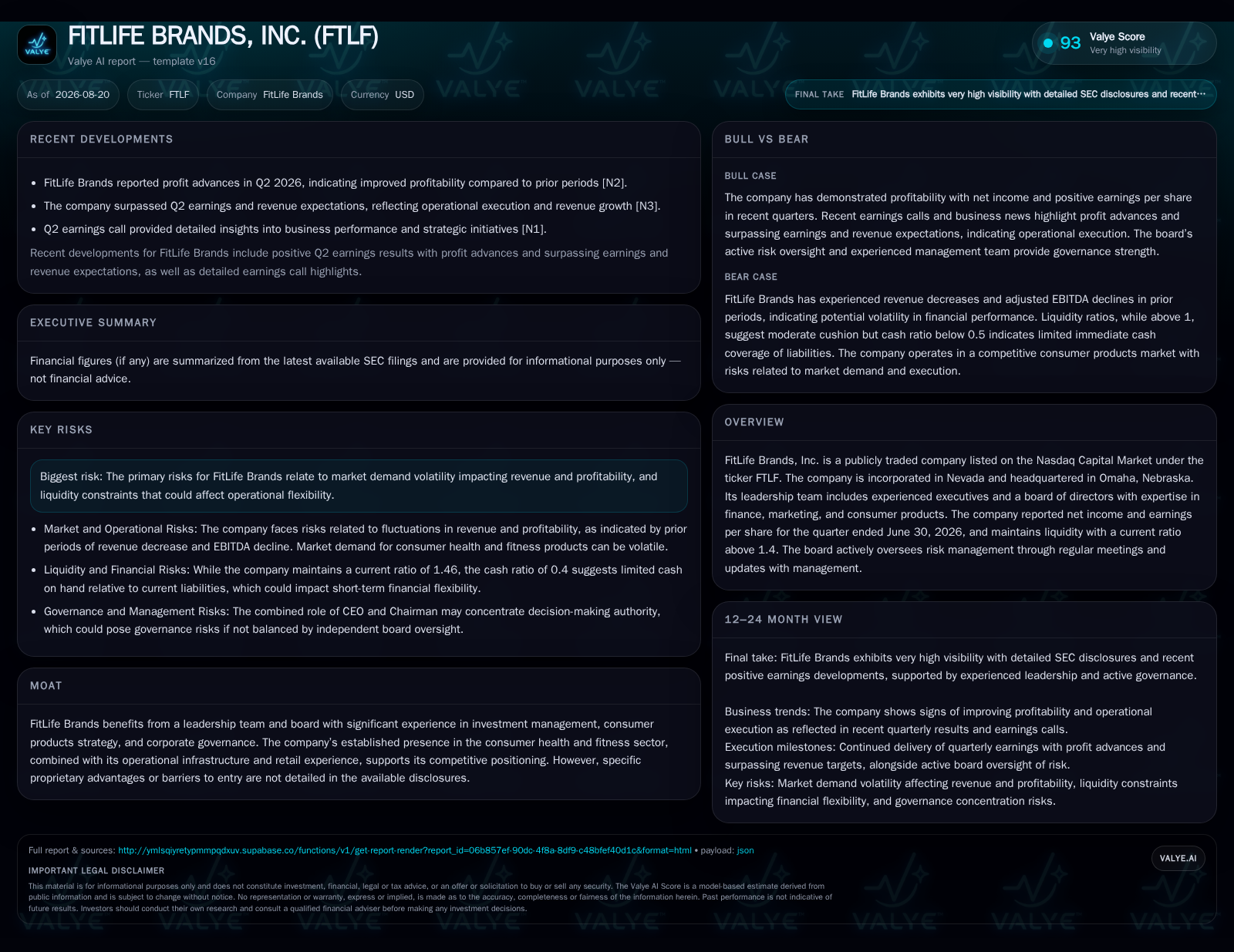
FitLife Brands, Inc. posted net income and earnings per share for the quarter ended June 30, 2026, reflecting an improvement in profitability compared to prior periods. The company sustained a current ratio of 1.46, indicating a liquidity position sufficient to cover short-term obligations and support operational flexibility. Governance stability was reinforced by the election of all director nominees and auditor ratification at the 2026 Annual Meeting. No material changes to risk factors were reported, maintaining the focus on market demand volatility and liquidity risks. These developments collectively suggest FitLife Brands is managing its financial and operational risks effectively in a cyclical consumer health and fitness market.
Q2 2026 Financial Performance and Profitability
FitLife Brands, Inc. reported net income and earnings per share for the quarter ended June 30, 2026, marking an improvement in operational profitability compared to prior periods [S2][S3]. The presence of positive net income and EPS indicates that the company has moved beyond loss-making quarters, reflecting progress in managing costs and generating sufficient revenue from its health and fitness-related consumer products. In this sector, profitability is a critical metric as it directly impacts valuation and the company’s ability to sustain operations and invest in growth initiatives.
Profitability improvement can be influenced by factors such as product mix, pricing strategy, and operational efficiency. While the filings do not detail margins explicitly, the positive net income suggests that FitLife Brands is effectively managing its cost of goods sold and operating expenses. Continued profitability is essential for the company to withstand the cyclical demand fluctuations typical of the consumer health and fitness industry.
The reported net income and earnings per share in Q2 2026 indicate that FitLife Brands has achieved operational profitability improvement compared to prior periods because the presence of net income and EPS in the latest quarterly filings demonstrates positive earnings generation, which is a key indicator of operational progress [S2][S3]. This improvement is significant as it signals the company’s ability to generate returns on its product portfolio and operational investments, which is crucial for long-term sustainability in a competitive market.
Liquidity and Balance Sheet Position
As of June 30, 2026, FitLife Brands maintained a current ratio of 1.46, supported by current assets of $30.55 million and current liabilities of $20.91 million [F1]. This liquidity buffer is important given the company’s exposure to market demand volatility, which can affect cash flow and working capital needs. Maintaining positive working capital allows FitLife Brands to manage inventory, meet supplier obligations, and invest in marketing or product development without undue financial strain.
The current ratio of 1.46 as of June 30, 2026, suggests that FitLife Brands maintains a liquidity buffer sufficient to cover short-term liabilities, supporting operational flexibility because current assets exceed current liabilities by a meaningful margin, and a ratio above 1.4 is generally considered adequate liquidity in the sector [F1][S2]. This level of liquidity is a positive indicator of the company’s financial health, reducing the risk of cash flow shortages that could disrupt operations or necessitate costly financing.
The balance sheet position reflects a stable working capital situation, which is critical for a company operating in a sector characterized by cyclical demand and potential volatility. The ability to maintain liquidity above 1.4 indicates prudent financial management and a capacity to absorb short-term shocks without compromising operational continuity.
Governance and Risk Profile
FitLife Brands held its 2026 Annual Meeting of Stockholders on August 11, 2026, where all director nominees were elected, and the appointment of auditors was ratified [S3]. This governance continuity supports strategic oversight and risk management, which are vital for navigating the competitive and cyclical consumer health and fitness market.
In the Q2 2026 10-Q filing, management reported no material changes to the risk factors compared to the 2025 10-K [S2]. The absence of new or heightened risk factors suggests that the company’s risk profile remains stable, allowing investors and stakeholders to assess future prospects with a degree of confidence based on known challenges.
Governance stability, as evidenced by the election of directors and auditor ratification, provides a foundation for consistent strategic direction and oversight. This is particularly important in a sector where market conditions can shift rapidly, requiring agile yet well-governed responses.
Business Model and Competitive Positioning
FitLife Brands operates by marketing and distributing health and fitness-related consumer products to retail customers and direct consumers [S1][S2][S3]. Revenue is generated primarily through product sales, with profitability influenced by pricing, cost management, and operational efficiency. The company’s experienced leadership and board expertise in finance, marketing, and consumer products contribute to its competitive positioning, although no specific proprietary advantages are disclosed.
The business model depends on consumers purchasing health and fitness-related products, with revenue mechanics centered on sales volume and pricing strategies. Margins and cash conversion are influenced by operational efficiency and cost controls. While the company benefits from an established operational infrastructure and experienced management, the filings do not indicate a proprietary moat, suggesting that competitive pressures remain a factor.
In this industry, companies face cyclical demand driven by health trends, seasonality, and consumer discretionary spending. Effective liquidity management and profitability are important to navigate these fluctuations. FitLife Brands’ current financial results indicate it is maintaining these operational metrics, which could support its ability to compete within its market segment.
Outlook and Watchpoints
The base scenario for FitLife Brands is continued maintenance of profitability and liquidity at current levels, enabling the company to manage market demand volatility without material disruption [S2][F1]. Confirmation of this scenario would come from consistent quarterly profitability and stable or improving liquidity ratios in future filings.
Conversely, a bear case would involve intensified market demand volatility leading to revenue declines and pressure on liquidity, potentially constraining operational flexibility. This scenario is plausible due to the company’s acknowledgment of market demand volatility and liquidity constraints as primary risks [S2]. Conditions that could trigger this include a significant downturn in consumer spending or unexpected increases in short-term liabilities.
Investors and analysts should watch subsequent quarterly earnings releases for revenue and net income trends, liquidity ratio developments, and any updates to risk factors in upcoming filings. Operational KPIs such as product sales volume or customer adoption, if disclosed, would also provide valuable insight into the company’s trajectory.
Overall, FitLife Brands’ Q2 2026 results demonstrate incremental financial progress and operational stability, which may be relevant in the context of the cyclical and competitive consumer health and fitness sector. The company’s ability to sustain profitability and maintain a liquidity position could support operational resilience and potentially reduce risk concerns amid market demand volatility.
Disclaimer: This is research-only, informational analysis and not investment advice. It may include AI-generated interpretation and general industry context. Always verify important details using primary sources.

Comments