
Duos Technologies Q2 2026: Edge Data Center Expansion and New Hosting Contracts
Duos Technologies advances its modular Edge Data Center platform with new five-year hosting contracts and a strong liquidity position as of mid-2026.
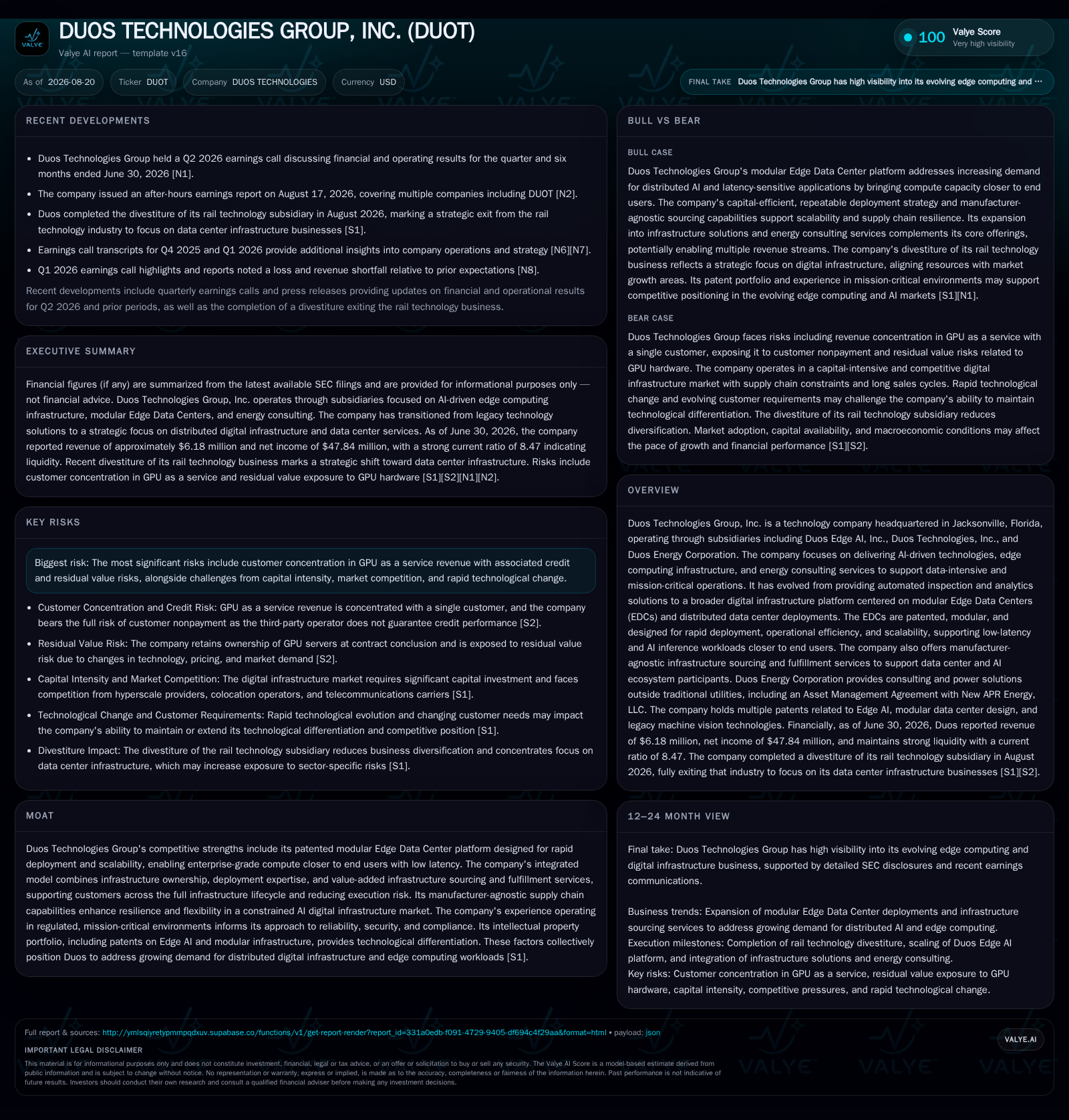
In Q2 2026, Duos Technologies Group executed five-year hosting service orders with Axe Compute Inc., marking a significant commercial milestone for its patented modular Edge Data Center platform. The company reported a current ratio of 8.47 as of June 30, 2026, reflecting ample liquidity to support capital-intensive infrastructure deployments. This progress aligns with Duos' strategic shift toward AI-driven edge computing and digital infrastructure services, although risks remain from customer concentration in GPU as a service revenue and residual value exposure on GPU servers.
Q2 2026 Operating Update and Contract Wins
Duos Technologies Group, Inc. reported a significant operational development in Q2 2026 with the execution of five-year hosting service orders from Axe Compute Inc. for its patented modular Edge Data Center platform [S12][S8]. These contracts represent a critical commercial validation of Duos’ core strategy to scale distributed digital infrastructure through modular, rapidly deployable edge data centers. The multi-year duration of these hosting agreements provides the company with recurring revenue visibility and supports the scalability of its platform, which is essential for justifying ongoing capital investments and operational expansion.
This development signals growing market acceptance of Duos’ modular edge data center solutions, which are designed to support low-latency compute workloads such as AI inference and real-time analytics. By securing long-term hosting contracts, Duos can better leverage its patented modular design and manufacturer-agnostic sourcing capabilities to meet increasing demand for distributed compute infrastructure. These contracts also underpin the company’s transition from legacy machine vision and analytics solutions toward AI-driven edge computing and infrastructure services [S1].
Liquidity and Financial Position
As of June 30, 2026, Duos Technologies reported current assets totaling $129.7 million and current liabilities of $15.3 million, resulting in a current ratio of 8.47 [F1]
The capital demands of deploying and operating distributed edge data centers are significant, involving costs related to site leasing, power supply agreements, hardware procurement, and supply chain coordination. Duos’ strong working capital position supports these growth initiatives and helps mitigate operational risks associated with lease renewals, power availability, and supply chain disruptions, which are material factors in the edge data center sector [S1].
Strategic Shift to Edge Data Centers and AI Infrastructure
Duos is actively shifting its business model from legacy machine vision and analytics toward AI-driven edge computing infrastructure and digital infrastructure services [S1]. This strategic pivot aligns the company with structural growth trends in the digital infrastructure sector, driven by rising demand for low-latency AI workloads and distributed compute capacity closer to end users.
The company’s business model involves generating revenue through contracts for hosting modular edge data centers, deployment and operation of digital infrastructure, and value-added supply chain services [S2]. Notably, Duos retains ownership of GPU servers used in its GPU as a service offerings, which exposes it to residual value risk due to rapid technology obsolescence and market pricing fluctuations.
Duos’ patented modular edge data center platform enables rapid deployment and operational scalability, while its manufacturer-agnostic sourcing and logistics services enhance supply chain resilience and flexibility. These capabilities are critical in a market where supply chain constraints and hardware lead times can delay infrastructure rollouts.
Risk Factors and Customer Concentration
A material risk for Duos lies in customer concentration within its GPU as a service revenue stream. The company’s GPU as a service revenue is concentrated with a single customer, exposing Duos to credit risk if the customer defaults or terminates the contract prematurely [S2]. Furthermore, Duos bears residual value risk on GPU servers retained at contract end, which could impact profitability and cash flow if asset values decline due to technological advances or market shifts.
Additional risks include geographic concentration of the company’s edge data center portfolio, primarily in Texas, and dependency on third-party utilities for power and network connectivity [S1]. Lease renewals and securing adequate power supply on favorable terms remain ongoing operational challenges that could affect deployment timelines and cost structures.
Business Economics and Implications
The five-year hosting contracts with Axe Compute Inc. materially advance Duos’ transition to a scalable edge data center platform by providing stable, recurring revenue streams and validating customer demand for its modular infrastructure [S12][S8]. This recurring revenue model supports operational scalability and capital allocation toward further deployments.
Strong liquidity as of June 30, 2026, with a current ratio of 8.47, equips Duos to manage the capital intensity of edge data center rollouts and absorb operational uncertainties related to leasing and supply chain coordination [F1]. Maintaining this liquidity buffer is crucial given the inherent risks of residual asset value fluctuations and customer concentration.
This milestone enhances revenue visibility and aligns with the company’s strategic shift toward distributed digital infrastructure. Coupled with reported liquidity metrics, Duos may have financial capacity to pursue capital-intensive deployments and manage operational risks, depending on future cash flows and capital requirements.
However, customer concentration in GPU as a service revenue and residual value exposure on GPU servers represent material risks that could affect profitability and cash flow. Ongoing execution in contract expansion, customer diversification, and operational scalability will be critical to validating the company’s strategic transition and realizing its growth potential.
Disclaimer: This is research-only, informational analysis and not investment advice. It may include AI-generated interpretation and general industry context. Always verify important details using primary sources.

Comments