
Flexsteel Industries Q4 2026: Inflation Pressures and Uneven Demand Impact Margins
Flexsteel's Q4 2026 results show margin compression amid inflation and tariff challenges despite stable revenue, highlighting structural risks in its blended manufacturing model.
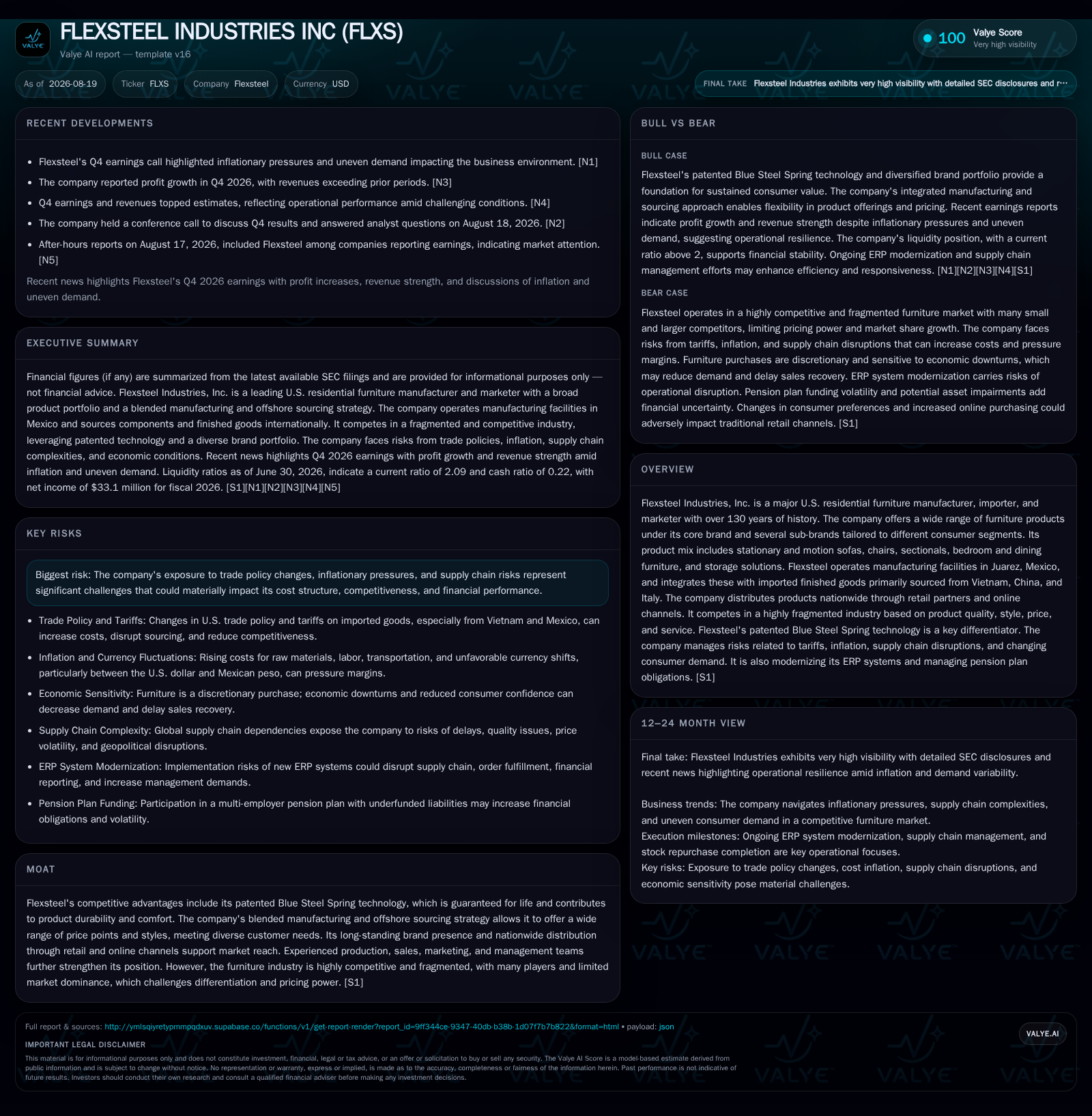
Flexsteel Industries reported fourth quarter and fiscal year-end 2026 operating results that reveal margin pressures driven by inflationary cost increases and uneven consumer demand. The company’s blended manufacturing in Mexico combined with offshore sourcing supports a broad product mix and pricing flexibility, while its patented Blue Steel Spring technology remains a key differentiator. However, tariff risks and supply chain disruptions present ongoing structural challenges to profitability. Flexsteel’s liquidity position remains solid with a current ratio of 2.09 as of June 30, 2026, providing operational stability amid cost pressures.
Latest Quarterly Operating Results and Margin Dynamics
Flexsteel Industries Inc reported its fourth quarter and fiscal year ended June 30, 2026, operating results on August 17, 2026, highlighting margin pressures primarily driven by inflationary cost increases and uneven consumer demand patterns [S3]. While revenue trends remained relatively stable, the company faced margin compression as input costs rose faster than pricing adjustments could fully compensate [S3]. This dynamic reflects broader industry challenges where inflationary pressures on raw materials, labor, and transportation costs have intensified, and price elasticity in discretionary furniture spending limits the pace at which cost increases can be passed to consumers.
Business Model and Competitive Positioning
Flexsteel operates a blended manufacturing and sourcing model, combining production facilities in Juarez, Mexico, with imported finished goods sourced primarily from Vietnam, China, and Italy [S1]. This approach allows the company to offer a wide assortment of residential furniture products, including stationary and motion sofas, loveseats, chairs, sectionals, bedroom furniture, dining sets, and occasional tables. The integrated manufacturing operation enables smaller, more frequent product runs and a broad product selection, while offshore sourcing supplements the product range with ready-to-deliver items.
A key competitive advantage lies in Flexsteel's patented Blue Steel Spring technology, which is guaranteed for life and contributes to product durability and consumer value [S1]. This technology supports brand differentiation in a highly fragmented furniture market characterized by many competitors and limited pricing power. The company distributes its products nationwide through retail partners and online channels, targeting various consumer segments with multiple sub-brands tailored to specific needs.
Risk Factors and Structural Challenges
Flexsteel’s 2026 annual 10-K filing details significant risks related to tariffs, inflation, and supply chain disruptions that materially affect its cost structure and competitive positioning [S1][S4][S6]. The company sources finished products offshore and manufactures in Mexico, exposing it to U.S. trade policy changes including tariffs and trade restrictions that can increase cost of goods sold and disrupt sourcing strategies. Recent tariff increases and the potential for further trade policy shifts contribute to cost volatility and uncertainty.
While Flexsteel attempts to mitigate these risks through pricing actions, supplier negotiations, and sourcing adjustments, the ability to fully offset increased costs is limited. Tariffs and trade restrictions also contribute to inflationary pressures and economic uncertainty, which can reduce consumer confidence and discretionary spending on furniture, further constraining demand. Claims related to tariff refunds received add another layer of financial risk, as potential reimbursement obligations to retail partners or suppliers could reduce the net benefit of such refunds.
Inflation impacts extend beyond tariffs to include rising ocean container rates, raw materials prices, labor costs, and domestic transportation expenses. Currency fluctuations, particularly the U.S. dollar against the Mexican peso and other foreign currencies, add complexity to cost management. The company’s manufacturing costs in Mexico are sensitive to peso movements, which can increase expenses and affect earnings. Overall, these structural headwinds exert downward pressure on margins, as cost increases often precede price recovery in the market.
Financial Position and Liquidity
As of June 30, 2026, Flexsteel reported cash and cash equivalents of $16.7 million, current assets of $158.4 million, and current liabilities of $75.7 million, resulting in a current ratio of 2.09 [F1]. This liquidity position indicates adequate working capital to support operational needs amid inflationary cost pressures and supply chain challenges [F1].
Although the company’s free cash flow could be constrained by ongoing inflation and supply chain costs, the balance sheet remains stable with current assets exceeding current liabilities by a factor of two, supporting short-term obligations and operational resilience [F1]. There were no disclosed material changes in capital allocation strategies in the latest filings, suggesting that liquidity is currently sufficient to fund ongoing operations and potential investments [S3][F1].
Scenario Analysis and Outlook
One plausible bull case for Flexsteel involves successful management of inflation through efficient sourcing and manufacturing adjustments, coupled with maintaining consumer demand via product differentiation and pricing flexibility [S1][S3]. The patented Blue Steel Spring technology and blended manufacturing/offshore sourcing model offer levers to sustain pricing and product appeal despite cost pressures. Confirmation of this scenario would include improved margin trends, stable or growing order volumes, and positive supply chain commentary in future earnings disclosures.
Conversely, the bear case envisions further tariff increases or worsening supply chain disruptions combined with weakening consumer discretionary spending, leading to sustained margin erosion and volume declines [S1][S3][S6]. Given the company’s exposure to offshore sourcing and the discretionary nature of furniture purchases, escalating cost shocks or demand softness could materially impair profitability. Indicators confirming this downside would be continued margin compression, reduced order backlogs, and negative disclosures regarding tariffs or supply chain issues.
Conclusion and Watchpoints
Flexsteel Industries faces structural challenges from inflation and tariff-related cost pressures that compress margins despite stable revenue. Its blended manufacturing and offshore sourcing strategy, along with patented product technology, provide operational flexibility and differentiation that partially mitigate these risks. The company’s liquidity position supports operational stability but does not eliminate exposure to cost volatility and demand fluctuations.
Investors and observers should closely monitor upcoming quarterly margin trends, tariff and trade policy developments, order backlog and consumer demand indicators, supply chain lead times and cost changes, and the effectiveness of pricing actions. These factors will be critical in assessing Flexsteel’s ability to sustain profitability and competitive positioning in a fragmented and cost-pressured residential furniture market.
Disclaimer: This is research-only, informational analysis and not investment advice. It may include AI-generated interpretation and general industry context. Always verify important details using primary sources.

Comments