
Fervo Energy Q2 2026: Increased Operating Expenses and Strong Liquidity Amid Cape Station Development
Fervo Energy's H1 2026 results show rising operating costs due to workforce growth supporting Cape Station projects, alongside substantial liquidity from recent financing.
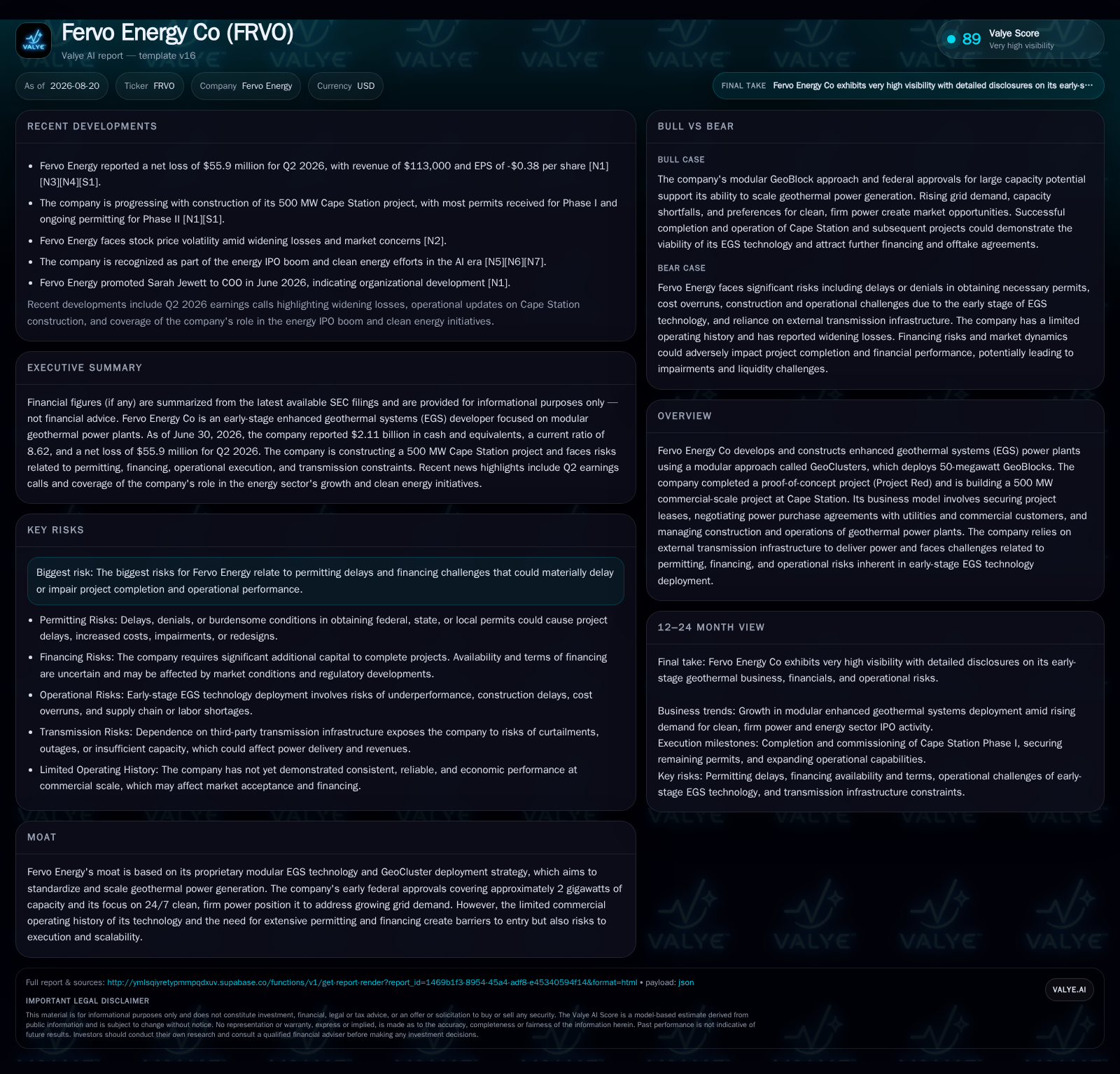
Fervo Energy reported a $15.6 million increase in employee-related expenses in the first half of 2026 compared to the prior year, reflecting workforce expansion to support its Cape Station geothermal project development. Despite higher operating costs, the company maintains a strong liquidity position with $2.1 billion in cash and equivalents and a current ratio of 8.62 as of June 30, 2026. Progress in permitting and project-level financing, including a $421.4 million Project Granite Facility, underpins ongoing development efforts. Key risks remain around permitting completion and financing execution, critical to advancing Cape Station toward commercial operations.
Operating Expense Growth and Workforce Expansion
Fervo Energy’s financial disclosures for the first half of 2026 reveal a significant increase in operating expenses, primarily driven by employee-related costs. Compensation expenses rose by $15.6 million compared to the same period in 2025, reflecting deliberate workforce expansion to support the development, execution, and corporate operations of its Cape Station geothermal projects [S2]. This increase encompasses salaries, payroll taxes, benefits, bonuses, stock-based compensation, and retirement contributions. Such growth in personnel is consistent with the capital-intensive nature of enhanced geothermal system (EGS) project development, which requires skilled labor for wellfield drilling, reservoir stimulation, plant construction, and regulatory compliance.
The rise in operating expenses indicates an operational ramp-up phase, which, while increasing cash burn, is necessary to advance complex geothermal projects [S2]. In the renewable energy power generation sector, scaling workforce capacity is a critical driver of project progress but also impacts near-term liquidity and capital requirements. The company’s increased cash outflows from changes in operating assets and liabilities—$17.8 million used in the current period compared to $23.3 million provided in the prior year—further illustrate the cash consumption associated with scaling activities.
Liquidity and Capital Structure
Despite higher operating costs, Fervo Energy held $2.1 billion in unrestricted cash and cash equivalents and reported a current ratio of 8.62 as of June 30, 2026 [F1]. Total debt was $231 million, resulting in a net cash position exceeding $1.8 billion [F1]. This liquidity level may provide resources for the company’s capital-intensive development activities.
Fervo’s subsidiaries entered into the Project Granite Facility in March 2026, providing $421.4 million in aggregate commitments to finance Cape Station Phase I [S2]. This senior secured credit agreement includes construction loans, tax credit transfer bridge loans, letter of credit facilities, and a term loan to refinance construction loans upon conversion conditions. The project-level nature of this financing reduces corporate credit risk and aligns funding with project milestones.
Permitting and Regulatory Progress
Permitting progress remains a critical factor for Fervo’s project timelines and execution risk. As of Q2 2026, the company has secured 79 of the 80 governmental permits required for Cape Station Phase I, with the remaining permit in process and no expected material delays [S2]. For Cape Station Phase II, 82 of 179 permits have been received, with the remainder in process. These pending permits are primarily administrative geothermal well permits and county-level approvals, and the company currently anticipates no significant delays or conditions that would materially impact project schedules.
In the context of geothermal project development, obtaining all necessary permits is essential to commence commercial operations. Delays or denials could increase capital costs and extend development timelines. Fervo’s progress suggests a favorable regulatory environment thus far, but the complexity and volume of permits for Phase II indicate ongoing regulatory risk.
Project Financing and Development Outlook
The Project Granite Facility’s $421.4 million in commitments is a cornerstone of Fervo’s financing strategy for Cape Station Phase I [S2][S4]. This facility’s structure, which includes construction and bridge loans alongside letters of credit, is designed to support the modular deployment of EGS technology through GeoClusters and GeoBlocks. The financing aligns with the company’s capital expenditure plans, which include wellfield drilling, plant equipment procurement, and reservoir development.
Fervo estimates remaining capital expenditures of approximately $850 million to $900 million for 2026, a majority of which relates to Cape Station facilities [S2]. The company has secured project financing and holds substantial cash reserves, which could support funding these expenditures, though actual liquidity needs will depend on execution and financing conditions.
Risks and Scenario Analysis
Fervo Energy faces inherent risks typical of early-stage enhanced geothermal systems deployment. Key risks include potential delays or denials in obtaining remaining permits, challenges in accessing or drawing down project-level financing, and operational execution risks related to drilling, reservoir stimulation, and plant construction [S2][S4].
One possible scenario is that Fervo successfully completes permitting and financing milestones for Cape Station Phases I and II on schedule, enabling commercial operations to commence as planned. This outcome would be supported by timely receipt of all permits, continued access to financing facilities, and achievement of construction milestones. Confirmation would come from public announcements of permit approvals, financing drawdowns, and operational progress reports.
Conversely, a bear case involves material delays in permitting or financing challenges that increase capital costs and cash burn. This could necessitate additional equity raises or project scope reductions. Evidence supporting this scenario would include public disclosures of permitting setbacks, financing covenant breaches, or construction delays.
Conclusion and Watchpoints
Fervo Energy’s Q2 2026 results reflect scaling of its workforce to support the development of its flagship Cape Station geothermal projects, resulting in increased operating expenses and cash burn [S2]. The company reported over $2 billion in cash and equivalents and has secured project-level financing, which may provide a financial buffer to fund ongoing capital-intensive activities [F1][S2].
Permitting progress for Cape Station Phase I is near completion, while Phase II remains underway with no expected material delays. The Project Granite Facility financing further supports project execution and reduces corporate risk.
Investors and observers should monitor the receipt of remaining permits for Cape Station Phase II, drawdowns under the Project Granite Facility, quarterly updates on operating expenses and cash burn, progress toward commercial operation dates, and any announcements regarding additional financing or equity raises. These factors will be critical in assessing Fervo’s ability to sustain its development trajectory and transition toward revenue-generating operations.
Overall, Fervo Energy’s current operating and financial profile is consistent with a development-stage renewable energy company advancing capital-intensive geothermal projects, with increased operating costs accompanied by substantial liquidity, including over $2 billion in cash and cash equivalents as of June 30, 2026 [F1][S2]
Disclaimer: This is research-only, informational analysis and not investment advice. It may include AI-generated interpretation and general industry context. Always verify important details using primary sources.

Comments