
GridAI Technologies Q2 2026: Early Commercialization Challenges and Liquidity Pressure
GridAI reported a $10.1 million goodwill impairment in Q2 2026 amid commercialization delays and faces significant liquidity constraints as it pivots to AI data center energy orchestration.
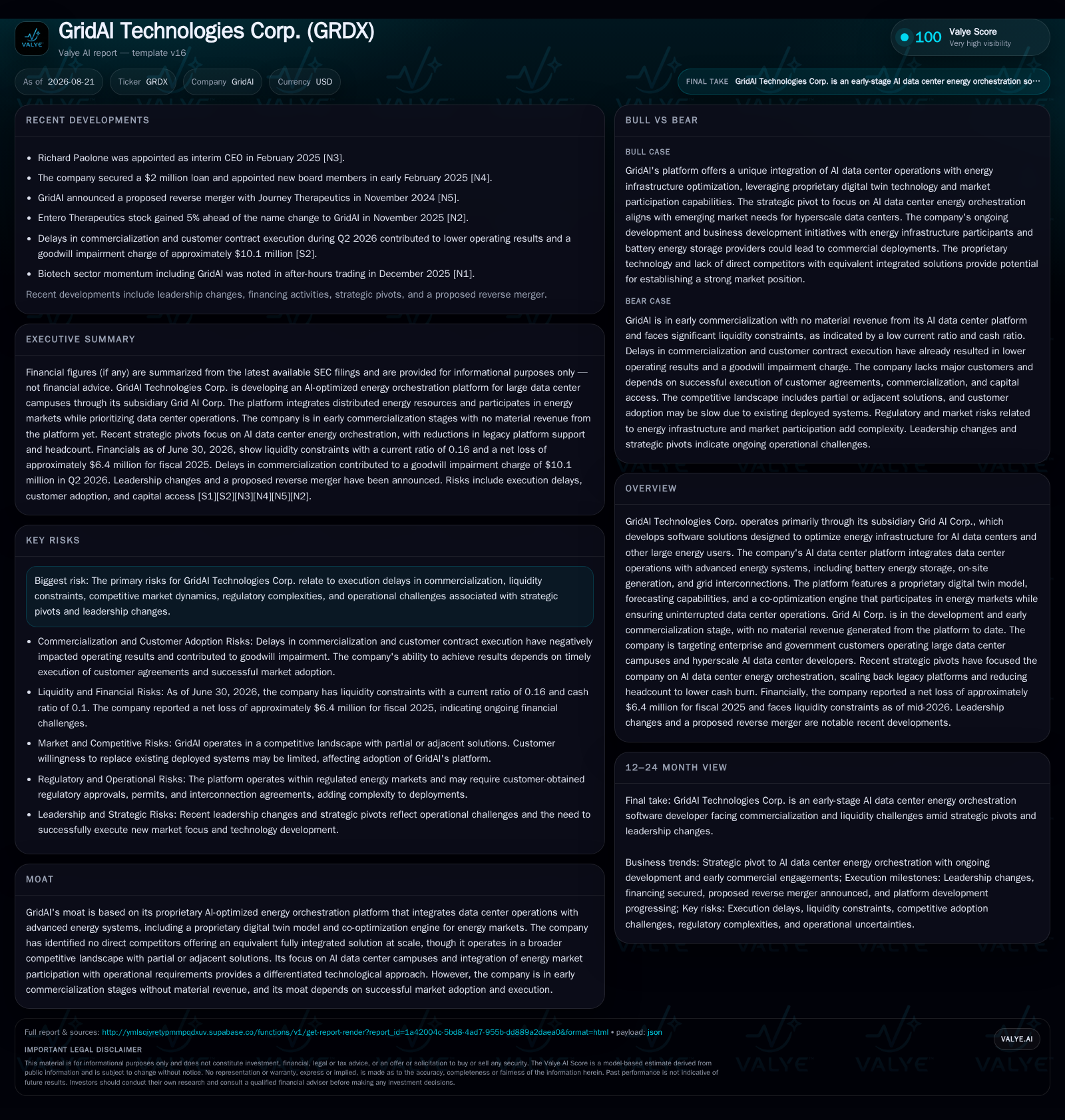
GridAI Technologies Corp. is navigating early commercialization hurdles for its AI-optimized energy orchestration platform targeting hyperscale data centers. The company recorded a $10.1 million goodwill impairment in Q2 2026 due to delays in customer contract execution, reflecting execution risk in its strategic pivot initiated in 2025. Liquidity remains strained with a current ratio of 0.16 and cash of $1.38 million against $14.15 million in current liabilities as of June 30, 2026. A recent $2 million loan to a third party further highlights capital allocation challenges. The company’s future hinges on successful commercialization and securing additional capital.
Q2 2026 Operating Update and Goodwill Impairment
GridAI Technologies Corp. reported significant operational challenges during the second quarter of 2026, marked by delays in commercialization and customer contract execution. These setbacks led to lower-than-projected operating results and contributed to a goodwill impairment charge of approximately $10.1 million for the quarter ended June 30, 2026 [S2]. Goodwill impairment in this context reflects a downward revision of expected future cash flows from the company’s AI data center energy orchestration platform, signaling material execution risk in the early commercialization phase.
The impairment charge highlights the difficulty GridAI faces in translating its proprietary technology into commercial deployments at hyperscale AI data centers. Execution delays directly impact the company’s future revenue potential and increase the urgency of securing customer contracts and successfully deploying its platform. This shift involved a reduction in headcount and scaling back of legacy programs such as DLS and ALICE to minimum support levels. The pivot represents a fundamental change in both market focus and technology architecture, positioning GridAI to address the growing complexity and energy demands of AI data centers through advanced digital twin models and co-optimization engines.
The company’s platform integrates data center operational data with energy systems and market participation capabilities, aiming to optimize energy usage, enhance operational reliability, and enable participation in energy markets. The business model anticipates future revenue generation primarily from software licensing, deployment services, and consulting once commercialization milestones are achieved. However, to date, GridAI has not generated material revenue, reflecting its early-stage commercialization status.
GridAI’s customers are expected to be enterprise operators of hyperscale AI data center campuses and related energy market participants who require sophisticated energy orchestration solutions to manage operational costs and regulatory compliance. The company’s proprietary technology combines digital twin simulations with co-optimization engines that can dynamically respond to energy market signals and data center operational needs, which could provide differentiation in the market. The company reported cash and cash equivalents of approximately $1.38 million against current liabilities of $14.15 million, resulting in a current ratio of 0.16 [F1]
Operating cash flow remains negative due to ongoing development and commercialization expenses. The goodwill impairment charge is a non-cash accounting adjustment reflecting diminished expectations for future cash inflows from the AI data center energy platform.
In July 2026, GridAI made a $2 million secured convertible promissory note loan to Pronghorn Resources, LLC, payable by December 31, 2026, or upon a change of control transaction [S3]. This capital deployment outside of core operations may further constrain liquidity available for GridAI’s primary business activities. The decision to extend this loan amid liquidity pressures raises questions about capital allocation priorities and the company’s ability to fund its commercialization efforts without additional capital raises.
Competitors include energy management software providers, virtual power plant platforms, battery system integrators, utilities, engineering firms, and in-house customer-developed solutions. Competition is driven by software functionality, scalability, interoperability, speed of deployment, regulatory expertise, customer relationships, and pricing.
GridAI’s proprietary digital twin and co-optimization technologies differentiate it by integrating data center operations with energy market participation, a complex and evolving niche. This integration is critical as AI data centers face increasing energy consumption and regulatory complexity, driving demand for sophisticated energy optimization solutions.
However, the sector’s structural growth drivers coexist with cyclical execution risks, particularly for early-stage companies like GridAI. Key performance indicators include customer contract execution, revenue growth, operating cash flow, and platform deployment milestones. GridAI’s early commercialization stage and recent execution delays place it at risk relative to competitors who may have more established deployments or diversified offerings.
Investment Scenarios and Risks
Two primary scenarios frame GridAI’s investment outlook based on its current operational and financial status:
Bull Scenario: GridAI successfully completes commercialization milestones, secures key customer contracts, and achieves scalable deployment of its AI data center energy orchestration platform. This would lead to material revenue growth and improved margins. The proprietary technology and strategic pivot position the company in a growing market niche with limited direct competition. Failure to secure customers or capital could exacerbate challenges.
Given the current liquidity position—with a current ratio of 0.16 and cash reserves of $1.38 million as of June 30, 2026—the company faces substantial near-term financial risk requiring capital raises or operational improvements to sustain its business [F1]. Investors should closely monitor forthcoming announcements regarding definitive customer contracts, revenue recognition, capital raising efforts, and any additional impairment or restructuring disclosures. Progress on regulatory approvals and market participation for deployed platforms will also be critical indicators of GridAI’s path toward commercial viability.
Grounded Watchpoint
A key watchpoint for GridAI is its ability to secure and execute definitive customer contracts and commercial deployments in the near term. Failure to achieve timely commercialization milestones or to raise sufficient capital could lead to further impairments, liquidity crises, or restructuring events.
Maintaining a clear focus on core business development and preserving cash resources will be critical to navigating the current financial pressures.
In summary, GridAI’s strategic pivot to AI data center energy orchestration addresses a structurally growing market with proprietary technology. However, early commercialization challenges, a significant goodwill impairment, and a precarious liquidity position present substantial risks. The company’s near-term trajectory will depend heavily on execution discipline, capital management, and the ability to convert its technology into commercial success.
Disclaimer: This is research-only, informational analysis and not investment advice. It may include AI-generated interpretation and general industry context. Always verify important details using primary sources.

Comments