
Invech Holdings Q2 2026: Continued Operating Losses and Limited Liquidity in Microcap Compliance Consulting
Invech Holdings remains in a development stage with no revenue and ongoing losses as liquidity constraints challenge its microcap compliance consulting business.
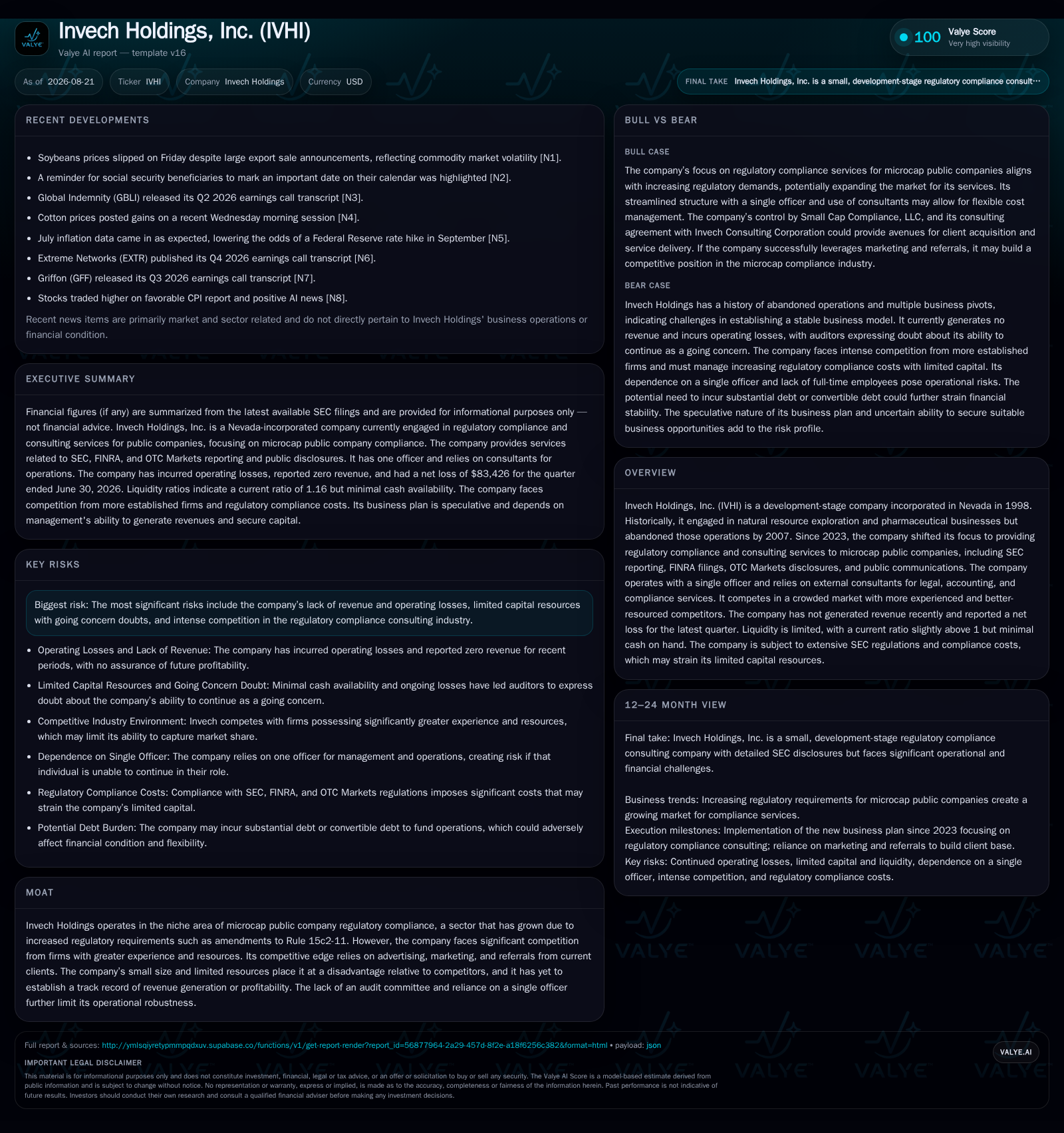
Invech Holdings, Inc. reported no revenue and a net loss for Q2 2026, continuing its pattern of operating losses without a proven revenue model. The company’s current ratio stood at 1.16 with minimal cash on hand as of June 30, 2026, highlighting significant liquidity constraints. Recent corporate moves include a July 2026 stock purchase agreement involving the majority shareholder and an August 2026 divestiture of its Paragon Assets SaaS platform, focusing the company exclusively on regulatory compliance consulting for microcap public companies. These developments underscore the financial and operational challenges facing Invech as it attempts to establish itself in a competitive industry.
Q2 2026 Operating and Financial Results
Invech Holdings, Inc. reported no revenue and a net loss for the quarter ending June 30, 2026, continuing its trend of operating losses without generating material revenue [S2]. The company’s balance sheet as of the same date shows current assets of $63,696 against current liabilities of $54,944, resulting in a current ratio of 1.16 [F1]. This modest liquidity buffer underscores the company’s constrained financial flexibility and limited cash resources to support ongoing operations or invest in growth initiatives.
The company’s negative operating cash flow is implied by ongoing net losses and minimal cash on hand, raising concerns about its ability to sustain operations without external capital support [S2]. The current ratio of 1.16, while above 1.0, provides only a slim margin of safety, indicating that current assets barely cover current liabilities [F1]. The company’s service portfolio includes SEC reporting such as Forms 8-K, 10-Q, and 10-K, FINRA filings including corporate actions and Rule 15c2-11 submissions, OTC Markets alternative reporting disclosure statements, and public company compliance documentation [S1][S6]. These services are critical for microcap companies to maintain regulatory compliance and market transparency.
The revenue model is based on fees charged for these compliance consulting services; however, Invech has not generated revenue in recent quarters and currently lacks a source of revenue, reflecting significant challenges in client acquisition and retention within this niche market [S2]. This absence of revenue confirms that the company remains in a development stage with an unproven business model, unable to commercialize its offerings effectively [S2].
Invech’s operational structure is notably lean, with a single officer managing the company and reliance on external consultants for legal, accounting, and compliance functions [S1][S2]. This minimal management bandwidth and the absence of a functioning board or audit committee limit the company’s ability to scale operations, develop client relationships, and compete effectively against better-resourced firms in the public company compliance consulting industry [S1][S2].
The competitive environment is challenging, with numerous established competitors possessing greater experience and resources [S1][S9]. These competitors benefit from stronger marketing capabilities, broader service offerings, and deeper client networks, which create barriers to entry and growth for Invech. The company’s small size and limited capital further constrain its ability to invest in service development or marketing to gain market share [S1][S9].
Recent Corporate Developments
In July 2026, Invech’s majority shareholder, Alexander M. Woods-Leo, entered into a Stock Purchase Agreement to sell his control block of stock, comprising 88,000,000 shares of common stock and 300,000 shares of Series A Preferred Stock [S3]. While this transaction could signal potential changes in ownership and governance, the details do not clarify any strategic direction or capital infusion that might affect operational prospects. The sale’s impact on company strategy, management, or funding remains uncertain at this stage.
In August 2026, the company divested its Paragon Assets SaaS platform, a real estate rental property management marketplace, to an entity controlled by Mr. Woods-Leo [S3]. This divestiture narrows Invech’s business focus exclusively to regulatory compliance consulting services, eliminating non-core operations and potentially reducing operational complexity [S3]. However, the divestiture also removes a potential revenue stream, further emphasizing the company’s reliance on its compliance consulting business, which has yet to generate revenue.
Without sufficient cash or access to capital, Invech may face difficulties funding operating expenses, investing in client acquisition, or sustaining its compliance consulting services. This financial position could raise liquidity risks, potentially requiring the company to curtail operations or seek additional financing under terms that may not be favorable.
Invech’s small size, limited management structure, and lack of a functioning board or audit committee further exacerbate these risks by restricting strategic oversight and operational agility [S2]. The company’s competitive disadvantages relative to better-resourced firms in the microcap compliance consulting market increase the difficulty of acquiring and retaining clients, which is essential for revenue generation and cash flow improvement [S2].
Moreover, the regulatory environment, while providing a structural demand for compliance services, also imposes ongoing compliance costs and risks. This scenario assumes continued access to funding, a stable regulatory environment supporting demand for compliance services, and no major competitive displacement. Persistent net losses, minimal cash, and intense competition from better-resourced firms create a high risk of business failure absent new funding or strategic shifts. Confirmation would include subsequent filings showing worsening liquidity and increased losses or disclosures of operational shutdown or bankruptcy proceedings.
Conclusion
Invech Holdings, Inc. remains a development-stage company focused on regulatory compliance consulting for microcap public companies, with no recent revenue generation and ongoing operating losses as of Q2 2026 [S2]. Its lean management structure and competitive disadvantages further challenge its ability to scale or sustain operations without additional capital [S2].
Recent corporate developments, including the July 2026 stock purchase agreement involving the majority shareholder and the August 2026 divestiture of the Paragon Assets SaaS platform, clarify ownership and business focus but do not materially alter the company’s financial challenges [S3]
Investors and observers should closely monitor upcoming quarterly revenue and net income trends, liquidity ratios, announcements of new client contracts or partnerships, disclosures of capital raises or debt financing, and any strategic developments following the majority shareholder’s stock sale.
Disclaimer: This is research-only, informational analysis and not investment advice. It may include AI-generated interpretation and general industry context. Always verify important details using primary sources.

Comments