
Provectus Biopharmaceuticals Q2 2026: Proprietary RBS Platform Advances While Liquidity Remains Tight
Provectus Biopharmaceuticals reports ongoing clinical progress with its rose bengal sodium platform amid significant liquidity challenges and a working capital deficit in Q2 2026.
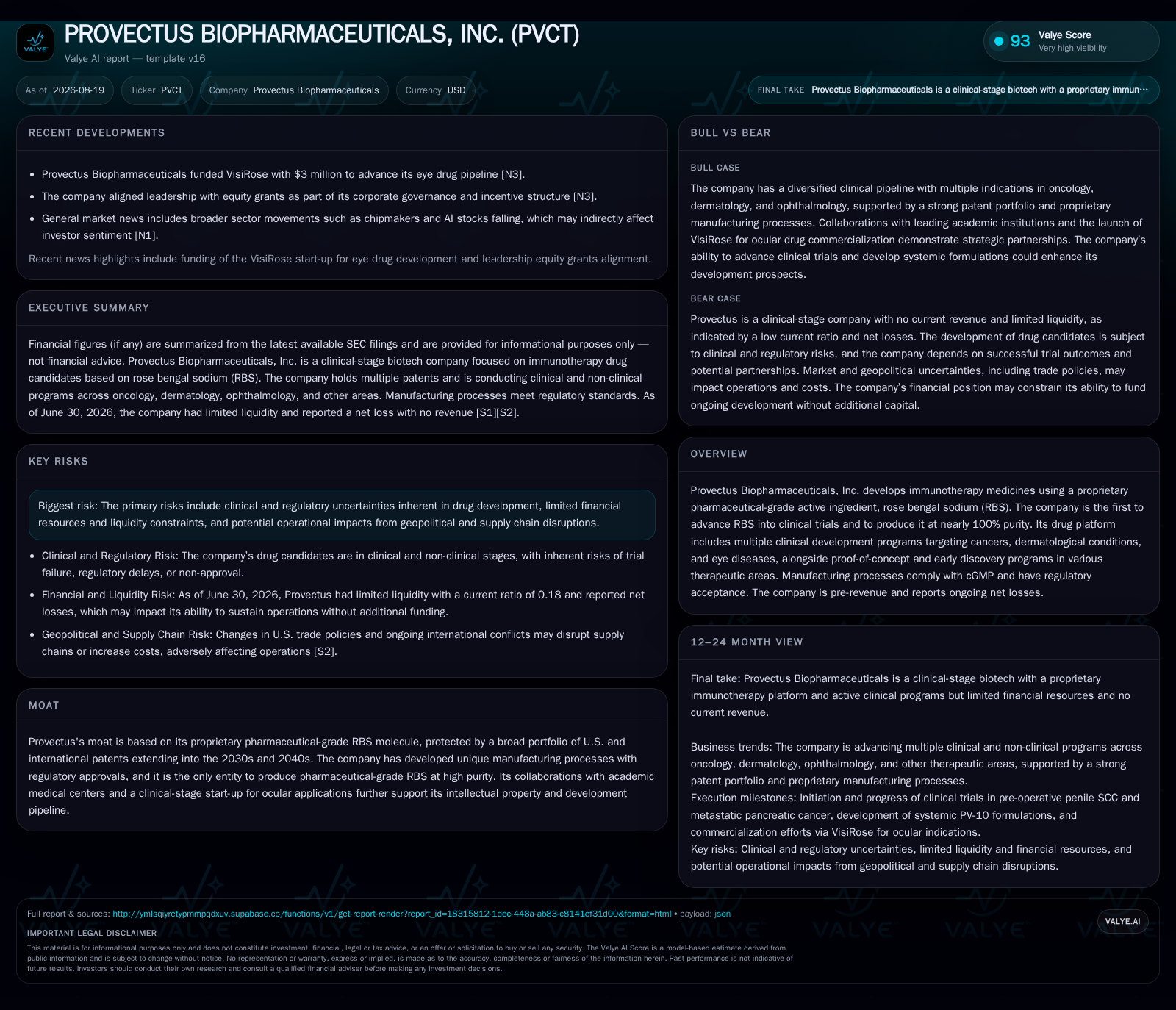
Provectus Biopharmaceuticals remains a pre-revenue clinical-stage biotech focused on its proprietary rose bengal sodium (RBS) platform, advancing multiple clinical programs in oncology, dermatology, and ophthalmology. As of June 30, 2026, the company reported a working capital deficit of approximately $6.3 million and a current ratio of 0.18, underscoring critical liquidity constraints that threaten its operational runway without additional financing. The Board approved converting accrued directors' fees into preferred stock in mid-2026, reflecting capital management amid cash shortages. Despite these financial pressures, Provectus's broad patent portfolio and unique manufacturing process for pharmaceutical-grade RBS underpin its long-term value proposition, though clinical and regulatory risks remain significant.
Q2 2026 Financial and Liquidity Update
Provectus Biopharmaceuticals, Inc., a clinical-stage biotechnology company, reported a working capital deficit of approximately $6.3 million and a current ratio of 0.18 as of June 30, 2026, according to its latest quarterly filing [F1][S2]. These figures reflect a significant imbalance between current assets, which totaled about $1.37 million, and current liabilities of roughly $7.7 million. The company remains pre-revenue and continues to incur net losses consistent with its ongoing clinical development activities [S2][S1]. This liquidity shortfall raises substantial doubt about Provectus's ability to continue as a going concern without securing additional capital, as the current liabilities far exceed current assets and ongoing operating losses imply continued negative cash flow [S2][F1].
The financial constraints are typical for clinical-stage biopharmaceutical companies that have yet to commercialize products and rely heavily on external financing to fund research and development (R&D) and clinical trials. Provectus's ability to sustain operations and advance its pipeline depends critically on raising new capital in the near term.
Proprietary RBS Platform and Clinical Pipeline
Provectus's core technology centers on its proprietary pharmaceutical-grade rose bengal sodium (RBS), a synthetic small molecule classified among halogenated xanthenes. This molecule serves as the active pharmaceutical ingredient (API) in all of the company's clinical and non-clinical programs [S1]. The company is the first and currently the only entity to manufacture pharmaceutical-grade RBS with a purity approaching 100%, utilizing a unique process compliant with current good manufacturing practices (cGMP) and accepted by regulatory authorities [S1].
The RBS platform supports a diversified pipeline with clinical development programs targeting oncology (intratumoral administration), dermatology (topical administration), and ophthalmology (topical administration). Additionally, Provectus pursues in vivo proof-of-concept studies in oncology (oral), hematology (oral), wound healing (topical), and veterinary oncology, alongside early-stage in vitro and in silico research programs [S1].
The company's intellectual property portfolio includes multiple U.S. patents covering the synthesis and therapeutic applications of RBS and related compounds, with patent protection extending into the 2030s and 2040s. This broad patent coverage provides a structural competitive advantage by safeguarding the proprietary RBS platform and its manufacturing process, which underpins Provectus's long-term value proposition despite the near-term financial challenges [S1].
Capital Management and Risk Factors
In response to cash constraints, Provectus's Board of Directors approved the conversion of accrued but unpaid directors' fees into Series D-1 Preferred Stock at a price of $2.862 per share in May 2026 [S3]. This equity-based compensation measure reflects alternative capital management efforts amid limited cash liquidity but does not improve the company's cash position or working capital directly.
The company's updated risk disclosures in the Q2 2026 filing highlight potential adverse impacts from changes in U.S. trade policies, tariffs, and ongoing geopolitical conflicts, such as military tensions in Eastern Europe and the Middle East [S2]. These factors may disrupt supply chains or increase costs for materials and equipment essential to Provectus's operations and those of its partners, thereby affecting financial condition and operational execution.
Investment Scenarios and Outlook
Provectus faces a critical juncture where its ability to continue advancing clinical programs hinges on securing additional capital. One plausible base-case scenario is that the company successfully raises new funds within the next 12 months, enabling continued clinical development and incremental pipeline progress without significant dilution. This scenario assumes receptive capital markets for clinical-stage biotech financings, absence of major clinical or regulatory setbacks, and effective execution of financing plans [S2][S3][F1]. Confirmation would come from announcements of successful equity or debt financings, positive clinical updates, and improved liquidity metrics in subsequent filings.
Conversely, a bear-case scenario involves failure to secure sufficient capital, forcing delays or termination of clinical programs and risking insolvency or restructuring. This outcome is plausible given the current working capital deficit and low cash reserves, compounded by potential tightening of capital markets, clinical or regulatory setbacks, and ongoing geopolitical uncertainties [S2][F1]. Confirmation would include disclosures of operational delays, further liquidity deterioration, or restructuring announcements.
Business Economics and Watchpoints
Provectus's business model is typical of clinical-stage biopharmaceutical companies: it incurs substantial R&D expenditures and operating losses while developing proprietary drug candidates, with no current revenue [S1][S2][S3]. The company's future revenue potential depends on successful regulatory approvals and commercialization of products based on its pharmaceutical-grade RBS platform. Monitoring these factors will help assess Provectus's ability to overcome near-term financial constraints and realize the long-term value of its proprietary RBS platform.
In summary, Provectus Biopharmaceuticals continues to advance its unique pharmaceutical-grade RBS platform across multiple clinical programs, supported by a broad and durable patent portfolio. These financial conditions highlight the importance of securing additional capital to sustain clinical development and operations.
Disclaimer: This is research-only, informational analysis and not investment advice. It may include AI-generated interpretation and general industry context. Always verify important details using primary sources.

Comments