
Target Group Inc. Q2 2026: Loan Default and Liquidity Challenges Amid Ongoing Cannabis Operations
Target Group Inc. reclassified its $7.33 million CLI loan as a current liability due to default, signaling liquidity stress despite ongoing cannabis production and proprietary product development.
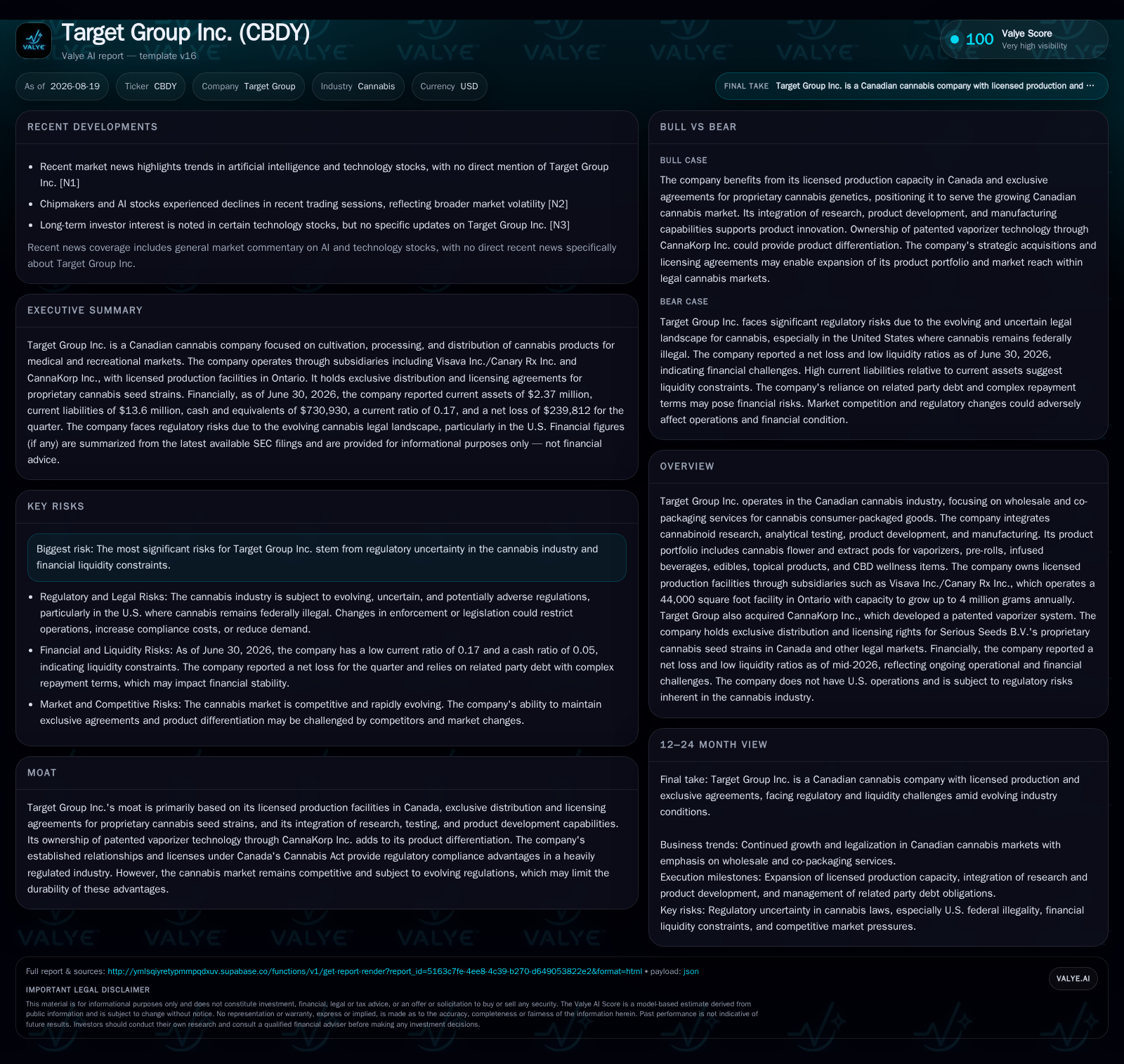
In Q2 2026, Target Group Inc. classified its entire $7.33 million CLI loan balance as a current liability because the loan is in default and due on demand, with no payments made during the quarter. This reclassification highlights significant liquidity constraints, evidenced by a low current ratio of 0.17 as of June 30, 2026. Despite these financial challenges, the company continues to operate licensed cannabis production facilities with an annual capacity of 4 million grams and maintains proprietary vaporizer technology and exclusive cannabis seed licenses that support its product portfolio and revenue potential in the Canadian cannabis market.
Q2 2026 Financial and Liquidity Update
Target Group Inc.’s latest quarterly filing dated August 13, 2026, reveals a critical financial development: the entire outstanding balance of its CLI loan, totaling $7,334,333, has been classified as a current liability due to default and is now payable on demand as of June 30, 2026 [S2][F1]. This marks a material change from prior periods when the loan was classified as non-current. Notably, the company made no payments on this loan during the quarter, underscoring cash flow constraints [S2].
The liquidity strain is further reflected in the company’s balance sheet, where current assets of $2.37 million are significantly outweighed by current liabilities of $13.6 million, resulting in a current ratio of 0.17 as of the quarter-end [F1]. This ratio indicates that Target Group’s short-term obligations exceed its readily available assets by a wide margin, highlighting potential solvency risks. The classification of the CLI loan as a current liability due to default materially increases the company’s refinancing uncertainty and liquidity risk [S2][F1].
The company is currently engaged in discussions with the lender to formalize revised loan arrangements, which, if successful, could alleviate immediate liquidity pressures [S2]. However, the absence of loan payments during the quarter and the low liquidity metrics raise concerns about the company’s ability to meet its obligations without restructuring or additional financing.
The negative working capital position, evidenced by current assets of $2.37 million versus current liabilities of $13.6 million, results in a current ratio of 0.17, which constrains the company’s operational flexibility [F1]. This financial pressure may limit Target Group’s ability to invest in growth initiatives or respond to unforeseen expenses, increasing the risk of operational disruptions if liquidity is not restored promptly.
Business Operations and Competitive Position
Despite these financial challenges, Target Group continues to operate licensed cannabis production facilities in Canada. Its key asset includes a 44,000 square foot cultivation and processing facility operated through Visava Inc./Canary Rx Inc., located in Norfolk County, Ontario, with an annual production capacity of up to 4 million grams of cannabis [S1]. This licensed producer (LP) status enables the company to supply the medical and adult-use recreational cannabis markets in Canada.
Target Group’s product portfolio is diversified and supported by proprietary technology. Through its acquisition of CannaKorp Inc., the company holds patented vaporizer technology, which is a differentiating factor in the cannabis consumer-packaged goods (CPG) market [S1]. Additionally, Target Group maintains exclusive distribution and licensing rights for proprietary cannabis seed strains, further supporting its product development and market positioning [S1].
The company’s business model centers on wholesale sales and co-packaging services, integrating cannabinoid research, analytical testing, and manufacturing capabilities. These operations underpin its revenue potential and competitive positioning within the regulated Canadian cannabis industry, which remains subject to evolving regulatory frameworks and competitive pressures.
Margins and cash conversion are influenced by production efficiency at the licensed cultivation and processing facilities, product mix, regulatory compliance costs, and working capital management. The company’s ability to optimize these factors will be critical to improving its financial health and addressing liquidity constraints.
However, the cannabis industry’s regulatory environment remains complex and evolving, particularly with cannabis still illegal under U.S. federal law despite state-level legalization. This regulatory uncertainty imposes compliance costs and operational risks that could affect Target Group’s expansion plans, especially if it seeks to enter or expand in U.S. markets in the future [S1].
Risks and Scenarios
The reclassification of the CLI loan as a current liability due to default elevates Target Group’s liquidity risk and refinancing uncertainty [S2][F1]. The loan balance of $7.33 million is due on demand, and with no payments made during the quarter alongside a current ratio of 0.17, the company faces significant challenges in meeting its short-term obligations [S2][F1].
One possible scenario is that Target Group successfully renegotiates the loan terms with CLI, stabilizing its liquidity position and allowing continued operations without major disruption [S2]. This outcome would be supported by disclosures of amended loan agreements, resumption of loan payments, and improved liquidity metrics in future filings. Such a resolution would provide the company with breathing room to manage its working capital and invest in operational improvements.
Conversely, failure to restructure the loan could lead to forced repayment demands, triggering a liquidity crisis and potential operational disruptions [S2][F1]. Confirmation of this scenario would include disclosures of default consequences, bankruptcy risk, or asset sales.
A more optimistic scenario envisions the company leveraging its proprietary vaporizer technology and exclusive seed licenses to expand market share and improve financial performance, enabling debt reduction and liquidity improvement [S1]. This would require favorable regulatory developments, successful commercialization of new products, and improved operational efficiency. Evidence would include revenue growth, margin expansion, and positive cash flow generation. Target Group’s negative working capital and loan default highlight the challenges of balancing growth investments with financial discipline in this environment.
Investors should closely monitor upcoming disclosures for updates on loan restructuring or amendments, as these will be critical indicators of the company’s near-term liquidity trajectory.
Operational KPIs such as production volumes, product launches, and commercialization success of proprietary technologies will be important to assess the company’s ability to generate sustainable revenue streams. Additionally, cash flow statements will be essential to evaluate the company’s capacity to service debt and fund operations going forward.
In summary, while Target Group’s licensed production capacity and proprietary product offerings remain valuable assets, the company’s financial health is currently constrained by liquidity challenges stemming from the CLI loan default [S2][F1]. The resolution of this debt situation and the company’s operational execution will be pivotal in determining its ability to sustain and grow its business in the competitive Canadian cannabis market.
Disclaimer: This is research-only, informational analysis and not investment advice. It may include AI-generated interpretation and general industry context. Always verify important details using primary sources.

Comments