
Caring Brands Q2 2026: Patent Portfolio Strengthens Product Pipeline Amid Nasdaq Compliance Risks
Caring Brands expands patent protections for key wellness products while facing Nasdaq listing challenges and maintaining stable liquidity in Q2 2026.
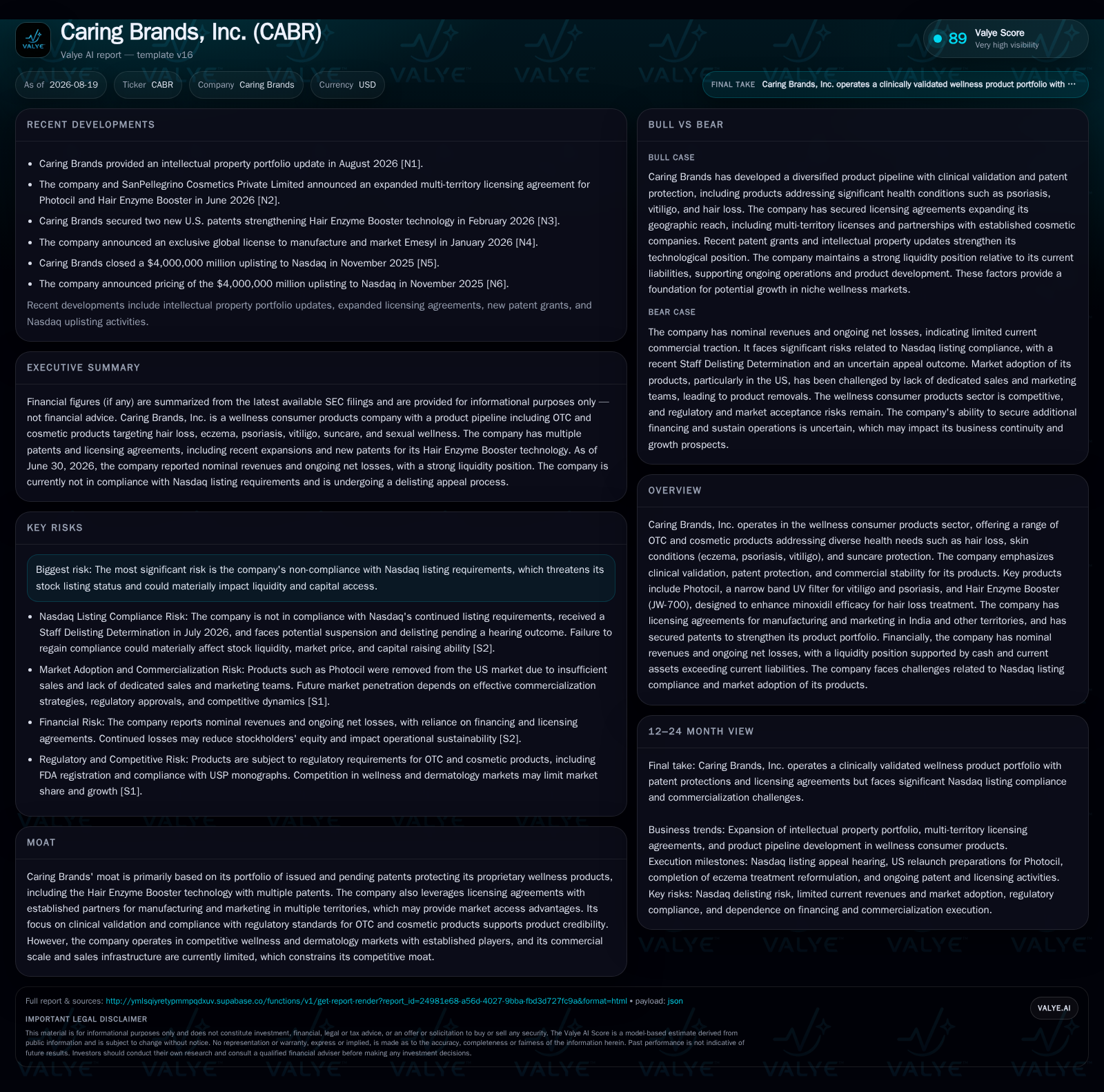
Caring Brands, Inc. reported in Q2 2026 continued development of its wellness product pipeline supported by an expanded patent portfolio covering Hair Enzyme Booster and Photocil products, which underpin product exclusivity and licensing opportunities. The company is preparing for a planned U.S. relaunch of Photocil after a prior market withdrawal. However, it faces material risk from Nasdaq non-compliance due to insufficient stockholders’ equity, with a delisting appeal hearing scheduled for August 25, 2026. Despite ongoing net losses and nominal revenues consistent with early-stage commercialization, Caring Brands maintains a stable liquidity position with a current ratio of 4.96 as of June 30, 2026.
Q2 2026 Operating and Financial Update
Caring Brands, Inc. reported its Q2 2026 operating results highlighting continued nominal revenues and ongoing net losses, consistent with its limited operating history and early-stage commercial development in the wellness consumer products sector [S2][S1]. As of June 30, 2026, the company maintained a stable liquidity position with cash and equivalents totaling approximately $1.82 million and current assets of $1.91 million against current liabilities of $0.38 million, yielding a current ratio of 4.96 [F1]. This liquidity buffer supports ongoing operations and product development, although the company’s ability to sustain operations depends on future capital access during persistent losses.
Patent Portfolio and Product Pipeline
A key development for Caring Brands is the expansion and maintenance of its patent portfolio, which covers its Hair Enzyme Booster and Photocil product platforms as of August 6, 2026 [S3]. These issued and pending patents provide intellectual property protection critical for product exclusivity in a competitive wellness market. Such protections enable the company to license manufacturing and marketing rights, particularly in markets where direct sales infrastructure is limited, thereby underpinning potential future revenue streams [S3][S1].
Nasdaq Listing Compliance and Delisting Appeal
Caring Brands currently faces significant regulatory risk related to its Nasdaq listing. On April 7, 2026, the company received notice from Nasdaq that it was not in compliance with Listing Rule 5550(b)(1), which requires a minimum of $2.5 million in stockholders’ equity [S2]. This non-compliance led to a Staff Delisting Determination denying the company’s request for continued listing, primarily because no definitive financing agreement had been secured to regain compliance.
The company has appealed this determination, and a hearing before the Nasdaq Hearings Panel is scheduled for August 25, 2026 [S2]. The appeal currently stays suspension of trading and delisting, but there is no assurance that the Panel will grant continued listing. Any exception would likely be subject to milestones, and failure to meet these could result in delisting and suspension of trading.
Delisting would materially reduce stock liquidity and the company’s ability to raise capital, which is critical given its ongoing net losses and limited revenues [S2][F1]. Its revenue model primarily involves direct sales in select markets and licensing fees from partners who manufacture and market its patented products in territories like India [S1].
The company emphasizes clinical validation and patent protection to differentiate its products, which include hair loss treatments, eczema and psoriasis therapies, vitiligo solutions, and suncare products. However, its limited sales and marketing infrastructure constrain revenue scale and margin expansion, as evidenced by nominal revenues and ongoing losses [S1][S2]. Licensing agreements help extend market access where direct commercial scale is lacking.
Risks and Scenarios
The expansion of Caring Brands’ patent portfolio and licensing agreements represents a critical structural asset supporting its potential to commercialize differentiated wellness products with protected market exclusivity [S3][S1]. These intellectual property rights and partnerships enable the company to pursue revenue growth despite limited direct sales infrastructure.
Conversely, the company’s Nasdaq listing non-compliance and pending delisting appeal constitute a material near-term risk. Delisting would impair stock liquidity and capital access, threatening the company’s ability to fund ongoing operations and product development amid persistent net losses [S2][F1]. A base-case scenario involves a successful appeal resulting in maintained Nasdaq listing, additional financing secured, and gradual revenue growth driven by the planned Photocil relaunch and licensing expansion [S2][S3][F1]. Confirmation would come from a positive Nasdaq panel decision, new financing disclosures, and revenue growth in subsequent quarters.
The bear-case scenario entails an unsuccessful appeal leading to delisting and trading suspension, severely limiting liquidity and capital access [S2][F1]. This would likely force operational cutbacks and delay or cancel product relaunch plans. Evidence confirming this would include a delisting notice, failure to secure financing, and announcements of operational downsizing.
Conclusion and Watchpoints
Caring Brands’ patent portfolio and licensing agreements are foundational to its competitive positioning and future revenue potential in the wellness sector. However, the company’s operational sustainability is materially challenged by Nasdaq listing compliance issues that threaten its capital access and stock liquidity.
These developments will be critical in assessing the company’s trajectory amid its current financial and regulatory challenges.
Disclaimer: This is research-only, informational analysis and not investment advice. It may include AI-generated interpretation and general industry context. Always verify important details using primary sources.

Comments