
Natics Corp. Q2 2026: Revenue Growth Amid Liquidity and Leverage Challenges
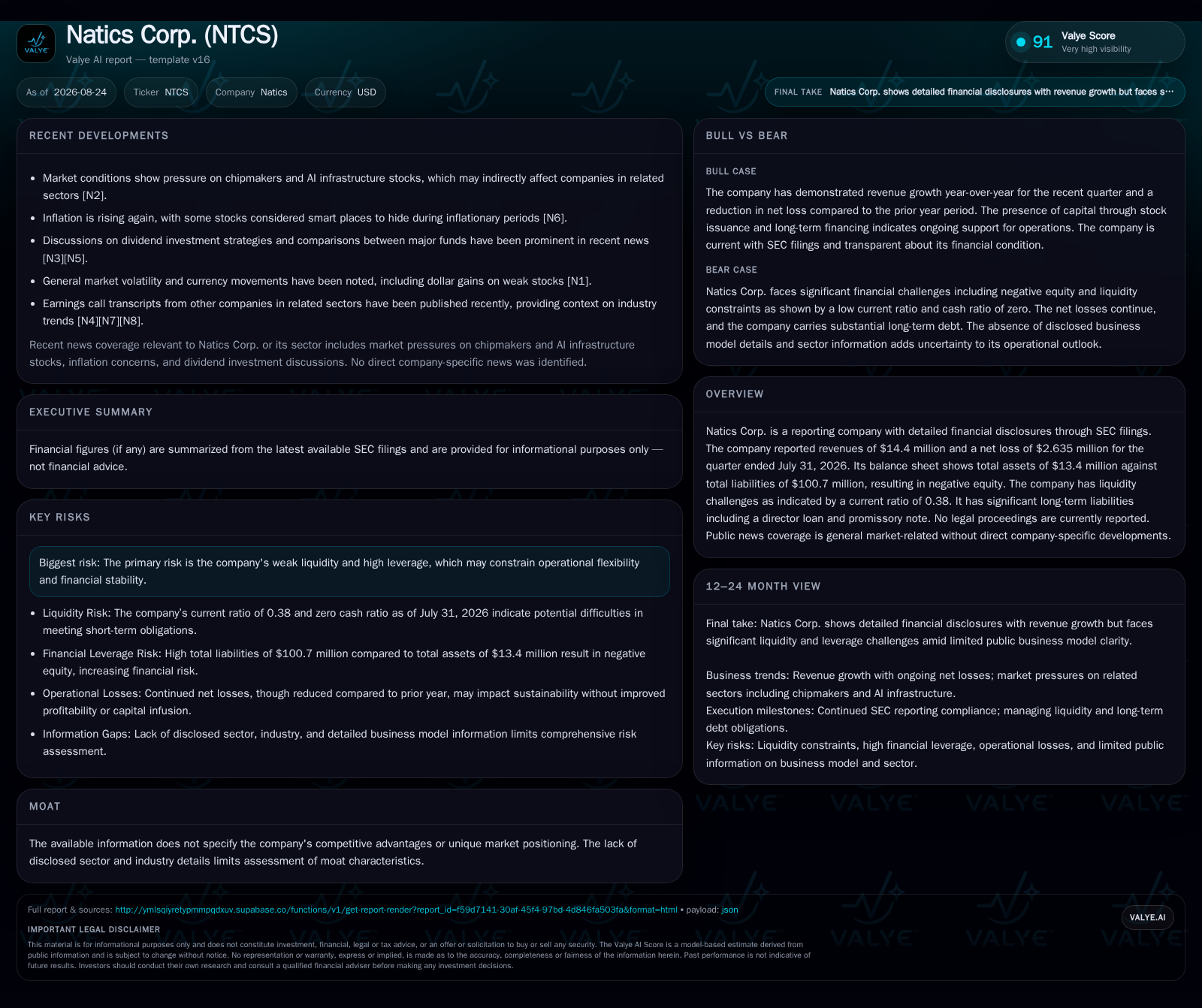
Natics Corp. reported $14.4 million in revenue and a net loss of $2.635 million in Q2 2026, while facing significant liquidity constraints and going concern risks.
In the quarter ended July 31, 2026, Natics Corp. generated $14.4 million in revenue but incurred a net loss of $2.635 million, reflecting ongoing operational activity alongside profitability challenges. The company’s liquidity remains severely constrained, with a current ratio of 0.38 and total liabilities of $100.7 million exceeding assets of $13.4 million, resulting in negative equity and substantial doubt about its ability to continue as a going concern. Without bank credit lines, Natics relies on private placements of equity and debt to finance operations and anticipates increased expenses and capital needs, making additional capital raises essential for sustaining long-term operations.
Natics Corp. reported $14.4 million in revenue and a net loss of $2.635 million for the quarter ended July 31, 2026, reflecting ongoing operational activity but continued financial stress [S2]. The net loss highlights the gap between operational expenses and revenue, typical for early-stage companies investing in growth. Management anticipates increased operating expenses and capital expenditures related to inventory acquisition, developmental activities, and marketing efforts, indicating that profitability and positive cash flow remain distant goals [S2].
As of July 31, 2026, Natics had current assets of $6.985 million and current liabilities of $18.275 million, resulting in a current ratio of 0.38, signaling significant liquidity constraints [F1]. Total assets were $13.4 million against total liabilities of $100.7 million, producing negative equity and a highly leveraged balance sheet [S2]. This capital structure places substantial financial stress on the company and raises substantial doubt about its ability to continue as a going concern, as noted in the latest 10-Q filing [S2].
Despite these challenges, management expects existing working capital, further advances, and debt instruments to fund operations for the next three months [S2]. However, this limited runway emphasizes the urgency of securing additional capital to sustain operations and avoid liquidity crises.
Natics currently has no bank credit lines or traditional banking financing, relying instead on private placements of equity and debt instruments to finance operations [S2]. The company carries promissory notes totaling $43,000 and a director loan, adding to its long-term liabilities [S2]. The absence of bank credit lines limits financial flexibility and increases dependence on capital markets.
Looking ahead, management anticipates increased operating expenses and capital expenditures driven by inventory acquisition, developmental activities, and marketing efforts [S2]. To meet these needs, Natics expects to raise additional funds through equity or debt sales [S2]. The success of these capital raises is critical to maintaining operations and progressing toward profitability.
Natics operates as an early-stage startup primarily funded by investors through private equity and debt placements [S2]. It does not currently generate revenue from customers purchasing products or services but relies on capital raises to finance developmental activities. Operating losses and increasing expenses related to inventory acquisition, development, and marketing constrain cash conversion and working capital. No explicit competitive advantages or moats are disclosed, and financial constraints combined with lack of bank financing limit operational flexibility and scalability [S2].
Two primary scenarios emerge:
Base Scenario: Natics faces liquidity constraints with a current ratio of 0.38 as of July 31, 2026, and an accumulated deficit of $112,530, raising substantial doubt about its ability to continue as a going concern [S2][F1]. The company has Promissory Notes of $43,000 on its balance sheet at that date. While management may seek to raise additional capital to fund operations and growth, no current evidence confirms successful capital raises or improved liquidity ratios as of the latest quarter [S2]. This scenario reflects the company's ongoing challenges in funding increased expenses and achieving profitability.
Bear Scenario: The company fails to secure additional capital in time, leading to a liquidity crisis that forces operational cutbacks, asset sales, or bankruptcy proceedings. This scenario would be confirmed by disclosures of liquidity shortfalls, restructuring announcements, or bankruptcy filings, and refuted by successful capital raises and improved operating results.
Natics’ Q2 2026 results reveal ongoing operations but significant financial stress characterized by severe liquidity constraints, high leverage, and net losses [S2]. The company’s ability to continue beyond the near term depends on raising additional capital through private placements [S2]. Investors should monitor announcements of capital raises, quarterly revenue and profitability updates, liquidity ratio changes, and any revisions to going concern disclosures. These indicators will be key to assessing the company’s financial trajectory and operational sustainability. Failure to secure capital could lead to operational disruptions or insolvency, while successful raises could provide runway to improve financial metrics and move toward profitability, albeit with continued risk given the early-stage nature of the business.

Comments