
Cingulate Inc. Q2 2026: FDA Complete Response Letter Delays Lead ADHD Drug Approval
The FDA's June 2026 Complete Response Letter for CTx-1301 highlights manufacturing deficiencies, delaying potential approval and impacting Cingulate's near-term prospects.
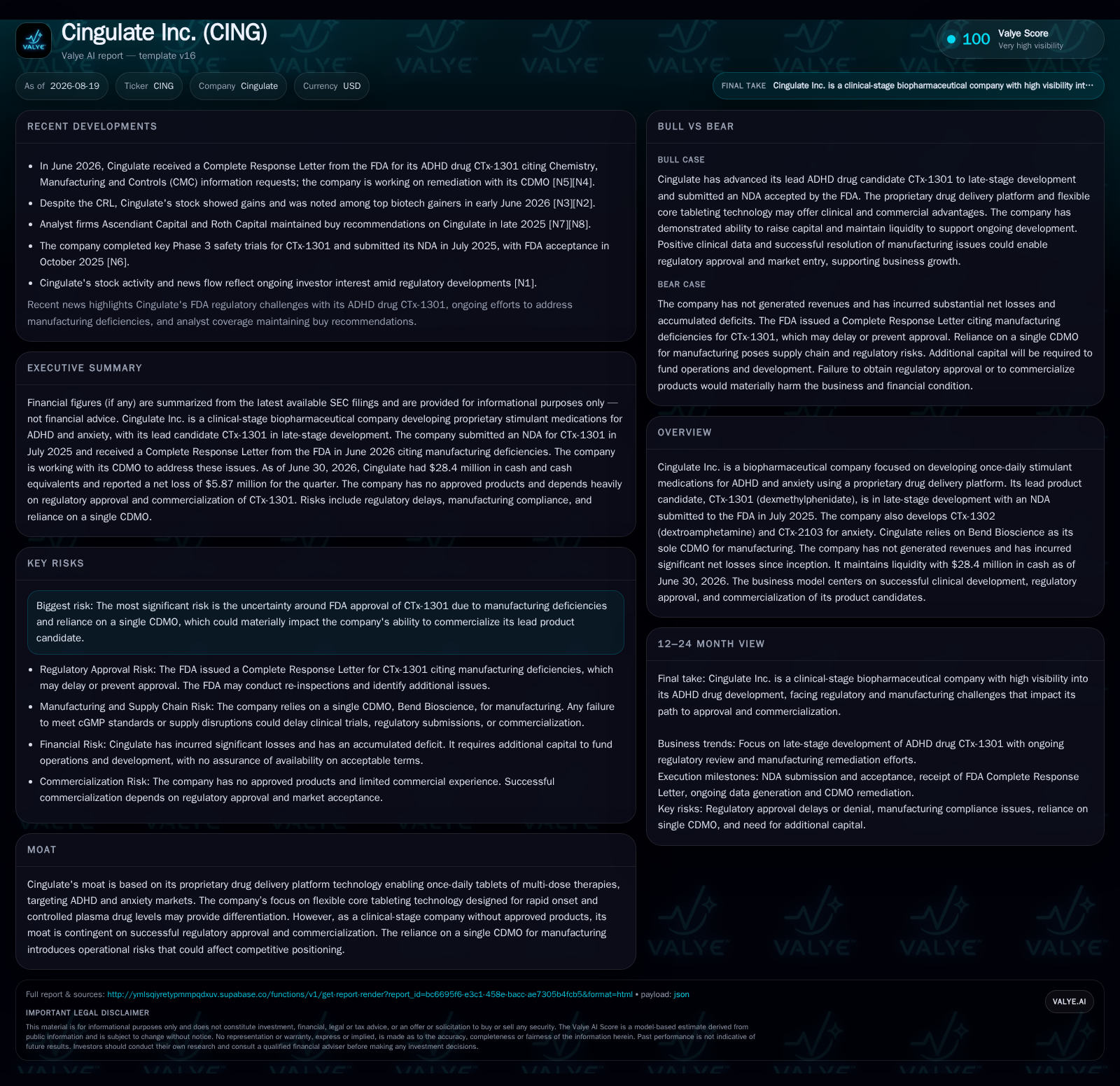
In Q2 2026, Cingulate Inc. received a Complete Response Letter (CRL) from the FDA for its New Drug Application (NDA) of CTx-1301, its lead ADHD drug candidate. The CRL cites Chemistry, Manufacturing and Controls (CMC) deficiencies linked to its sole contract development and manufacturing organization (CDMO), Bend Bioscience, delaying regulatory approval. While the FDA raised no clinical safety or efficacy concerns, the company must generate additional data and remediate manufacturing issues before resubmission. As of June 30, 2026, Cingulate holds $28.4 million in cash and equivalents, supporting near-term operations but underscoring the need for further funding to sustain remediation efforts and ongoing development.
Regulatory Setback on Lead Product Candidate
In June 2026, Cingulate Inc. received a Complete Response Letter (CRL) from the U.S [S2]. Food and Drug Administration (FDA) regarding its New Drug Application (NDA) for CTx-1301, the company's lead candidate targeting attention deficit hyperactivity disorder (ADHD). The CRL identifies specific deficiencies in Chemistry, Manufacturing and Controls (CMC) data, which must be addressed before the FDA will consider approval. Notably, the letter does not raise concerns about the clinical safety or efficacy of CTx-1301, indicating that the clinical profile remains intact. However, the requirement for additional data generation and remediation delays the regulatory approval timeline, materially affecting the company's near-term commercialization prospects.
The FDA's focus on manufacturing issues rather than clinical data suggests that Cingulate's clinical development efforts have not been undermined. Nevertheless, the delay in approval increases uncertainty around the timing and likelihood of CTx-1301 reaching the market. This setback directly impacts the company's ability to generate revenues from its lead product candidate and heightens operational and financial risks.
Manufacturing and Operational Risks
A central operational risk for Cingulate is its dependence on a single contract development and manufacturing organization (CDMO), Bend Bioscience, for the manufacture and remediation activities related to CTx-1301. The CRL explicitly links the manufacturing deficiencies to Bend Bioscience's processes, requiring the CDMO to generate additional CMC data and undergo FDA re-inspection. There is no assurance that Bend Bioscience will successfully remediate the deficiencies or pass the FDA re-inspection, which could lead to further delays or denial of approval [S1][S2]. This concentration risk is significant because any failure or delay by Bend Bioscience could stall the NDA resubmission or result in additional regulatory hurdles. The company’s reliance on a sole CDMO for critical manufacturing functions introduces a bottleneck that may constrain operational flexibility and extend the timeline for regulatory compliance and commercialization.
Financial Position and Liquidity
As of June 30, 2026, Cingulate reported cash and cash equivalents of $28.4 million and a current ratio of 3.5, reflecting current assets of approximately $30.2 million against current liabilities of $8.6 million [F1]. This liquidity position supports the company's near-term operational needs, including ongoing clinical development and the data generation required to address the FDA's CMC deficiencies.
Despite this cash buffer, Cingulate remains a pre-revenue clinical-stage biopharmaceutical company with negative cash flow from operations due to continued investment in research and development and manufacturing validation. This candidate is a once-daily stimulant and anxiolytic tablet developed using the company's proprietary drug delivery platform. Revenue generation will depend on successful FDA approval and subsequent product sales to healthcare providers, insurers, and patients.
The company is obligated to pay milestone and royalty payments to Bend Bioscience contingent on regulatory approvals and sales, which will impact future margins. Currently, margins and cash conversion are negative due to the company's clinical-stage status and ongoing R&D expenses. The proprietary delivery platform may offer differentiation in the ADHD market, but the operational constraint of relying on a single CDMO introduces risk that could affect manufacturing efficiency and timing of market entry.
Analytical Conclusions and Outlook
The FDA's CRL focused on manufacturing deficiencies rather than clinical issues implies that CTx-1301's clinical profile remains viable, but the approval process is delayed pending remediation [S2]. The company's dependence on Bend Bioscience for manufacturing remediation presents a material operational risk that could further delay or prevent NDA approval and commercialization.
One plausible base scenario is that Cingulate and Bend Bioscience successfully address the FDA's CMC concerns, enabling NDA resubmission and eventual approval within 12 to 18 months. This would require timely data generation, successful FDA re-inspection of the CDMO, and sufficient liquidity to fund these activities. Confirmation would come from FDA acceptance of the resubmission and positive inspection outcomes, while further delays or inspection failures would challenge this scenario.
Conversely, a bear scenario involves difficulties in remediating manufacturing deficiencies, potentially leading to prolonged FDA delays or denial of approval [S1][S2]. Progress updates on other pipeline candidates, such as CTx-1302 and CTx-2103, remain important but are less immediate given their early development stages.
In summary, Cingulate's Q2 2026 update underscores the operational and regulatory challenges faced by clinical-stage biopharmaceutical companies reliant on external manufacturing partners. The FDA's CRL introduces a significant delay in the lead product candidate's approval timeline, increasing the importance of effective manufacturing remediation and financial resource management for the company's future prospects.
Disclaimer: This is research-only, informational analysis and not investment advice. It may include AI-generated interpretation and general industry context. Always verify important details using primary sources.

Comments