
Freedom Metals Acquisition Corp. 2026 Q2: SPAC Status and Liquidity Constraints
As of Q2 2026, Freedom Metals Acquisition Corp. remains a pre-acquisition SPAC with no operating business and low liquidity, while commencing separate trading of shares and warrants.
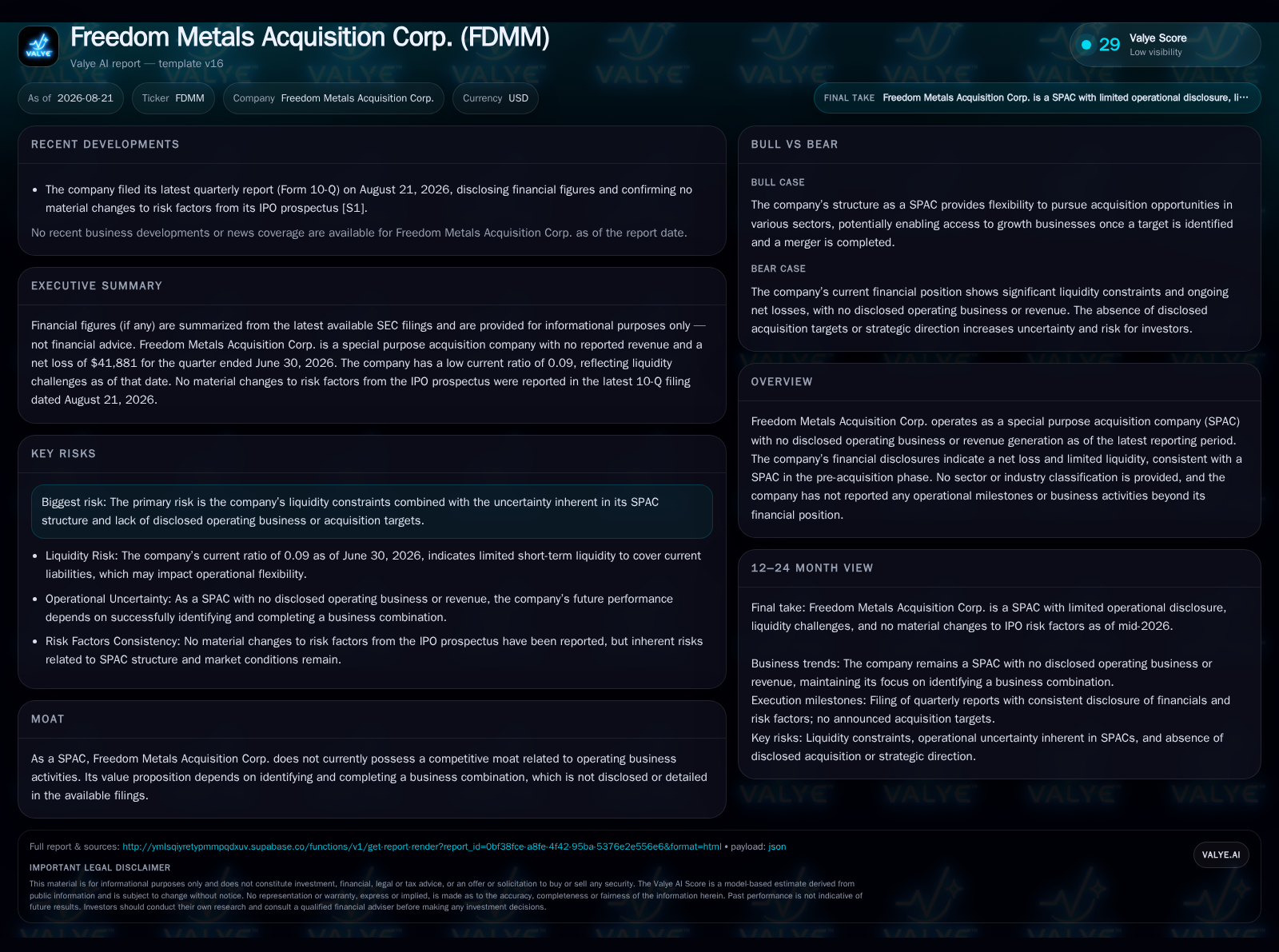
Freedom Metals Acquisition Corp. operates solely as a special purpose acquisition company (SPAC) with no disclosed operating business or revenue generation as of June 30, 2026. The company’s liquidity position is constrained, reflected in a low current ratio of 0.09, due to current liabilities significantly exceeding current assets. In August 2026, the company began separate trading of its Class A ordinary shares and warrants, a change affecting trading dynamics but not the fundamental business risk profile. The ability to complete a business combination and transition to an operating company remains dependent on resolving liquidity constraints and securing a target acquisition.
Freedom Metals Acquisition Corp. (FDMM) remains a pre-acquisition special purpose acquisition company (SPAC) with no operating business and a current ratio of 0.09 as of June 30, 2026, reflecting low liquidity as disclosed in its Q2 2026 10-Q filing [S2]. The company's value hinges on completing a business combination, but its liquidity constraints and lack of operating revenue increase investment risk, underscoring the challenges faced by SPACs prior to de-SPAC transactions.
As of June 30, 2026, the company's balance sheet shows current assets of $29,121 against current liabilities of $314,857, resulting in a current ratio of 0.09 [F1]. Without operating cash flow or unrestricted liquid assets, Freedom Metals Acquisition Corp. faces challenges in funding operational expenses or acquisition-related costs without additional financing [F1],[S2].
Recent Trading Structure Change
On August 3, 2026, the company announced that starting August 4, 2026, holders of its IPO units—which consist of one Class A ordinary share and one-third of one redeemable warrant—may separately trade the Class A ordinary shares and warrants [S3]. Each whole warrant entitles the holder to purchase one Class A ordinary share at an exercise price of $11.50 per share. This separation means that investors can trade shares and warrants independently rather than as combined units.
While this change may increase market liquidity and provide investors with greater flexibility in managing their holdings, it does not alter the underlying business or financial position of the company. The company remains a pre-acquisition SPAC with no operating revenues or assets beyond the trust account proceeds [S3]. Since the company has no operating business or revenue, it cannot generate cash flow to alleviate these liquidity pressures. This constraint could impede the company's ability to pursue or complete a business combination, which is essential for transitioning from a shell company to an operating public entity [F1],[S2].
One possible scenario is that Freedom Metals Acquisition Corp. successfully identifies and negotiates a business combination within the SPAC timeline, utilizing the IPO proceeds held in trust to complete the transaction. This would enable the company to transition to an operating company, potentially improving liquidity and creating shareholder value. Confirmation of this scenario would come from announcements of definitive business combination agreements and improved liquidity metrics post-acquisition [S2],[F1].
Conversely, if liquidity constraints persist and market conditions or strategic factors prevent the company from securing an acquisition target, the SPAC may be forced to liquidate or return funds to shareholders. This outcome would be indicated by public announcements of wind-down plans or failure to announce an acquisition within the mandated timeframe [F1],[S2].
Business Economics and Watchpoints
Freedom Metals Acquisition Corp.'s economics are typical of SPACs: investors purchase units consisting of shares and warrants during the IPO and private placement, with proceeds held in trust until a business combination is completed. The absence of operating assets and revenue means that shareholder value is entirely contingent on the successful identification and closing of a suitable acquisition target.
Key watchpoints for investors include any announcements regarding definitive business combination agreements, changes in liquidity ratios or the balance sheet composition in future filings, and trading behavior of the separated Class A shares and warrants. Monitoring these factors will provide insight into the company's progress toward acquisition and its ability to manage liquidity constraints.
The recent commencement of separate trading of shares and warrants introduces new trading dynamics but does not affect the underlying business risks. The company’s future value depends on resolving liquidity challenges and successfully completing a business combination within the SPAC timeline.
Disclaimer: This is research-only, informational analysis and not investment advice. It may include AI-generated interpretation and general industry context. Always verify important details using primary sources.

Comments