
Ubiquiti Inc. 2026 Q3: Operating Update Highlights Supply Chain and Warranty Risk Management
Ubiquiti’s Q3 2026 filing details warranty accrual practices, indemnification exposures, and supply chain dependencies shaping its operational risk profile.
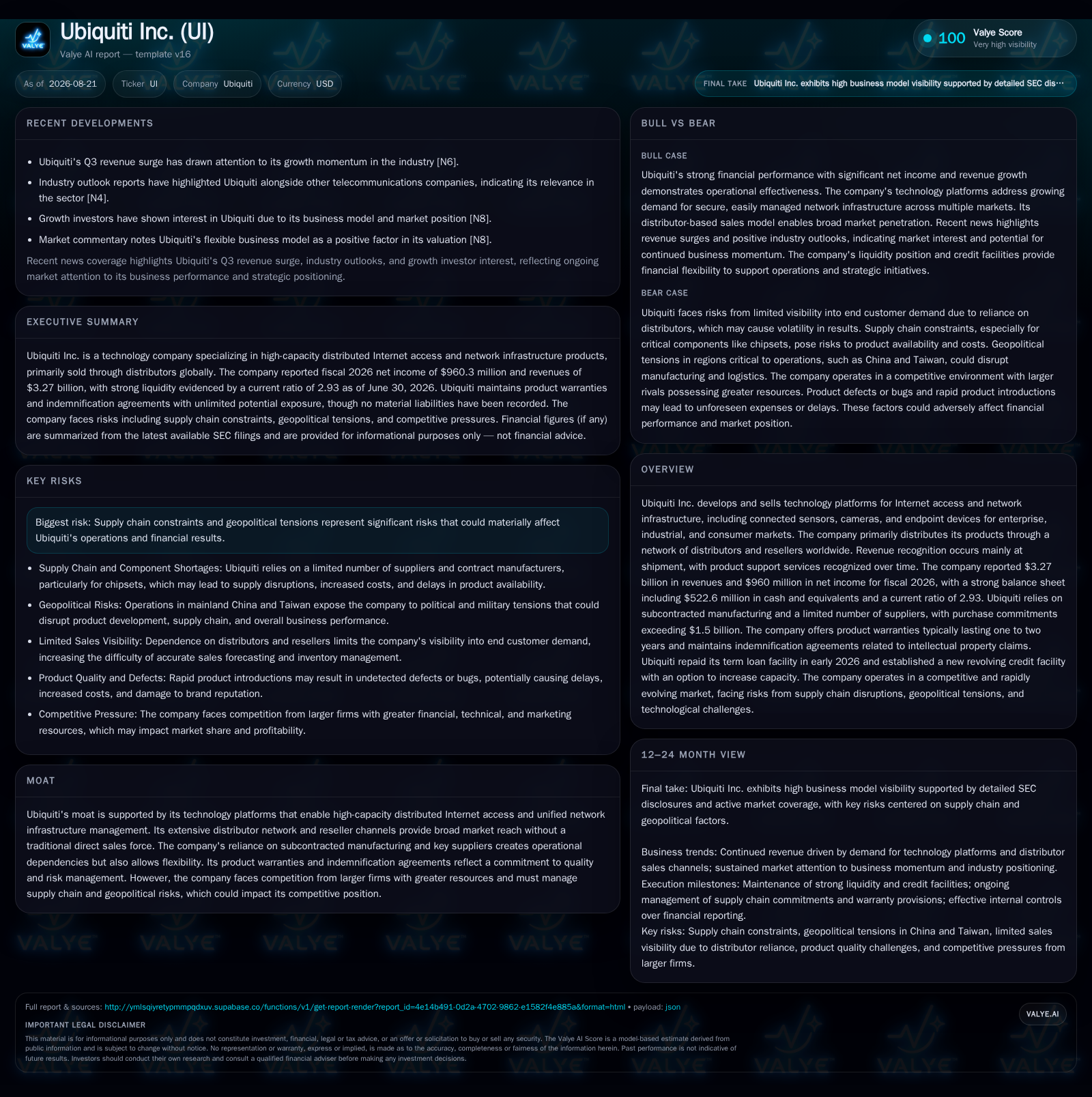
In its Q3 2026 10-Q filing, Ubiquiti Inc. disclosed key operational risk factors including its warranty accrual methodology, unlimited indemnification obligations, and reliance on subcontracted manufacturing with significant supplier concentration. These factors introduce potential variability in cost of goods sold and product availability, which are critical for near-term financial stability. While the company maintains a strong balance sheet and has actively managed its capital structure in early 2026, supply chain and warranty risks remain material considerations for investors monitoring Ubiquiti’s operational resilience.
Operating Risk and Warranty Management
Ubiquiti Inc.'s Q3 2026 10-Q filing provides important disclosures on its warranty accrual policies and indemnification exposures, which are central to understanding its operational risk profile [S2]. The company offers warranties generally spanning 12 to 24 months from purchase, covering parts and labor. While distributors typically bear freight costs for warranty returns, Ubiquiti absorbs freight costs for replacements under warranty. These accruals are based on historical warranty experience and are regularly reviewed and adjusted to reflect updated estimates [S2].
This warranty accrual approach represents a conservative risk management practice, ensuring that estimated future warranty costs are anticipated and embedded in margins from the outset. By provisioning these costs upfront, Ubiquiti reduces the likelihood of unexpected margin compression due to warranty claims, supporting more stable profitability [S2]. The filing also highlights that Ubiquiti has entered into standard indemnification agreements with distributors and other partners. These agreements may require Ubiquiti to indemnify partners against third-party claims alleging infringement of intellectual property rights related to Ubiquiti products. The potential indemnification exposure is unlimited in amount, although no liabilities have been recorded as of Q3 2026 [S2]. The company also indemnifies its directors and officers under separate agreements, with insurance coverage mitigating exposure. Based on historical experience and current information, Ubiquiti does not anticipate material liabilities arising from these indemnities in the near term.
Supply Chain Dependencies and Operational Risks
Ubiquiti’s business model relies extensively on subcontracted manufacturing and a limited number of key suppliers. As disclosed in the 2026 annual 10-K, the company’s purchase commitments with these suppliers exceed $1.5 billion, underscoring significant operational dependencies [S1]. This supplier concentration introduces risks related to product availability and procurement costs. Any disruption in manufacturing capacity, geopolitical tensions, or logistical challenges could delay shipments and increase costs, thereby impacting revenue recognition and margins.
Such supply chain reliance is common in the industrial hardware and network infrastructure sector, where companies often outsource manufacturing to specialized subcontractors. However, the limited supplier base reduces flexibility and increases exposure to external shocks. For Ubiquiti, managing these risks is critical given its revenue recognition primarily occurs at shipment to distributors and resellers [S1]. These figures provide historical context for the company’s capacity to absorb operational risks but do not reflect the latest quarter's financial position [S2].
In early 2026, Ubiquiti fully repaid its term loan facility scheduled to mature in March and subsequently entered into a new revolving credit agreement in May. These moves reflect active capital structure management aimed at maintaining financing flexibility amid evolving market conditions [S1]. While the Q3 2026 filing does not disclose updated liquidity metrics, the company expects to sustain financing flexibility despite macroeconomic uncertainties [S2].
Business Model and Competitive Positioning
Ubiquiti’s revenue is generated primarily through sales of network infrastructure products—including wireless access points, routers, switches, Internet access platforms, connected sensors, cameras, and endpoint devices—sold to distributors and resellers who then reach end customers [S1]. Revenue recognition occurs mainly upon shipment to these channel partners, with warranty costs accrued simultaneously in cost of goods sold. Product support services revenue is recognized over time.
Margins and cash conversion are influenced by warranty costs, procurement and freight expenses, and distributor payment terms [S1]. The company’s proprietary technology platforms and broad distributor network support competitive positioning, though supply chain dependencies and competition from larger firms remain constraints.
Analytical Conclusions and Implications
Ubiquiti’s warranty accrual policy, which provisions estimated future warranty costs in cost of goods sold at revenue recognition and adjusts accruals based on historical experience, reflects a prudent approach to managing product quality risk [S2]. This practice helps stabilize margins by anticipating warranty-related expenses, reducing the risk of unexpected cost shocks.
Conversely, the company’s reliance on subcontracted manufacturing and a concentrated supplier base, coupled with substantial purchase commitments, creates operational risks. Supply chain disruptions or cost increases could negatively affect product availability and gross margins, thereby influencing revenue and profitability [S1]
Watchpoints for Investors
Investors should monitor several key indicators to assess Ubiquiti’s ongoing operational risk and financial outlook. These include trends in warranty claims and accrual adjustments in future quarterly filings, which could signal changes in product quality or cost pressures. Developments in supply chain reliability, such as supplier concentration disclosures or reported shipment delays, will also be critical to watch.
Additionally, distributor order volumes and revenue recognition updates provide insight into demand dynamics and channel health [S2]. This would be confirmed by stable distributor orders, consistent warranty accruals without large spikes, and no material supply chain disruptions.
In a bear case, supply chain disruptions and rising warranty claims could materially increase costs and reduce product availability, pressuring margins and revenue growth [S2]. Confirmation would come from increased warranty charges, shipment delays, and declining distributor order volumes
Overall, Ubiquiti’s Q3 2026 disclosures provide valuable transparency on operational risk factors that are central to evaluating its near-term business resilience and financial stability.
Disclaimer: This is research-only, informational analysis and not investment advice. It may include AI-generated interpretation and general industry context. Always verify important details using primary sources.

Comments