
Virtuix Holdings Q2 2026: Tesla Partnership and Meta Quest Launch Drive Growth Amid Liquidity Constraints
Virtuix Holdings reported Q2 2026 results highlighting VR platform expansion through new product launches and strategic partnerships, alongside financial control challenges and liquidity constraints.
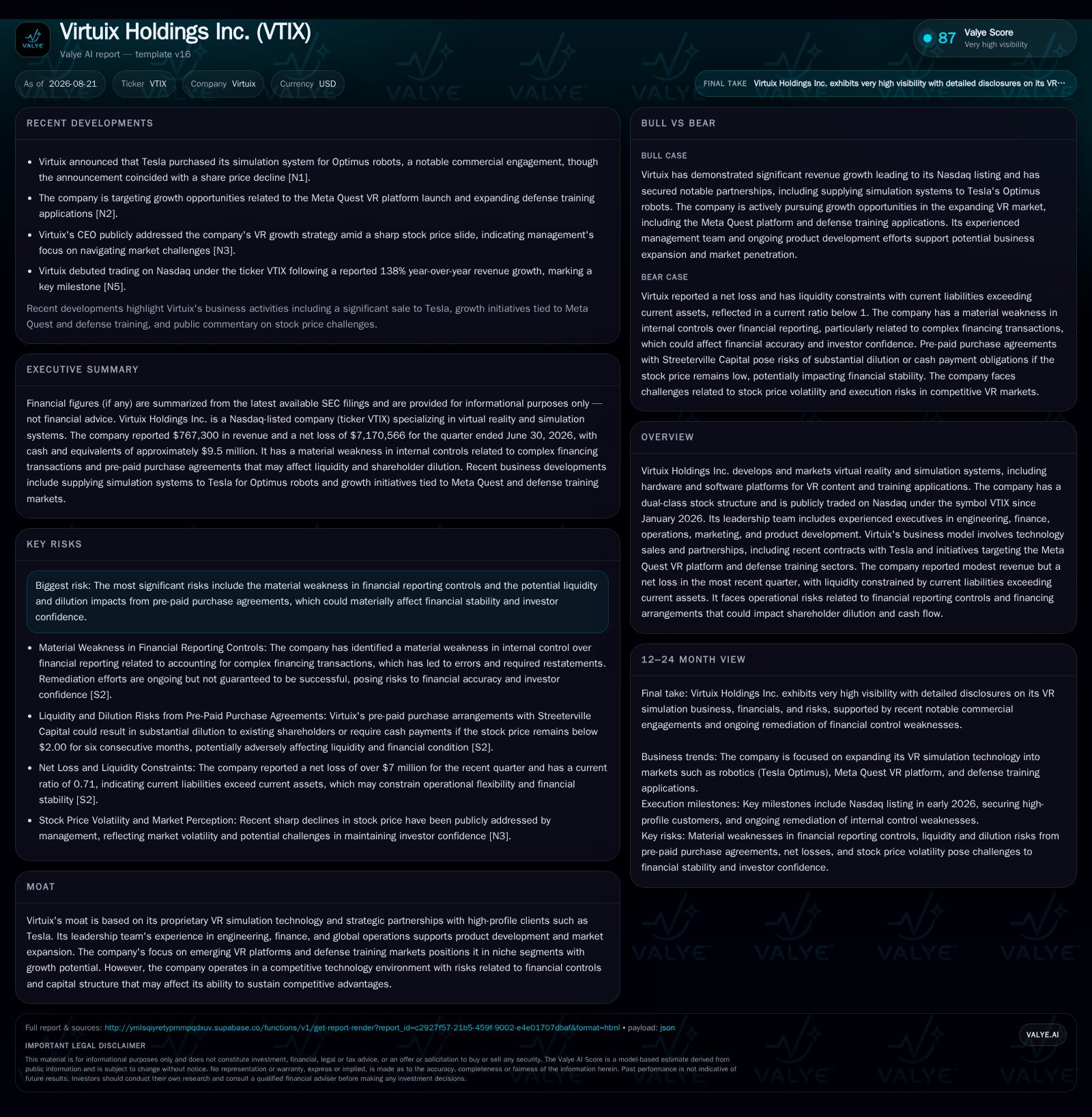
In Q2 2026, Virtuix Holdings advanced its virtual reality hardware business by launching the Omni One platform for Meta Quest and securing a strategic contract with Tesla for robotics simulation systems. These developments broaden its market reach into consumer VR and industrial robotics training. However, the company disclosed a material weakness in internal financial controls related to complex financing transactions, which has caused accounting errors and necessitated prior period adjustments. Additionally, Virtuix faces liquidity pressures with current liabilities exceeding current assets, raising concerns about its financial stability and ability to fund growth initiatives without further financing.
Q2 2026 Operating Developments and Market Expansion
Virtuix Holdings Inc. reported significant operational progress in the second quarter of 2026, centered around expanding its virtual reality (VR) hardware platform and securing strategic partnerships [S1][S5][N1]. In June 2026, Virtuix launched its Omni One omnidirectional treadmill for the Meta Quest VR platform, marking a notable expansion into the consumer VR market. This launch positions Virtuix to capitalize on the growing adoption of Meta Quest devices by offering immersive hardware that enhances user experience through full-motion simulation.
Complementing this consumer-facing initiative, Virtuix secured a contract with Tesla to provide simulation systems for Tesla’s Optimus robots. This partnership represents a strategic move into industrial robotics training, leveraging Virtuix’s simulation technology to support Tesla’s robotics development efforts. The Tesla contract underscores Virtuix’s ability to diversify its addressable market beyond consumer VR into specialized industrial applications, potentially opening recurring revenue opportunities through long-term engagements [S1][N2]. Together, these developments expand Virtuix’s market presence across both consumer and industrial VR segments. The Omni One launch on Meta Quest integrates Virtuix’s proprietary hardware with a leading VR platform, which could accelerate product adoption and revenue growth if consumer uptake is strong. Meanwhile, the Tesla partnership demonstrates Virtuix’s technology application in a high-profile robotics context, which may enhance its credibility and could open doors to additional corporate or defense contracts if further engagements materialize.
Financial Reporting Controls and Risk Assessment
Despite operational advances, Virtuix disclosed a material weakness in its internal control over financial reporting related to the accounting for complex financing transactions as of June 30, 2026 [S2]. Specifically, the company identified deficiencies in its processes for evaluating and documenting the application of U.S. GAAP to debt instruments with embedded features requiring bifurcation and separate accounting as derivative liabilities.
This control deficiency led to errors in the accounting for certain financing arrangements, necessitating adjustments and revisions to previously reported financial statements. The weakness existed as of March 31, 2026, and persisted through the quarter ended June 30, 2026 [S2]. Management has initiated remediation efforts, including enhanced procedures for identifying transactions requiring technical accounting analysis and engaging qualified accounting and valuation specialists. However, there is no assurance that these measures will fully remediate the weakness or prevent future deficiencies.
The material weakness raises the risk of financial misstatements, potential restatements, and delays in reporting. Such issues can undermine investor confidence and complicate access to capital markets, which is particularly critical for a company like Virtuix that operates in a capital-intensive industry and is currently managing liquidity constraints.
Liquidity and Capital Structure Analysis
As of June 30, 2026, Virtuix’s balance sheet reflects working capital challenges [F1][S2]
Total debt stood at about $14.56 million, consistent with the company’s elevated current liabilities and reflecting ongoing leverage pressures [F1][S2]. The liquidity shortfall suggests that Virtuix may face challenges in funding product development, market expansion, and operational expenses without securing new capital or improving cash flow from operations.
In this capital-intensive VR hardware and simulation sector, managing working capital and financing arrangements is crucial for sustaining product commercialization and scaling operations. Its customers span consumers, corporate clients, and defense entities who utilize VR hardware for immersive gaming experiences, robotics training, and defense simulation applications [S1].
Revenue generation primarily comes from hardware sales, supplemented by licensing agreements and strategic partnerships, such as the recent Tesla contract [S1][S2][S3]. Margins are influenced by product sales volume and mix, while cash conversion depends on effective working capital management and the complexity of financing arrangements, which have recently posed accounting challenges.
Virtuix’s competitive differentiation may lie in its proprietary VR hardware technology and its ability to secure strategic partnerships that could support validation of its platform across diverse markets. However, financial reporting control issues and liquidity constraints represent material challenges that could impede growth if not resolved.
Scenario Analysis and Investment Implications
Looking forward, several scenarios frame Virtuix’s potential trajectory:
Bull Case: Successful remediation of financial control weaknesses combined with improved liquidity management could enable Virtuix to leverage its Meta Quest Omni One launch and Tesla partnership to accelerate revenue growth and margin expansion [S2][S1][N1][N2]. Confirmation would come from subsequent filings showing no control issues, improved liquidity ratios, and stronger revenue trends
Base Case: Partial remediation efforts may stabilize some control deficiencies, but liquidity constraints persist, limiting growth investments [S2][F1]. Revenue growth from new products could be modest, with ongoing operating losses and potential dilution from financing. This would be supported by continued control challenges and current ratios below 1 in interim disclosures
Bear Case: Failure to remediate control weaknesses and worsening liquidity could lead to further financial reporting errors, operational disruptions, and loss of key partnerships [S2][F1]. These developments broaden the company’s market reach and validate its technology in consumer and industrial VR sectors.
However, the material weakness in financial reporting controls related to complex financing transactions and the constrained liquidity position present significant risks to financial stability and investor confidence. Addressing these issues is critical for Virtuix to sustain growth and capitalize on its recent operational advances.
These factors will be key indicators of Virtuix’s ability to navigate its current challenges and realize its growth potential.
Disclaimer: This is research-only, informational analysis and not investment advice. It may include AI-generated interpretation and general industry context. Always verify important details using primary sources.

Comments