
Sysco Corp 2026 Q4: Board Expansion and Operating Update with Solid Liquidity
Sysco Corporation expanded its Board of Directors and reported a stable liquidity position as of Q4 2026 amid ongoing industry challenges.
In August 2026, Sysco Corporation increased its Board of Directors from eleven to thirteen members, appointing two new directors effective September 1, 2026, reflecting a governance evolution. The company’s Q4 2026 financial disclosures show a current ratio of 1.28 and cash and equivalents of $1.786 billion as of June 27, 2026, supporting operational stability despite total debt of $12.315 billion. Persistent industry risks including low margins, inflationary pressures, labor shortages, and regulatory compliance challenges remain key considerations for future performance.
Governance Update and Board Expansion
Sysco Corporation announced on August 14, 2026, an increase in the size of its Board of Directors from eleven to thirteen members, with the appointments of Mr. Jason Murray and Mr. Thomas Ondrof effective September 1, 2026 [S3]. These new directors have been assigned to key committees, with Mr. Murray joining the Technology Committee and Mr. Ondrof the Audit Committee. This expansion represents a moderate evolution in governance, potentially strengthening oversight in areas critical to Sysco’s operational and financial risks. The addition of directors focused on technology and audit functions could support enhanced risk management and strategic initiatives, which is particularly relevant given the company’s exposure to supply chain complexities and regulatory compliance challenges.
The board expansion may also reflect a strategic response to the increasing complexity of Sysco's operating environment, where technology integration and financial oversight are paramount. By bolstering the Technology Committee, Sysco positions itself to better address risks related to cybersecurity, supply chain technology, and the growing use of artificial intelligence systems in operations. Similarly, strengthening the Audit Committee enhances the board’s capacity to oversee financial reporting, compliance, and internal controls, which is critical given the company's significant indebtedness and exposure to regulatory scrutiny [S3]
Latest Quarterly Financial Position and Liquidity
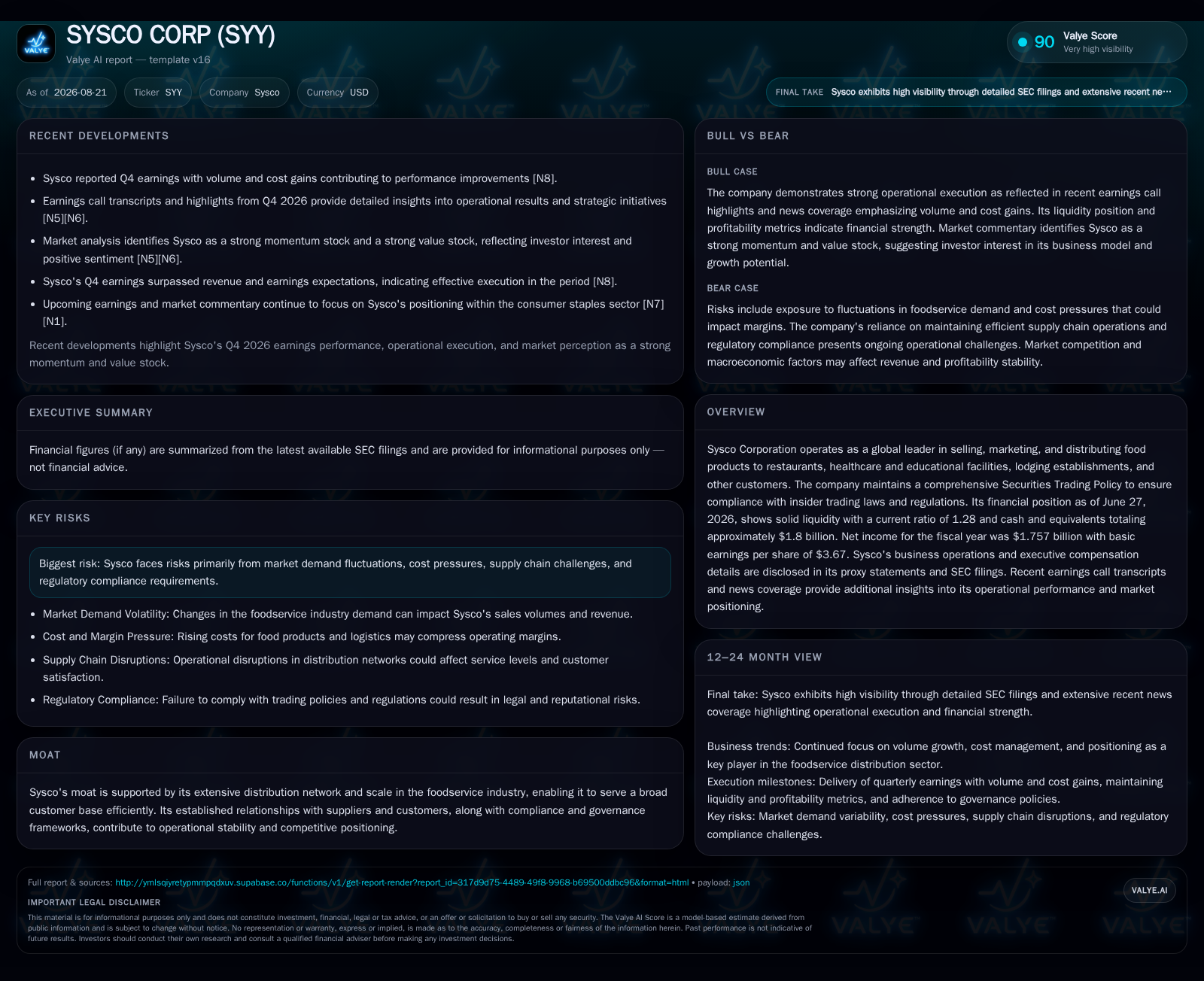
As of June 27, 2026, Sysco reported a current ratio of 1.28, reflecting current assets of $13.437 billion exceeding current liabilities of $10.523 billion [F1]. This liquidity coverage indicates the company’s ability to meet short-term obligations without stress. Cash and cash equivalents totaled approximately $1.786 billion, providing a significant buffer for operational needs and near-term liabilities [F1].
Total debt stood at $12.315 billion, with net debt—total debt less cash—approximately $10.529 billion as of June 27, 2026 [F1]. The company’s leverage level is substantial but appears manageable given its liquidity position and expected operational cash flows. However, refinancing risks remain a watchpoint, as adverse market conditions or credit rating downgrades could increase borrowing costs or limit access to capital.
Sysco faces ongoing risks that could pressure its financial performance and liquidity. Inflationary pressures continue to increase product and fuel costs, while labor shortages and wage inflation impact operating expenses [S1][S5]. Supply chain disruptions remain a concern, potentially affecting inventory availability and delivery reliability.
Competition and the influence of group purchasing organizations (GPOs) exert margin pressure, while changes in customer mix—particularly growth in multi-unit customers who typically generate lower margins than locally managed customers—pose risks to gross and operating margins [S1][S6]. Regulatory compliance remains a critical concern, with potential liabilities arising from food safety, labor laws, and environmental regulations [S5][S7]. These risk factors contribute to earnings volatility and operational challenges that require vigilant management and governance oversight.
Industry Risks and Operational Challenges
Sysco operates in an industry characterized by structurally low margins and cyclical demand fluctuations influenced by economic conditions and consumer spending on foodservice [S1]. The company’s risk profile includes several significant factors that could adversely affect its business and financial condition. Inflation or deflation can materially impact product costs and profitability. Labor shortages and rising labor costs may reduce earnings, while supply chain interruptions can impair product availability and service levels.
Additionally, regulatory compliance risks are pronounced. Sysco is subject to extensive federal, state, and local laws governing food safety, labor practices, environmental standards, and data privacy. Non-compliance could result in lawsuits, fines, or operational restrictions, adversely affecting reputation and financial results [S5][S7]. The company also faces risks related to product liability and recalls, which could have material financial and reputational consequences.
The competitive landscape is intense, with pressure from other distributors and GPOs limiting pricing power and margin expansion [S6]. Customer concentration and contract renewals are critical, as the loss or renegotiation of major customer agreements could materially impact revenues and margins. The anticipated shift toward a higher proportion of multi-unit customers, who typically generate lower margins due to higher volume but lower value-added services, could further compress profitability
Business Model and Competitive Positioning
Sysco’s business model centers on purchasing, marketing, and distributing food and related products to a diverse customer base that includes restaurants, healthcare and educational institutions, lodging establishments, and other foodservice providers [S1]. Revenue is primarily generated through sales volume and distribution services. Margins are influenced by product mix, customer segmentation, and cost pressures such as fuel and labor expenses.
The company’s extensive distribution network and scale provide operational efficiencies and broad market reach, which are key competitive advantages. These capabilities enable Sysco to serve a wide array of customers efficiently and maintain a significant market presence. However, the company faces margin constraints due to competitive pressures and the bargaining power of GPOs, which can negotiate lower prices and terms [S1][S5]
Sysco’s ability to manage costs, maintain customer relationships, and adapt to changing market dynamics is critical to sustaining profitability. The company’s governance enhancements, including the board expansion with new committee appointments, may support strategic initiatives to address these challenges.
Analytical Conclusions
The recent board expansion reflects a governance evolution that could enhance oversight, particularly through the addition of directors with specialized committee roles in technology and audit. This may strengthen Sysco’s ability to manage operational and financial risks inherent in its complex supply chain and regulatory environment [S3]. The focus on technology oversight is timely given the company’s reliance on advanced systems and the risks associated with cybersecurity and AI integration.
Financially, Sysco’s liquidity position as of June 27, 2026, is solid, with a current ratio of 1.28 and cash and equivalents of $1.786 billion providing a buffer against near-term obligations [F1]. Changes in customer mix between multi-unit and locally managed segments will also be important, as shifts could impact margin stability. Additionally, debt refinancing activity and any changes in credit ratings warrant close attention, given the company’s leverage.
Governance developments, particularly committee activities and disclosures, will provide insight into how effectively the board manages emerging risks. Regulatory compliance updates and any product recall incidents should be watched closely due to their potential financial and reputational impact.
While the company faces persistent risks from low margins, inflationary cost pressures, labor shortages, and regulatory compliance, its governance enhancements and financial profile support operational resilience. Continued vigilance on cash flow, margin trends, and refinancing risks will be essential to sustaining this stability going forward.
Disclaimer: This is research-only, informational analysis and not investment advice. It may include AI-generated interpretation and general industry context. Always verify important details using primary sources.

Comments