
SunPower Inc Q2 2026: Operating Expansion and Liquidity Challenges Amid Debt Covenants
SunPower broadens its national solar platform through acquisitions and partner networks while facing liquidity pressures and secured debt covenant risks.
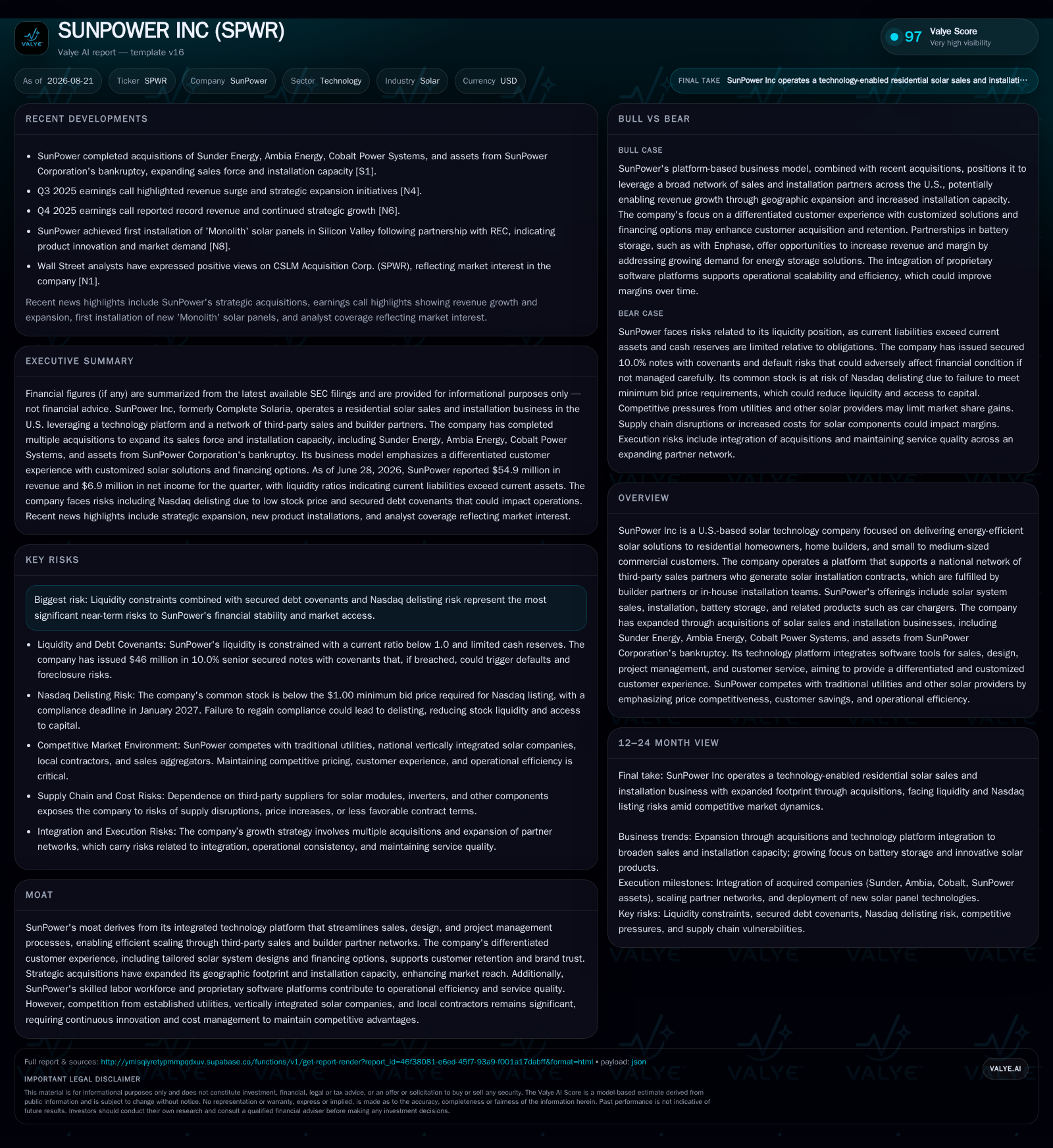
In Q2 2026, SunPower Inc significantly expanded its solar sales and installation platform by acquiring multiple regional companies and integrating third-party sales partners, enhancing its geographic footprint and installation capacity. The company leverages a proprietary technology platform to streamline operations and deliver a differentiated customer experience. However, SunPower's liquidity position remains constrained, with a current ratio of 0.82 and $46 million in secured 10.0% Notes carrying restrictive covenants that pose default and foreclosure risks. A recent $3.5 million SAFE equity investment highlights ongoing capital needs. The company’s growth prospects depend on managing these financial risks while scaling its expanded platform.
Operating Expansion Through Acquisitions and Partner Networks
SunPower Inc has continued to expand its national solar sales and installation platform in the second quarter of 2026 through a series of strategic acquisitions and an extensive network of third-party sales and builder partners [S2]. The company operates a platform where third-party sales partners generate residential solar installation contracts, which are fulfilled either by SunPower’s in-house installation teams or through local builder partners.
Since late 2024, SunPower has acquired several entities including Sunder Energy, Ambia Energy, Cobalt Power Systems, and assets from SunPower Corporation. These acquisitions have significantly increased the company’s geographic footprint and installation capacity across multiple U.S. regions [S1][S7]. For example, Sunder Energy provides a third-party solar sales force that initiates and executes contracts nationwide, while Ambia and Cobalt contribute residential solar installation capabilities in various markets, including the San Francisco Bay area. This expanded footprint positions SunPower to access a broader customer base and accelerate revenue growth opportunities in the U.S. residential solar sector.
The company’s business model centers on selling solar systems to residential homeowners, home builders, and small to medium-sized commercial customers. Revenue is primarily generated from installation contracts initiated by the national sales partner network [S1][S2][S7]. SunPower manages project execution by providing pre-construction services such as engineering plans and permitting, then contracts with builder partners or deploys in-house crews to complete installations. This approach allows SunPower to scale operations efficiently while maintaining a differentiated customer experience.
Technology Platform and Customer Experience Differentiation
A key enabler of SunPower’s scalable growth is its integrated technology platform, which supports sales, solar system design, project management, and customer service functions [S1][S6][S11]. The platform incorporates software tools such as Salesforce.com for order management and Merdeka, acquired through Sunder, which provides end-to-end visibility from bookings through energization. This technology ecosystem simplifies and streamlines the lifecycle of residential solar projects, empowering both large-scale and smaller sales and builder partners with plug-and-play capabilities.
SunPower emphasizes delivering a differentiated customer experience by offering customized solar solutions tailored to individual homeowners’ needs. This includes design-specific systems, flexible pricing configurations, and a consultative sales process focused on maximizing customer savings relative to traditional utility energy costs [S1][S6][S11]. The company’s platform also supports national-scale sales partners, enabling consistent offerings and execution processes across diverse territories, including regions where SunPower previously had limited presence.
The integration of battery storage solutions through partnerships, such as with Enphase, represents an additional avenue for revenue and margin expansion [S1]. As of June 28, 2026, the company’s current ratio was 0.82, indicating that current liabilities of $139.2 million exceed current assets of $113.8 million, reflecting a working capital deficit and liquidity pressure [F1]. Cash and equivalents stood at $4.1 million at the same date, underscoring constrained short-term liquidity [F1].
In April and May 2026, SunPower issued $46 million aggregate principal amount of secured 10.0% Notes [S2][S13]. These notes carry customary covenants and events of default that could lead to acceleration of debt repayment and foreclosure on collateral.
The company also received a Nasdaq Delisting Notice during Q2 2026, which adds to financial and market access risks, potentially complicating refinancing and capital raising efforts [S2]. These factors collectively heighten refinancing risk and operational uncertainty if liquidity deteriorates further or covenant compliance is breached.
Capital Raising and Financial Outlook
In August 2026, SunPower entered into a $3.5 million Simple Agreement for Future Equity (SAFE) with an institutional investor [S3]. This agreement provides for conversion into equity at the price of the next financing round without a discount, indicating ongoing capital needs and efforts to bolster the financial runway.
The recent SAFE investment, combined with the issuance of secured notes, reflects active capital raising to support the company’s growth initiatives and operational needs amid liquidity constraints. The company’s integrated technology platform and broad partner network lower customer acquisition costs and enable geographic expansion, which are vital for revenue growth and margin improvement. Additionally, expanding battery storage offerings can enhance margins by adding higher-value products to the solar system sales mix.
A working capital deficit, as indicated by a current ratio of 0.82 as of June 28, 2026 [F1], could constrain SunPower’s ability to invest in growth, manage operational costs, or refinance debt on favorable terms. The Nasdaq Delisting Notice further complicates market access and investor confidence.
Watchpoints
Key indicators to monitor in upcoming quarters include:
- Quarterly revenue and margin trends to assess whether acquisition integration and partner network expansion translate into sustained growth.
- Liquidity metrics such as the current ratio and cash balances to evaluate improvements or deterioration in working capital.
- Compliance with the 10.0% Notes covenants and any default or waiver notices that could signal financial distress.
- Progress in battery storage sales and integration, which could drive margin expansion.
- Additional capital raises or equity issuances that affect the company’s capital structure and dilution.
Conclusion
SunPower Inc’s Q2 2026 disclosures highlight a company actively expanding its national solar sales and installation platform through acquisitions and partner networks supported by proprietary technology [S1][S7][S2]. This expansion significantly enhances its addressable market and installation capacity, positioning SunPower for potential revenue growth in the competitive U.S. residential solar sector.
At the same time, the company faces significant financial risks from liquidity constraints and secured 10.0% Notes debt covenants that could limit operational flexibility and growth execution [F1][S2][S13]. The recent $3.5 million SAFE equity investment provides some near-term capital support but also signals ongoing funding needs [S3].
Disclaimer: This is research-only, informational analysis and not investment advice. It may include AI-generated interpretation and general industry context. Always verify important details using primary sources.

Comments