
OSI Systems Q3 2026: Contract Milestones Drive Security Segment Cash Flow and Stock Buyback Expansion
Achievement of contractual milestones in OSI Systems' Security segment reduces contract assets, boosting cash flow, while deferred revenue growth reflects service contract dynamics.
In Q3 2026, OSI Systems reported a $67.9 million decrease in contract assets driven by milestone achievements in its Security division, enabling invoicing and enhancing near-term cash flow. Concurrently, deferred revenue rose by $12.1 million, primarily due to service contracts allowing payment before performance, indicating a shift in revenue recognition timing. The company’s Board approved an additional 1 million shares for repurchase, increasing the total remaining authorization to about 1.08 million shares. As of June 30, 2026, OSI Systems maintained a strong liquidity position with a current ratio of 3.15, cash and equivalents of $360 million, and net debt near $658 million, supporting operational flexibility and capital allocation.
Contract Asset and Deferred Revenue Dynamics
OSI Systems Inc reported a significant $67.9 million reduction in contract assets during Q3 2026, primarily attributable to the achievement of contractual milestones within its Security segment [S2]. Contract assets represent revenue that has been earned but not yet invoiced; thus, milestone completion triggers the company's right to invoice customers. This transition from contract assets to accounts receivable enables cash collection, directly improving near-term cash flow. In industries such as security systems manufacturing, where turnkey contracts often include milestone-based billing, this dynamic is a critical operating KPI reflecting contract execution progress.
Alongside this, deferred revenue increased by $12.1 million in the same period, mainly due to service contracts that allow OSI Systems to collect payments before fulfilling performance obligations [S2]. Deferred revenue, a contract liability, represents customer advances for services yet to be performed. Growth in deferred revenue indicates an expanding portion of recurring or service-based contracts, which can enhance revenue visibility but also shifts revenue recognition timing. While this may smooth revenue volatility over time, it delays cash recognition until the company satisfies its performance obligations.
These contract asset and deferred revenue movements illustrate structural aspects of OSI Systems’ business model, which combines product sales with service contracts across government, healthcare, and commercial customers [S1]. The milestone-driven invoicing in the Security segment accelerates cash conversion, whereas service contracts contribute to deferred revenue balances that affect top-line timing.
Liquidity, Leverage, and Capital Allocation
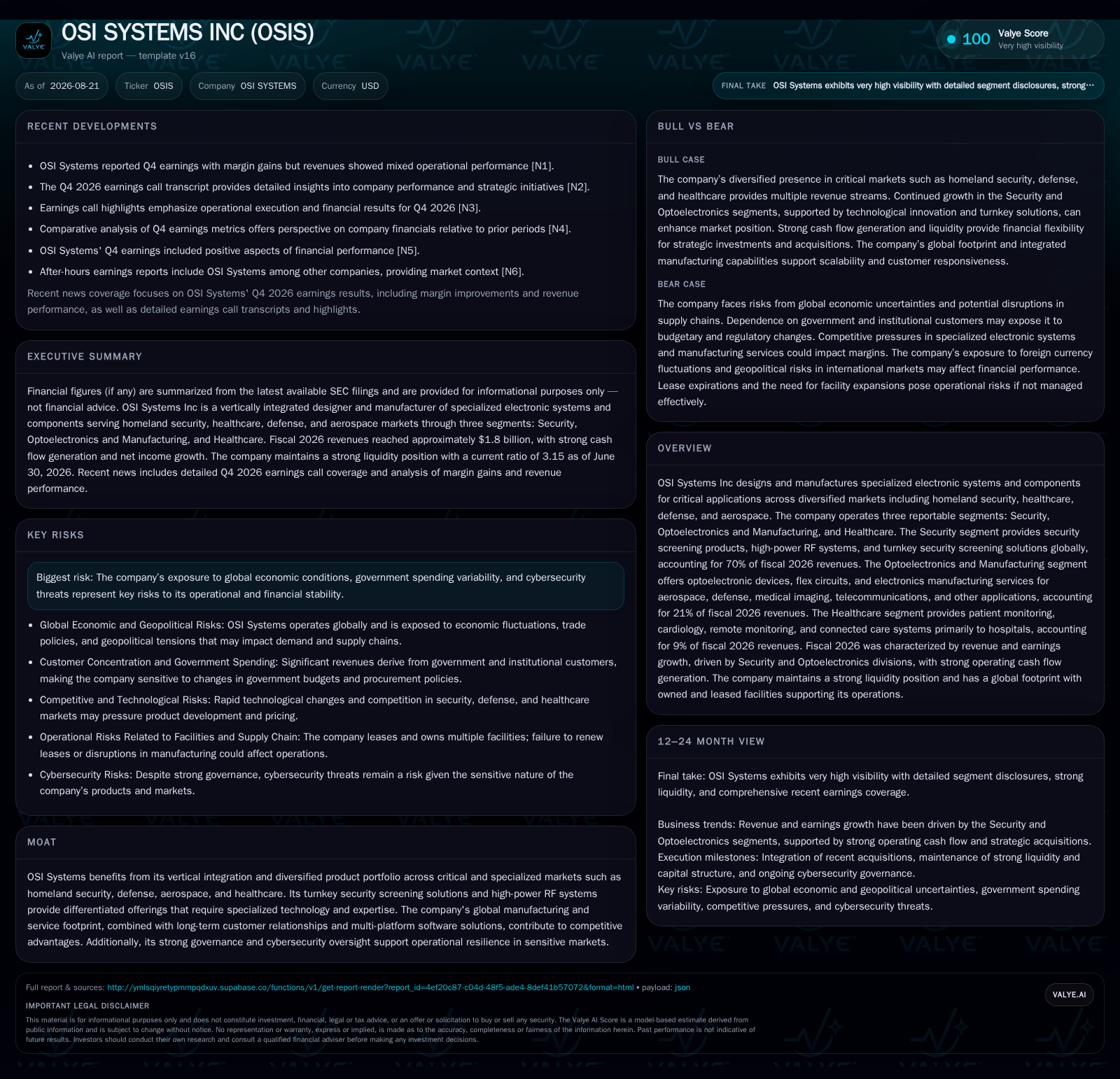
As of June 30, 2026, OSI Systems reported cash and cash equivalents of $359.8 million and total debt of $1.0176 billion, resulting in net debt of approximately $657.8 million [F1]. The company’s current assets were $1.6117 billion against current liabilities of $511.1 million, yielding a current ratio of 3.15 [F1].
Reflecting this financial position, OSI Systems’ Board of Directors approved an additional 1 million shares for repurchase in August 2026, increasing the total remaining buyback authorization to about 1.08 million shares [S3]. This expanded share repurchase authorization signals active capital return to shareholders and suggests that the company is leveraging its improved cash flow and liquidity to optimize capital allocation.
The interplay between contract milestone achievement, which enhances cash inflows, and the company’s liquidity and leverage metrics underpins its capacity to pursue share repurchases without compromising operational needs.
Business Model and Competitive Positioning
OSI Systems operates as a vertically integrated manufacturer and integrator of specialized electronic systems, serving government agencies, healthcare providers, aerospace and defense contractors, and commercial customers [S1]. Its product portfolio includes security screening solutions, optoelectronic devices, and healthcare monitoring systems.
Revenue recognition is closely tied to contractual milestones and service contract performance. Milestone achievement in security contracts triggers invoicing rights, converting contract assets into accounts receivable and cash. Service contracts, on the other hand, often involve customer advances recorded as deferred revenue until performance obligations are met.
Vertical integration and a diversified product mix across critical markets allow OSI Systems to manage margins and supply chain risks effectively. The company’s turnkey security solutions and strong cybersecurity governance further differentiate it within its industry segments.
Scenario Analysis and Investor Implications
One plausible bullish scenario is that OSI Systems continues to achieve contract milestones steadily or at an accelerating pace in its Security segment. This would sustain or enhance cash flow from operations, supporting further share repurchases and potentially enabling margin expansion due to improved cash conversion.
Conversely, a bearish scenario could arise if the increase in deferred revenue from service contracts reflects slower-than-expected contract performance or delays in fulfilling obligations. This would defer revenue recognition and cash inflows, potentially pressuring margins and limiting capital allocation flexibility [S2]. Indicators confirming this would include growing deferred revenue without corresponding revenue recognition, negative cash flow trends, or margin compression.
Investors should monitor future quarterly filings for trends in contract assets and deferred revenue, cash flow from operations, and share repurchase activity [S2][F1]. The concurrent growth in deferred revenue from service contracts signals evolving revenue recognition dynamics that may smooth top-line volatility but require careful monitoring. Future developments in contract execution and financial metrics will be key to validating these trends and their impact on OSI Systems’ operational and financial trajectory
Disclaimer: This is research-only, informational analysis and not investment advice. It may include AI-generated interpretation and general industry context. Always verify important details using primary sources.

Comments