
ModuLink Inc. Q2 2026: Technology Integration and Liquidity Challenges Amid Project Development Pause
ModuLink's Q2 2026 update reveals a continued halt in new modular construction projects, a strategic acquisition in AI robotics, and persistent liquidity constraints.
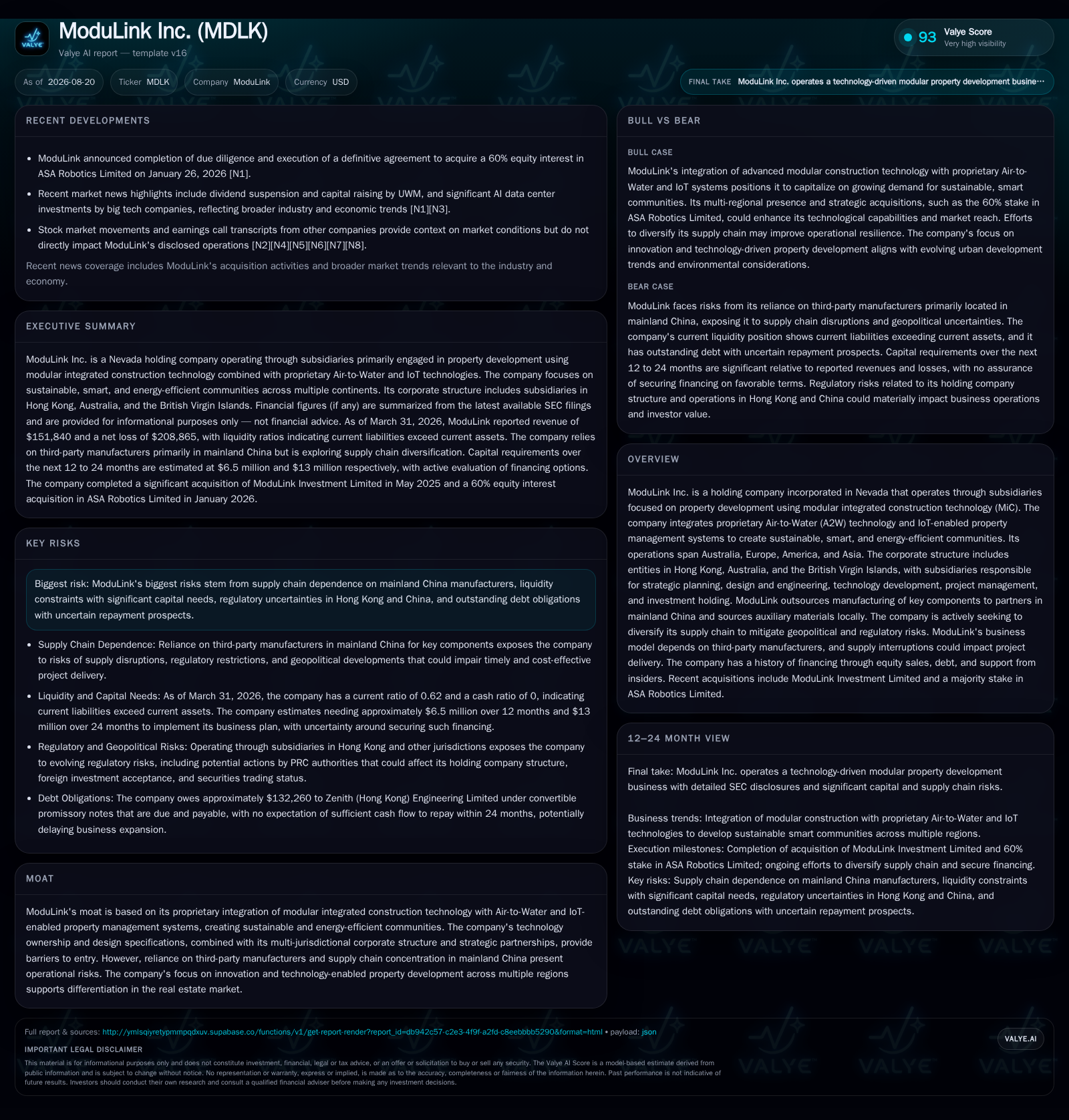
ModuLink Inc. remains in a development phase without initiating new modular integrated construction projects since 2024, focusing on groundwork and technology integration. The company completed a majority acquisition of ASA Robotics in April 2026 to enhance its technology capabilities. Despite this strategic expansion, ModuLink faces liquidity challenges with a current ratio of 0.62 as of March 31, 2026, and revenue concentration risks from reliance on two customers. These factors limit near-term revenue growth and operational scalability, with future progress dependent on securing funding and successful technology integration.
Latest Quarterly Operating and Financial Update
ModuLink Inc.'s latest quarterly filing dated August 19, 2026, confirms the company remains in a development phase without initiating any new modular integrated construction (MiC) projects since 2024 [S2][S1]. The company is currently focused on foundational activities such as regulatory planning, site selection, and capital preparation for future projects, with an expectation to commence one to two MiC projects in Vancouver within the next 18 months, contingent on securing necessary funding.
Business Model and Revenue Concentration Risks
ModuLink operates as a property developer utilizing modular integrated construction technology embedded with proprietary Air-to-Water (A2W) systems and an IoT-enabled property management platform. The company generates revenue primarily from property development projects that rely on project initiation and completion milestones [S1]. The absence of long-term contracts and the ability of these customers to terminate services with notice heighten exposure to revenue volatility and margin pressure [S1]. This concentration risk is critical in a capital-intensive industry where project financing and customer stability directly impact operational viability.
Technology Acquisition and Strategic Positioning
In April 2026, ModuLink completed the acquisition of a 60% equity interest in ASA Robotics Limited, a Hong Kong-based AI and robotics solutions company [S5]. ASA Robotics is now a majority-owned subsidiary, consolidated in ModuLink's financial statements, and expected to enhance the group's technology capabilities through AI-driven automation solutions.
This acquisition aligns with ModuLink's strategic emphasis on integrating advanced technology into sustainable property development. While the transaction expands the company's technological portfolio, the immediate financial impact on revenue and margins remains unreported, and the benefits depend on successful integration and commercialization of ASA Robotics' solutions [S5][S6][S7]
Financial Position and Liquidity Constraints
Recent capital allocation includes the issuance of Series A Convertible Preferred Stock valued at approximately $641,000 to acquire ASA Robotics and a private placement raising about $300,000 in May 2026, reflecting ongoing efforts to secure funding necessary for operational continuity and future project development [S5][S12]. The company's financial statements are prepared on a going concern basis, explicitly noting reliance on continued financial support from insiders and majority shareholders. This dependence highlights the risk that any withdrawal of support or failure to secure additional funding could materially impair operations [S1].
Scenario Analysis and Investment Considerations
Given the current operating and financial profile, three scenarios emerge:
Business Economics and Risk Watchpoints
ModuLink's business model depends heavily on initiating and completing modular construction projects that integrate proprietary A2W and IoT technologies. The capital-intensive nature of modular property development requires substantial upfront financing for land acquisition and modular unit procurement, making liquidity management a critical operational factor.
Customer concentration risk is elevated, with two customers generating virtually all revenue and no long-term contracts in place. This exposes the company to significant revenue volatility and pricing pressure, which could adversely affect margins and operational sustainability.
The acquisition of ASA Robotics introduces potential for technological differentiation through AI and robotics integration, which could enhance project efficiency and product offerings. However, the value of this acquisition hinges on successful integration and commercialization, which remains to be demonstrated.
The working capital deficit and high customer concentration underscore operational and financial risks that will influence the timing and success of future project rollouts. The company's ability to secure funding, integrate new technologies, and diversify its revenue base will be pivotal in shaping its growth trajectory.
Disclaimer: This is research-only, informational analysis and not investment advice. It may include AI-generated interpretation and general industry context. Always verify important details using primary sources.

Comments