
Transportation & Logistics Systems Q2 2026: Insolvency and Shell Status Persist Amid PGS Acquisition Delay
TLSS remains a non-operating shell company with severe liquidity constraints and delayed acquisition progress as of Q2 2026.
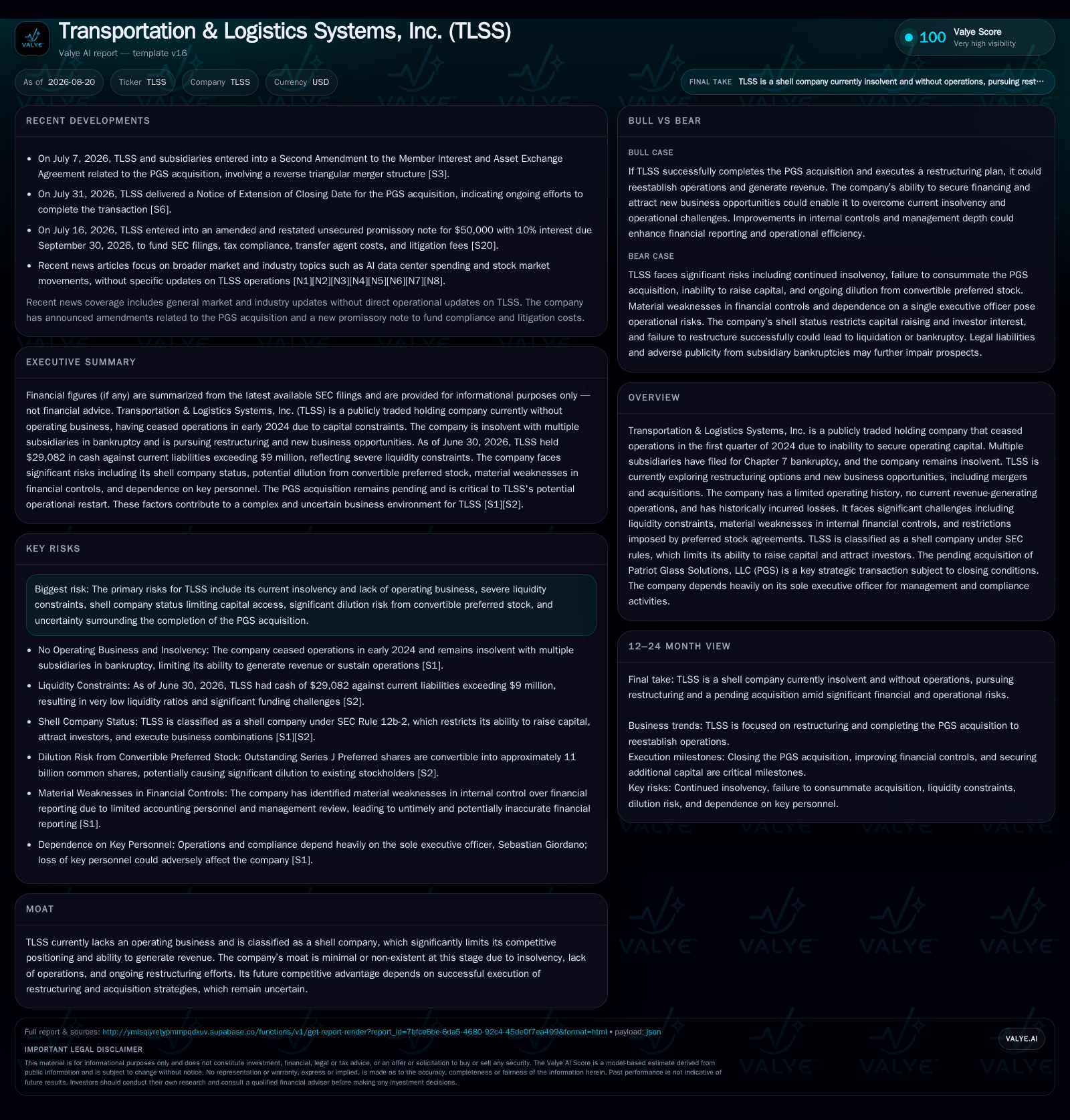
Transportation & Logistics Systems, Inc. ceased operations in early 2024 and continues as an insolvent shell company with no revenue generation as of Q2 2026. The pending acquisition of Patriot Glass Solutions, LLC has been delayed, extending uncertainty about the company’s ability to resume operations or improve its financial position. Severe liquidity shortfalls, a current ratio effectively at zero, and significant dilution risk from convertible preferred stock complicate the company’s prospects for capital raising and shareholder value restoration.
Q2 2026 Operating and Financial Status
Transportation & Logistics Systems, Inc. (TLSS) remains a non-operating, insolvent shell company as of the quarter ended June 30, 2026 [S2][F1]. Multiple subsidiaries have filed for Chapter 7 bankruptcy, underscoring the structural insolvency that persists [S1][F1]. The company ceased operations in the first quarter of 2024 due to an inability to secure operating capital, and this cessation has continued without any resumption of business activities [S1][S2].
This results in a current ratio effectively at zero, indicating severe liquidity constraints and a working capital deficit that precludes normal operating activity or meaningful capital deployment [F1]. Specifically, TLSS held only $29,082 in cash and cash equivalents against current liabilities totaling $9,164,673 as of June 30, 2026, yielding a current ratio of 0 [F1]. The balance sheet reflects liabilities vastly exceeding assets, consistent with the company’s insolvency status. TLSS’s classification as a shell company under SEC rules further restricts its ability to raise capital or resume operations, as it lacks significant assets or ongoing business [S2]. The acquisition agreement, initially entered into in April 2026 and amended twice subsequently, was extended by a Notice of Extension issued on July 31, 2026, delaying the closing date [S2][S10][S11]. This delay prolongs the company’s uncertain status as a shell entity.
The acquisition involves a reverse triangular merger whereby TLSS’s wholly owned subsidiary, TLSS Reverse PGS, LLC, merges with and into PGS, with PGS as the surviving entity [S11]. The transaction contemplates the exchange of the Seller’s 80% membership interest in PGS and certain nanotechnology patents for consideration from TLSS [S11]. Despite these strategic intentions, the delay in closing the acquisition extends the period during which TLSS remains without operating assets or revenue-generating business.
Failure to consummate the PGS acquisition would maintain TLSS’s shell classification, restricting capital raising opportunities and the ability to replace discontinued operations. Even if the acquisition closes, TLSS must demonstrate operational substance to be removed from shell company status, a process that involves regulatory disclosures and operational milestones [S2]. The SEC requires that a company no longer meet the definition of a shell by having significant assets and operations, and until such conditions are met, TLSS’s securities may suffer from impaired marketability and liquidity. The delay thus extends the period of financial and operational uncertainty, which is critical for shareholder value and liquidity restoration.
Capital Structure and Dilution Risks
TLSS’s capital structure presents significant challenges for existing shareholders. The company’s outstanding Series J Preferred Stock is convertible into approximately 11 billion shares of common stock as of June 30, 2026, excluding accrued dividends that may increase this number further [S2]. Each share of Series J Preferred is initially convertible into 100,000 shares of common stock, and the preferred stock accrues dividends at a rate of 10% per annum, payable in cash or additional shares, thereby increasing potential dilution [S2].
This conversion potential creates substantial dilution risk, which would materially reduce the ownership percentage and voting power of current common stockholders. The magnitude of this dilution is significant given the enormous number of shares issuable upon conversion relative to the current common shares outstanding. This risk is compounded by the company’s inability to generate revenue or positive cash flow, which limits its capacity to repurchase shares or otherwise mitigate dilution.
In August 2026, TLSS shareholders approved a 5,000-for-1 reverse stock split aimed at consolidating shares [S3]. However, this corporate action does not address the underlying operational or financial issues, nor does it mitigate the dilution risk posed by the preferred stock conversion [S3]. The reverse stock split primarily serves to adjust the share count and improve the per-share trading price, which may be necessary for compliance with listing standards or to enhance marketability, but it does not improve liquidity or solvency.
Business Model and Industry Position
Historically, TLSS operated in the transportation and logistics sector, providing related services to customers. However, since ceasing operations in early 2024, the company has no active service offerings or revenue streams [S2]. Its current business model is that of a non-operating shell company, with value contingent on completing restructuring transactions or acquisitions that would restore operational capacity [S3].
The company’s inability to secure operating capital and the insolvency of multiple subsidiaries have eliminated its competitive position in the logistics industry. Without operations, TLSS lacks the customer contracts, assets, and personnel necessary to compete effectively. The company’s future business model depends entirely on the successful acquisition and integration of PGS or another viable business opportunity.
In this industry context, shell companies face structural constraints including limited access to capital markets, regulatory compliance burdens, and investor skepticism. The company’s negligible cash position relative to liabilities and shell company classification limit its operational options and capital market access. Peers in the logistics sector typically maintain positive operating cash flow, stable capital structures, and ongoing contract renewals, contrasting sharply with TLSS’s current status.
Risks and Outlook
TLSS faces multiple risks that impair its viability absent successful restructuring or acquisition. The severe liquidity shortfall, with cash and equivalents of only $29,082 against current liabilities of $9,164,673, precludes meaningful operational activity or investment [F1]
Failure to consummate the acquisition would maintain the company’s shell status, restricting capital raising and operational restart options.
Significant dilution risk from the Series J Preferred Stock conversion further complicates shareholder value prospects [S2]. The approved reverse stock split does not mitigate these financial challenges and primarily serves administrative purposes [S3].
Key watchpoints for investors and stakeholders include the timing and completion of the PGS acquisition, changes in liquidity and working capital in future filings, any conversion activity related to Series J Preferred Stock, potential resumption of operations or revenue generation, and further corporate actions such as capital raises or restructuring agreements. Monitoring these factors will be critical to assessing TLSS’s viability and prospects for recovery.
In summary, as of Q2 2026, Transportation & Logistics Systems remains a shell company facing severe financial and operational challenges. Its future depends heavily on completing the delayed acquisition and managing dilution risks to restore operational substance and financial health. The structural nature of its insolvency and shell status, combined with the protracted acquisition timeline and capital structure risks, present significant obstacles to recovery and value creation.
Disclaimer: This is research-only, informational analysis and not investment advice. It may include AI-generated interpretation and general industry context. Always verify important details using primary sources.

Comments