
VisionWave Holdings Q2 2026: Early-Stage Defense Tech Progress Amid Severe Liquidity Constraints
VisionWave Holdings advances proprietary defense technologies amid severe liquidity constraints and going concern risks as of Q2 2026.
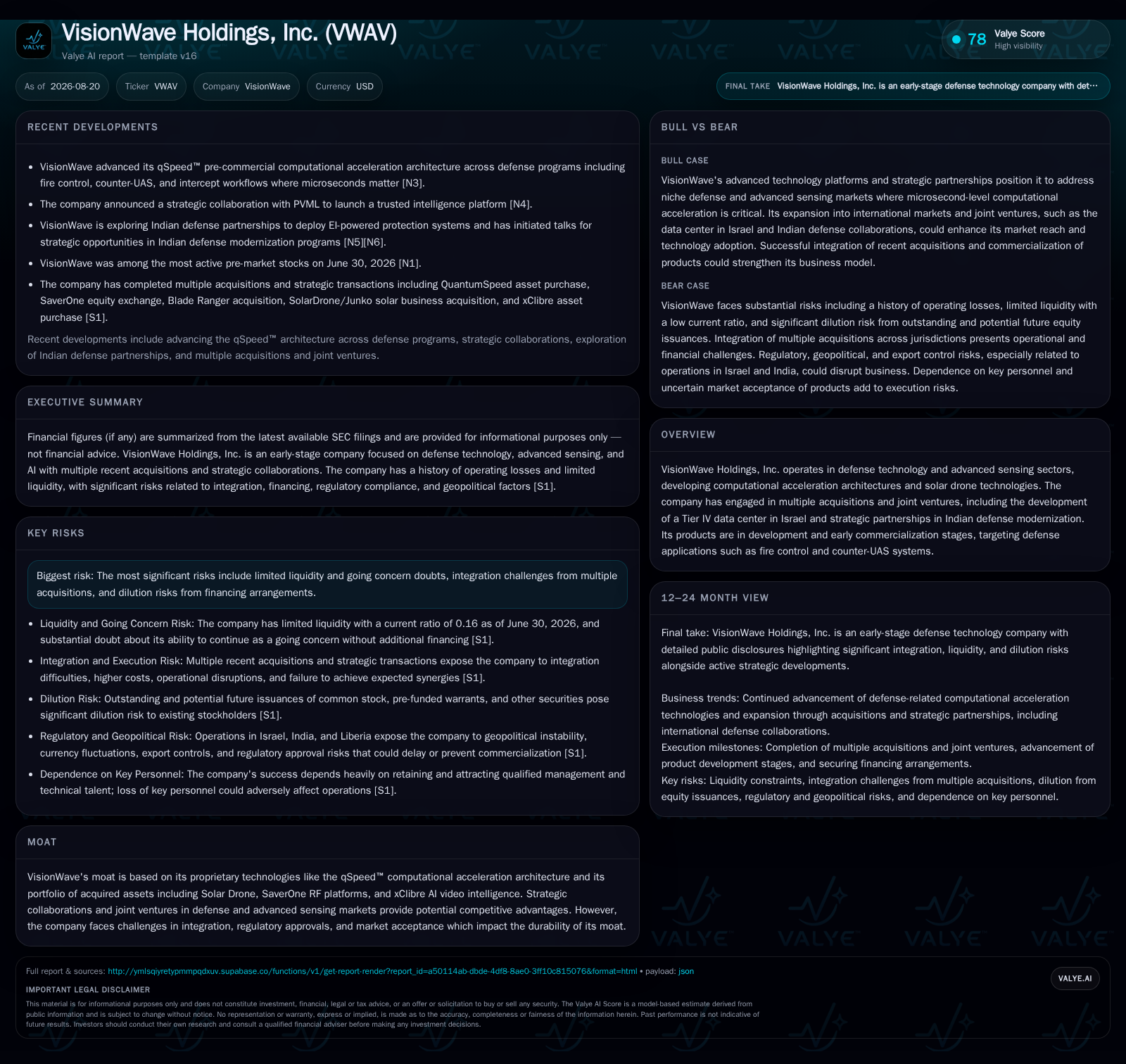
VisionWave Holdings, Inc. continues to develop its early-stage defense technology platforms, including computational acceleration and solar drone systems, while facing critical financial challenges. As of June 30, 2026, the company reported a severely constrained liquidity position with only $26,186 in cash and a current ratio of 0.16, reflecting a significant working capital deficit. Despite strategic initiatives such as appointing an experienced executive to expand business development in Europe, the company’s ability to sustain operations and achieve commercialization depends heavily on securing additional financing and overcoming integration hurdles.
Q2 2026 Operating and Financial Update
VisionWave Holdings, Inc. reported continued development of its proprietary defense technology platforms during the quarter ended June 30, 2026. The company remains focused on advancing its qSpeed™ computational acceleration architecture and Solar Drone technologies, which target aerospace and defense applications through advanced sensing and unmanned systems [S2]. However, financial disclosures highlight severe liquidity constraints that pose significant operational risks. This resulted in a current ratio of 0.16, indicating a substantial working capital deficit and limited near-term liquidity to fund ongoing operations [F1]. As of June 30, 2026, VisionWave held cash and cash equivalents of only $26,186, underscoring the acute shortage of liquid resources available to meet immediate financial obligations [F1].
Technology Development and Market Expansion Efforts
VisionWave’s business model centers on developing advanced defense technologies for government agencies and prime contractors, with revenue expected from product sales, licensing, and strategic partnerships as commercialization progresses [S2]. The company is actively integrating multiple acquired platforms, including Solar Drone and the SaverOne RF sensing system, which contributes to ongoing operating losses. These integration efforts are critical to building a comprehensive technology portfolio but also extend the timeline before meaningful revenue generation can occur [S2].
To support market penetration, VisionWave appointed a senior executive with over 25 years of experience in defense and technology sectors to lead business development and sales across the UK and Europe, with the role covering aerospace and defense markets [S3]
The company’s total debt was approximately $6.99 million as of February 26, 2026, reflecting significant leverage relative to its limited liquidity and current assets [F1]. This debt level, combined with the working capital deficit, places considerable pressure on the company’s financial flexibility. Management explicitly acknowledges substantial doubt about the company’s ability to continue as a going concern within one year absent committed financial support, which has been secured but remains uncertain in sufficiency and timing [S2]. With current assets totaling approximately $6.32 million against current liabilities of nearly $39.59 million, the resulting current ratio of 0.16 starkly illustrates the company’s inability to cover short-term obligations from available resources [F1]. This working capital deficit is a critical constraint on operational continuity and strategic initiatives.
Cash reserves are minimal, with only $26,186 available at quarter-end, limiting the company’s capacity to fund research and development, integration activities, and commercialization efforts without immediate additional financing [F1]. The company’s capital allocation remains focused on advancing proprietary technologies and integrating acquisitions, activities that are capital intensive and require sustained investment [S2].
The debt position, reported as of February 26, 2026, stands at approximately $6.99 million [F1]. Liquidity metrics as of June 30, 2026, show current assets of $6.32 million against current liabilities of $39.59 million, resulting in a current ratio of 0.16 [F1]. The difference in reporting dates between debt and liquidity figures should be noted when assessing the company's financial position and leverage [F1].
Risks and Outlook
VisionWave’s early-stage status in the defense technology sector entails extended development cycles, high R&D expenditures, and integration complexities that contribute to continued operating losses. The company has proprietary platforms and recent strategic hires related to aerospace and defense markets, but near-term revenue visibility remains limited. The critical risk lies in the company’s liquidity constraints and working capital deficit, which pose a material threat to sustaining operations and advancing commercialization without successful capital raises or milestone achievements.
Management’s acknowledgment of substantial doubt regarding the company’s ability to continue as a going concern highlights the precarious financial position. Although committed financial support has been secured, the sufficiency and timing of such support remain uncertain, creating a significant risk factor for investors and stakeholders [S2].
Key watchpoints for investors and stakeholders include quarterly updates on revenue or order intake that would confirm progress toward commercialization, announcements regarding financing arrangements to alleviate liquidity pressures, milestones related to technology integration and regulatory approvals, and changes in operating cash flow and burn rate in subsequent quarters. Monitoring these factors will be essential to assess whether VisionWave can overcome its financial challenges and capitalize on its technology development efforts within the structurally driven defense technology sector.
In summary, VisionWave Holdings continues to advance its defense technology platforms amid significant financial constraints. The company’s ability to execute its business plans and realize value from its proprietary technologies depends on securing additional funding and achieving commercialization milestones in a capital-intensive and competitive industry environment. The severe liquidity shortfall and working capital deficit represent material risks that must be addressed to sustain operations.
(Word count: approximately 710).
Disclaimer: This is research-only, informational analysis and not investment advice. It may include AI-generated interpretation and general industry context. Always verify important details using primary sources.

Comments