
Ranger Gold Corp. Q2 2026: Exploration Stage Status Maintained Amid Capital and Operational Constraints
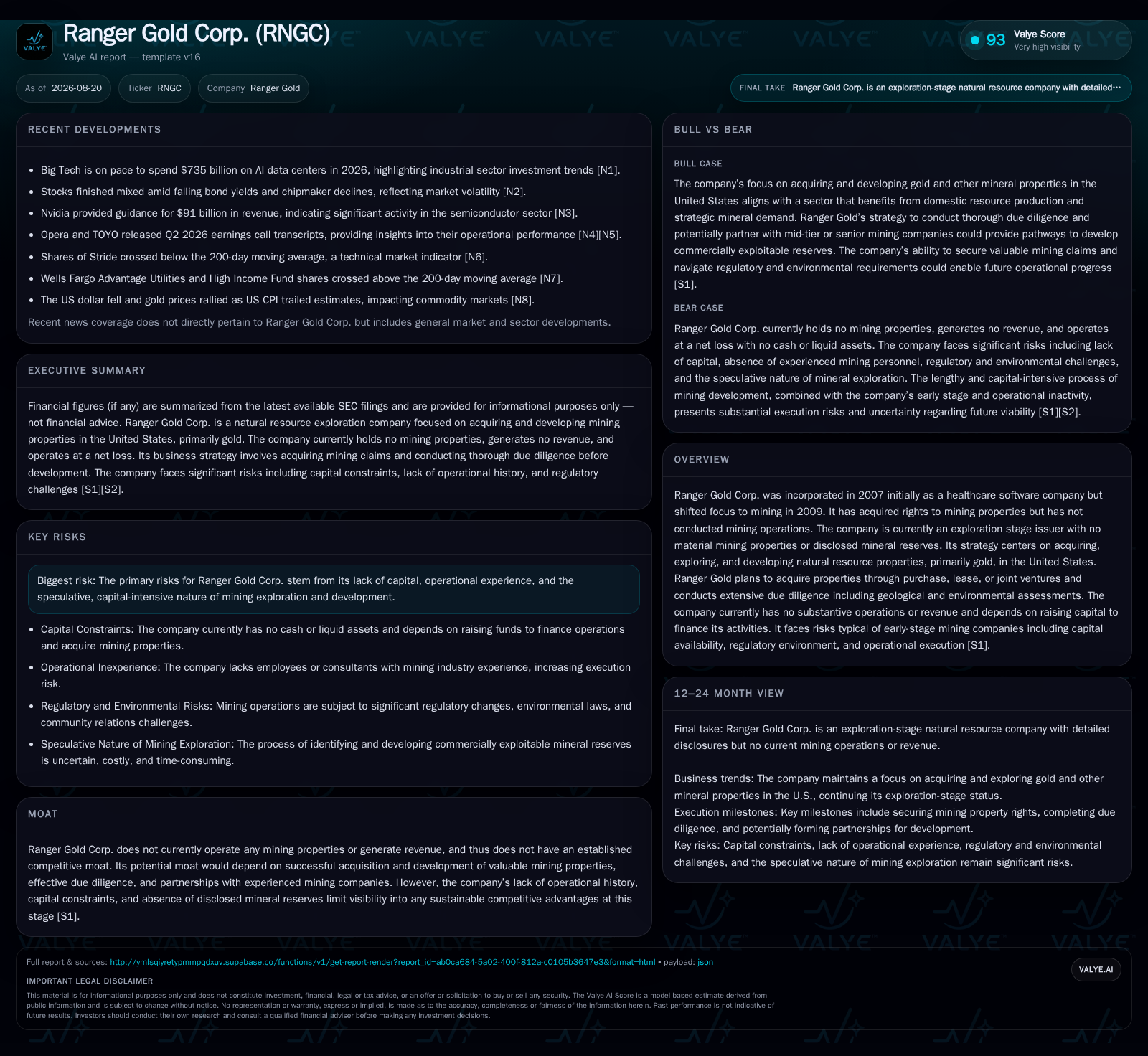
Ranger Gold Corp. continues as an exploration stage company with no mining operations or assets, relying entirely on external capital to fund its business.
As of Q2 2026, Ranger Gold Corp. holds no current assets and faces current liabilities exceeding assets, confirming its status as an exploration stage issuer without mining operations or revenue. The company’s business model depends on raising capital to acquire and develop mining properties, primarily for gold, but it currently lacks any material mining properties or disclosed mineral reserves. This financial and operational position underscores the speculative and high-risk nature of Ranger Gold’s business, with continued dependence on its sole officer and director for funding and no assurance of future financing or operational progress.
Latest Quarterly Financial Position and Operating Status
Ranger Gold Corp.'s latest quarterly filing for the period ended June 30, 2026, confirms that the company remains an exploration stage issuer with no mining operations or revenue generation [S2]. The balance sheet as of this date shows zero current assets and current liabilities of $1,177, resulting in a current ratio of zero and a negative working capital position [F1]. This financial snapshot highlights the company's lack of liquid resources to fund any operational activities or property acquisitions independently.
Business Model and Strategic Context
Ranger Gold Corp.'s business model centers on acquiring, exploring, and developing natural resource properties, primarily gold, within the United States. This acquisition may occur through outright purchase, lease, license, claim, or other agreements granting real property and mining rights [S1]. However, the company has not yet acquired any substantive mining properties or mineral rights that would constitute material assets.
The company depends entirely on external capital raising to finance its operations and acquisition activities. There is no assurance that such financing will be successful or sufficient to commence mining operations [S1][S2]. Since January 2019, the company's sole officer and director, Bryan Glass, has funded operations through loans or investments, but he is not contractually obligated to continue doing so [S1]. This reliance on a single individual for funding further underscores the company's fragile financial position.
The company's capital allocation is focused exclusively on raising funds to acquire mining properties, with no capital expenditures reported to date [S2].
Industry and Competitive Landscape
In the junior natural resource exploration and mining sector, companies like Ranger Gold operate at the upstream end of the value chain, focusing on property acquisition, exploration drilling, resource estimation, and feasibility studies. Success in this sector depends heavily on securing capital, acquiring properties with disclosed mineral reserves, and advancing projects toward development and production.
Junior mining companies face intense competition for mineral properties, financing, and qualified personnel. Senior mining companies typically dominate production and often partner with juniors to develop properties [S9]. Ranger Gold’s lack of capital, absence of experienced personnel, and no owned mining properties place it at a significant competitive disadvantage relative to better-capitalized peers.
Risks and Operational Challenges
Ranger Gold faces several structural risks that constrain its ability to progress. The absence of disclosed mineral resources or reserves and lack of mining operations confirm the company remains in an early, speculative exploration stage with high operational and financial risk.
Other risks include the company’s reliance on its sole officer and director for funding, lack of employees or consultants with mining experience, and the capital-intensive nature of mineral exploration and development. Regulatory and environmental compliance risks also pose potential challenges, as mining operations require permits and adherence to evolving environmental laws [S1][S5].
Analytical Conclusions and Outlook
Ranger Gold Corp.'s financial and operational position as of Q2 2026 underscores the speculative nature of its business model [S1][S2]. The company’s zero current assets and liabilities exceeding assets structurally limit its ability to acquire or develop mining properties without external capital infusion [F1][S2]. The absence of mineral reserves or mining operations confirms it remains in an early exploration stage with significant operational and financial risks.
Investors and stakeholders should monitor key developments including announcements of capital raising efforts, acquisition or leasing of mining properties with disclosed mineral reserves, engagement of qualified technical personnel, and progress on permitting or regulatory approvals. These markers would indicate potential advancement beyond the current exploration stage.
Until such milestones are achieved, Ranger Gold’s operations and economic viability remain highly dependent on successful financing and the willingness of its principal stockholder to continue funding. The company’s lack of liquid assets and operational history highlight the speculative and high-risk nature of its business model in the capital-intensive mining exploration sector.
Disclaimer: This is research-only, informational analysis and not investment advice. It may include AI-generated interpretation and general industry context. Always verify important details using primary sources.

Comments