
DNA X, Inc. Q2 2026: Transition from 5G Solutions Business Highlights Liquidity and Capital Structure Risks
Following the January 2026 sale of its enterprise 5G assets, DNA X, Inc. faces significant liquidity pressures and a redefined business focus as of Q2 2026.
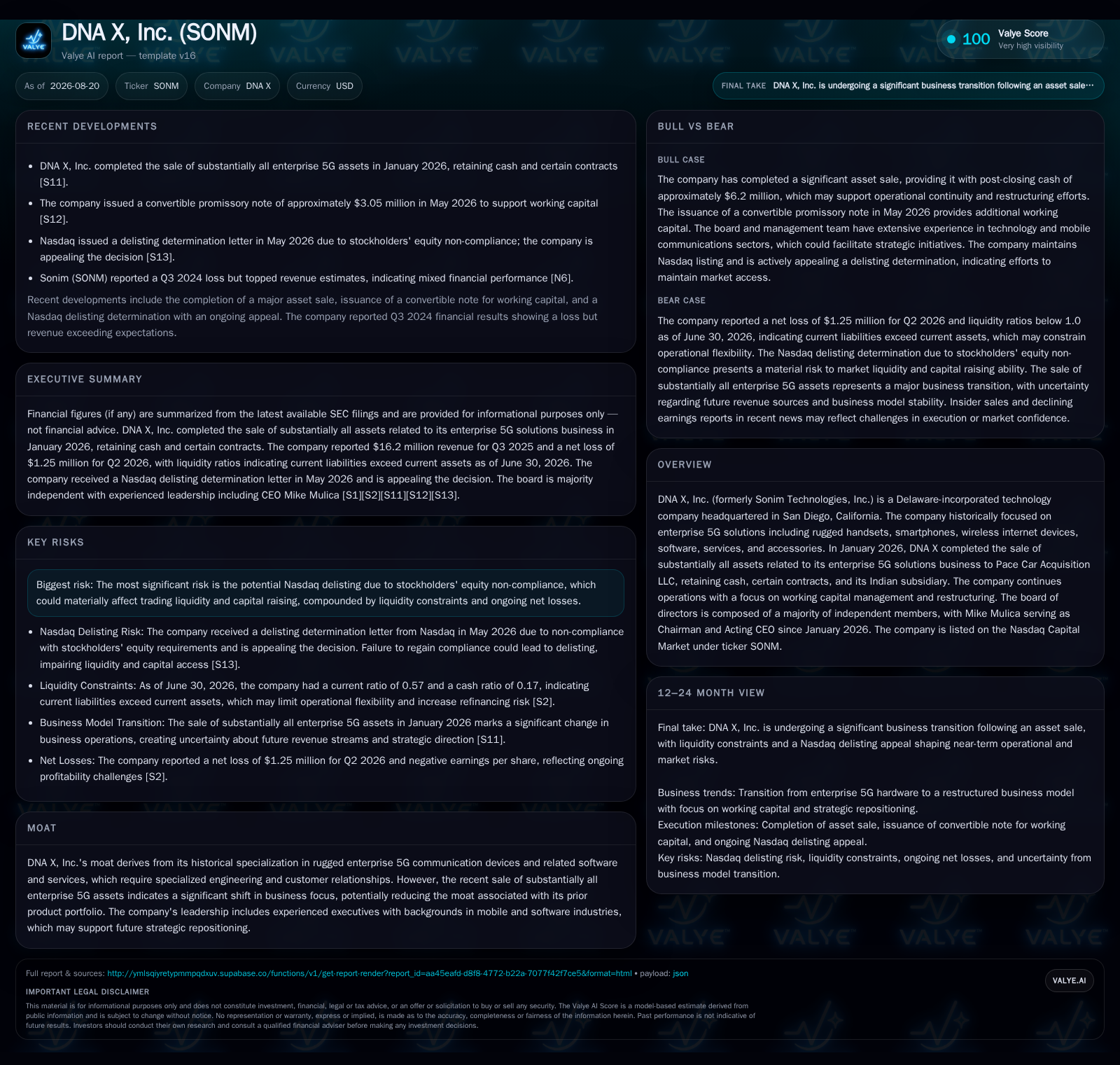
DNA X, Inc. completed the divestiture of its core enterprise 5G solutions assets in early 2026, marking a major shift away from its historical hardware and software business. As of June 30, 2026, the company reported cash of $0.9 million and a current ratio of 0.57, reflecting substantial liquidity constraints. These financial conditions limit operational flexibility and raise risks related to Nasdaq listing compliance. The company now emphasizes working capital management and restructuring efforts amid a materially reduced business scope.
Recent Asset Sale and Business Model Shift
In January 2026, DNA X, Inc. completed the sale of substantially all assets related to its enterprise 5G solutions business [S1]. This transaction marked a fundamental change in the company's operations, leaving it with only cash reserves, certain residual contracts, and an Indian subsidiary. Historically, DNA X generated revenue through the design, manufacture, and sale of ruggedized 5G communication devices, software licensing, and related services for enterprise customers. The divestiture effectively ended this core business, significantly reducing the company's operational scale and revenue-generating capacity.
This structural pivot shifts DNA X’s business model away from hardware-centric enterprise 5G solutions toward a focus on managing working capital and restructuring efforts. The company no longer operates the core 5G solutions business, which had involved transactional sales of specialized hardware and software [S2]. However, current liabilities stood at $5.15 million, resulting in a current ratio of 0.57, well below the generally accepted threshold of 1.0 that indicates sufficient short-term liquidity [F1]. This negative working capital position signals pressure on the company's ability to meet near-term obligations and maintain operational stability.
Total debt was reported at $1.2 million as of March 31, 2026, with no redemption rights on Series B Preferred Stock as of July 2026, underscoring a constrained capital structure without immediate debt relief options [F1][S3]. Further capital allocation flexibility is limited by restrictions agreed upon in the asset sale purchase agreement, which impose constraints on the issuance and sale of company securities pending stockholder approval. These restrictions, coupled with consulting agreements involving equity issuance, reflect the company's limited ability to raise capital or restructure equity freely in the near term [S3].
The liquidity shortfall and capital limitations restrict DNA X's operational flexibility, complicating efforts to stabilize the business and invest in potential new initiatives. In a sector where working capital management and cash conversion cycles are critical due to the capital-intensive nature of hardware manufacturing and service delivery, such constraints heighten financial risk.
Risks and Outlook
DNA X faces material risks related to its Nasdaq listing status. The company's disclosures highlight ongoing net losses and stockholders’ equity non-compliance, which, combined with the current liquidity profile as evidenced by a current ratio of 0.57 and negative working capital, increase the risk of delisting or the need for equity recapitalization [S2], [F1].
Given the structural shift away from enterprise 5G hardware and software sales, DNA X's future financial performance will depend heavily on its ability to manage working capital effectively and execute restructuring plans. The absence of a recurring revenue base from product sales or service contracts further complicates cash flow predictability.
Key watchpoints include the outcome of stockholder approval for securities issuance restrictions, which will affect the company's ability to raise capital. Additionally, forthcoming quarterly filings will be critical to monitor cash flow trends, working capital improvements, and any announcements regarding restructuring progress or new business initiatives. Updates on Nasdaq listing compliance will also be essential to assess the company's financial health and risk profile going forward.
Business Economics and Sector Context
In the technology hardware and services sector, companies like DNA X typically rely on the sale of specialized ruggedized devices, software licensing, and service contracts to generate revenue. These businesses require efficient working capital management due to the capital-intensive nature of hardware manufacturing and the need to absorb fixed costs over product lifecycles. The divestiture of DNA X’s core enterprise 5G assets removes its primary sources of product sales and recurring revenue streams, shifting the company’s economic model toward managing residual contracts and restructuring liabilities.
A ratio below 1.0, as seen with DNA X’s 0.57 figure [F1], signals that current liabilities exceed current assets, which can constrain operational activities and increase refinancing risk. This situation is compounded by the company's ongoing net losses and equity deficiencies, common challenges that can lead to regulatory and listing risks [S2].
DNA X’s constrained capital structure and limited cash reserves restrict its ability to invest in new product development or scale operations, placing it at a competitive disadvantage relative to peers with stable enterprise contracts and stronger liquidity profiles. As of June 30, 2026, the company faces acute liquidity challenges, with a current ratio of 0.57 and cash of $0.9 million, limiting financial flexibility and heightening the risk of Nasdaq delisting due to equity non-compliance and ongoing losses [F1], [S2]. The transition from a hardware and software enterprise solutions provider to a working capital and restructuring-focused entity underscores the critical importance of cash management and capital structure adjustments in the near term.
Investors and stakeholders should closely monitor stockholder approval for securities issuance restrictions, upcoming quarterly cash flow and working capital trends, restructuring progress, and any developments related to Nasdaq listing compliance. These factors will be pivotal in determining DNA X’s ability to stabilize operations and potentially rebuild its business model in a challenging financial environment.
Disclaimer: This is research-only, informational analysis and not investment advice. It may include AI-generated interpretation and general industry context. Always verify important details using primary sources.

Comments