
KEEMO Fashion Group Struggles with Revenue Generation and Liquidity Amid Asset-Light Apparel Wholesale Push
KEEMO reported no revenue and sustained losses in Q2 2026, reflecting liquidity pressures and early-stage market penetration in a competitive China apparel wholesale sector.
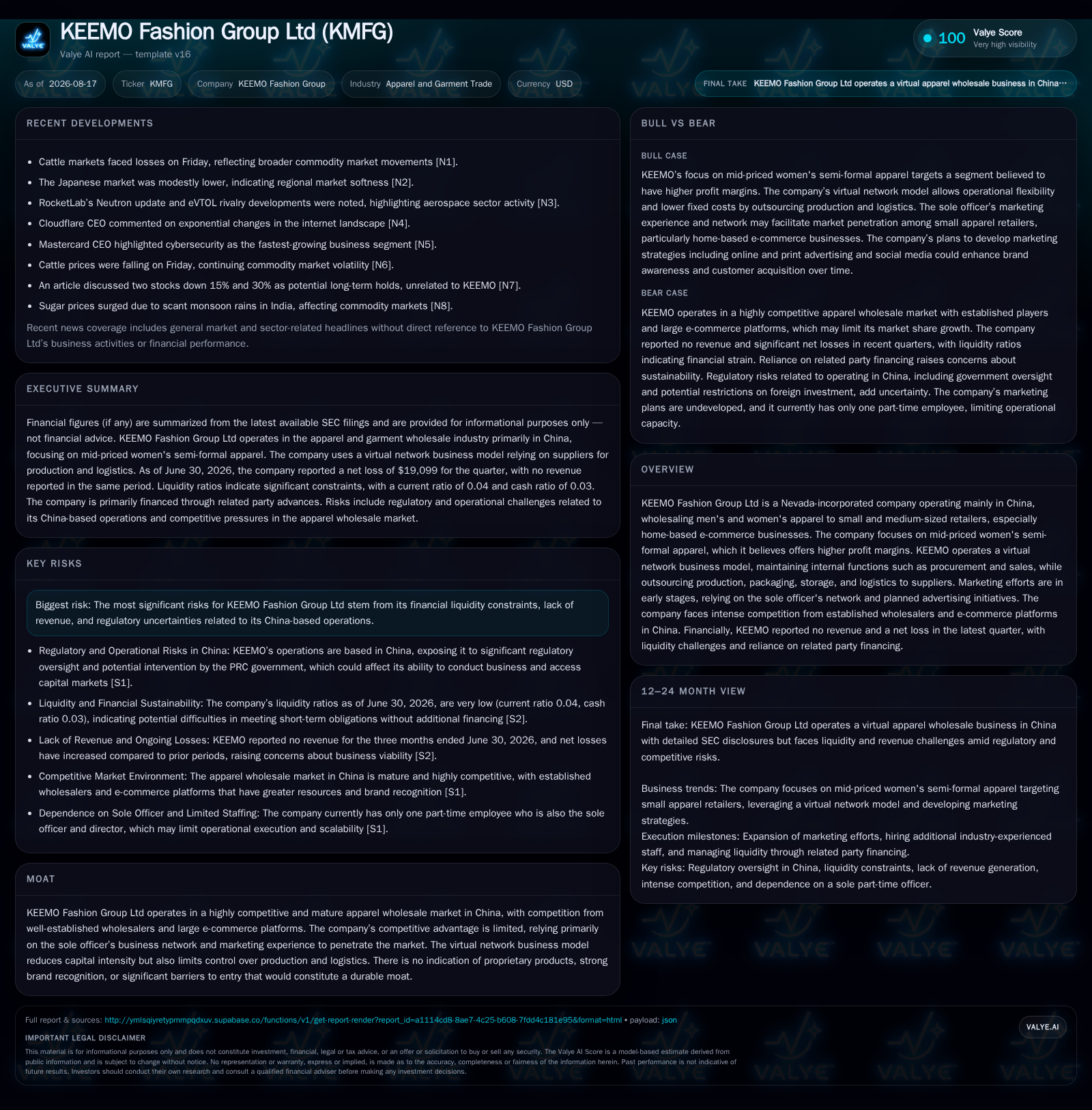
KEEMO Fashion Group Ltd's latest quarterly filing reveals ongoing financial distress marked by zero revenue generation and net losses of $19,099 in Q2 2026, despite efforts to develop its apparel wholesale business targeting small e-commerce retailers in China. The company's asset-light virtual network model lowers capital expenditure but constrains operational control and scale. Intensifying competition from established wholesalers and e-commerce platforms, combined with limited marketing reach and liquidity challenges, define KEEMO’s near-term profile. Critical watchpoints include the company's ability to secure financing, activate its sales pipeline, and execute marketing strategies to convert targeted retailers into customers.
Recent Operating Update
KEEMO Fashion Group Ltd’s most recent quarterly filing for the period ending June 30, 2026 demonstrates continued operational stagnation with no recorded revenue from either its apparel trading or digital publishing segments during the quarter [S20]. This marks an ongoing challenge since the company’s earlier periods where limited trade activity was reported. The company incurred a net loss of $19,099 in Q2 2026 compared to a smaller loss in the same period last year, accompanied by net cash used in operating activities totaling approximately $24,636 over the three months [S9]. These metrics underscore both stagnant top-line performance and deteriorating cash flow dynamics.
The balance sheet reveals acute liquidity pressure: current liabilities stood at $648,317 against a mere $25,368 in current assets as of quarter-end, yielding an extremely low current ratio of 0.04 [F1]. This disparity underscores significant short-term funding risk. Although KEEMO generated roughly $31,000 from related-party advances during Q2 2026 providing some working capital relief, these inflows are far below what would be necessary for meaningful business expansion absent sustained revenue growth [S9]. Investors and stakeholders should monitor closely whether additional financing emerges or whether operational cash burn intensifies.
Business Model Analysis
KEEMO’s core business focuses on wholesale distribution of men’s and women’s mid-priced semi-formal apparel primarily targeting small to medium-sized retail outlets within Asia — predominantly China — with an emphasis on home-based e-commerce operators struggling with apparel sourcing and logistics [S1]. The company operates a virtual network business model: it retains internal functions like procurement and sales while outsourcing manufacturing, packaging, storage, and shipping responsibilities to third-party suppliers. This asset-light arrangement reduces fixed asset burden but simultaneously diminishes direct control over product quality management and supply chain execution.
Revenue mechanics typical to this wholesale sub-sector involve purchasing inventory from manufacturers (usually priced at cost plus margin) then reselling goods under trade credit terms that allow incremental volume growth but also amplify working capital needs due to inventory holding requirements [S20]. However, KEEMO has yet to establish any measurable sales volumes or recurring customer contracts resulting in zero reported revenue for the recent quarter despite market-facing activities
Marketing efforts are minimal; earlier disclosure highlights intention to deploy print advertising campaigns alongside digital paid ads aiming to elevate brand recognition among fragmented small apparel retailers who lack sophisticated procurement channels [S1]. KEEMO's reliance on the sole officer's existing network for customer introductions creates vulnerability given limited scale and absence of differentiated product offerings.
Additionally, KEEMO recently acquired GW Reader Holding Limited along with its subsidiaries operating digital content publishing via mobile applications focused on web novels — diversifying beyond traditional apparel wholesale [S8], [S20]. Nevertheless, this new segment remains dormant commercially with no revenues recognized yet.
Industry Structure and Competitive Position
The apparel wholesale industry serving Chinese retailers is mature and intensely competitive. Incumbent wholesalers boast established supplier relationships spanning domestic manufacturers as well as international brands. Additionally, large e-commerce platforms such as Shein and JD.com not only compete directly through vast product assortments but also indirectly influence wholesale demand patterns by enabling direct-to-consumer (DTC) sales models that bypass traditional distributors.
Smaller wholesalers targeting niche segments often face margin compression driven by price competition and inventory risks due to rapid fashion changes. KEEMO’s chosen segment—mid-priced women’s semi-formal wear—has moderate gross margin potential compared to commodity low-end apparel but requires effective trend curation capabilities coupled with high inventory turnover ratios to manage markdowns effectively.
Unlike larger peers who manage integrated supply chains or own partial manufacturing capacity (e.g., Li & Fung), KEEMO’s virtual network approach trades off operational control for lower capital expenditure. This model can create bottlenecks around order fulfillment rate variability and quality consistency issues since outsourced suppliers drive production timelines.
Brand positioning in this domain typically correlates strongly with marketing muscle and relationship depth across retail channels; KEEMO lacks proprietary brand strength or market share advantage which limits pricing power.
Growth Drivers
A key growth lever is leveraging the expanding population of small and home-based e-commerce apparel retailers who increasingly seek reliable sourcing partners amid supply chain complexities exacerbated by global disruptions. If KEEMO activates its planned marketing programs effectively—moving beyond purely relying on executive networks—it may progressively attract these emerging retailers requiring curated inventories tailored for semi-formal wear segments.
The continued shift towards online retail channels offers opportunity if KEEMO can position itself as a trusted wholesaler offering competitive pricing alongside streamlined order fulfillment supported by efficient logistics outsourced partners. Outsourcing production reduces upfront capital commitments allowing investment focus on customer acquisition once initial sales volumes build.
Expansion into digital content with GW Reader Holding subsidiaries could represent longer-term diversification away from cyclical fashion wholesale volatility dependent upon successful platform monetization through user purchases of virtual currency redeemable for content access. However, this requires distinct operational competencies unrelated directly to apparel wholesale.
Risks and Constraints
KEEMO faces immediate risks stemming from its precarious liquidity profile highlighted by severe negative working capital that threatens going concern assumptions absent fresh financing or rapid revenue ramp-up [S2], [F1]. The absence of any reported sales activity continues raising questions about market acceptance of the company's offerings amidst fierce competition.
The dependence on related parties for interim funding introduces counterparty risk should support falter unexpectedly. Furthermore, operating entirely within the People’s Republic of China exposes the company to regulatory risks that could include sudden changes limiting offshore financial or equity market access impacting investor sentiment plus operational overrides tied to PRC policy interventions outlined explicitly in their filings [S1]. These geopolitical factors are non-trivial given heightened scrutiny on China-based listing entities internationally.
Supply chain outsourcing also injects quality control risks where defective or delayed shipments harm retailer trust impacting customer retention rates — a critical KPI yet unreported at this stage—thereby potentially forcing markdowns that erode gross margins.
Finally, delayed marketing activation leaves the company vulnerable to missing windows where small retailers cement supplier relationships elsewhere creating switching costs that reduce later acquisition likelihood.
What To Watch Next
Subsequent reporting periods should be closely observed for:
- Any initial revenue recognition across either core apparel trading or digital publishing segments indicating nascent commercial traction
- Changes in marketing spend levels vs prior disclosures that might indicate strategic acceleration toward customer acquisition
- Updates on liquidity management strategies including shareholder financing commitments or external capital raises
- Developments addressing operational control over production/supply chain risk given the virtual network model
- Progress related to regulatory risk mitigation especially concerning PRC oversight impacting foreign-listed companies like KEEMO
- Metrics such as customer counts secured (if disclosed), order fulfillment rates or gross margin improvement which validate business model scalability
- Any material changes in segment performance following adoption of ASC guidance expanding reportable segment disclosures which might improve transparency
- Signs of monetization milestones in digital content vertical given it represents nascent diversification outside core competency.
Financial Profile Discussion
KEEMO’s financial statements reflect stretched liquidity characterized by disproportionate current liabilities exceeding $648K compared to current assets slightly above $25K as at end-June 2026 resulting in a critically low current ratio near 0.04—a recognized red flag for going concern viability without intervention [F1], [S2]. Meanwhile net losses persist consistent with earlier quarters ($19K loss recorded this quarter), pressuring operating cash flows underscored by a negative figure close to $24K consumed just within three months period prior end-June 2026 despite modest related-party financing inflows [$31K] partially offsetting outflows [S9].
This financial stress narrative aligns with typical early-stage asset-light wholesalers lacking working capital resilience while ramping customer acquisition. These conditions highlight dependency on external capital injections rather than self-sustaining cash generation which is crucial given extended DSO typical in wholesale trade cycles compounded by evolving supply chain relationships requiring balance-sheet support capabilities for inventory procurement.
In summary, KEEMO’s financial situation demands vigilant monitoring around upcoming capital raises or operational inflections confirming sustainable revenue growth capable of closing existing cash flow deficits while addressing underlying working capital imbalances inherent in their business design.
This analysis synthesizes all available updates per SEC reports through August 14, 2026 without extrapolation beyond documented evidence. All financial figures are duly cited from official filings noting present challenges faced by KEEMO Fashion Group Ltd as it endeavors to establish itself within China’s crowded apparel wholesale ecosystem while exploring adjacent digital media ventures. Given prevailing liquidity constraints and absence of clear revenue momentum alongside geopolitical exposure risks intrinsic to China operations sub-sector participants should approach developments attentively without presuming near-term turnaround signals prematurely.
Disclaimer: This is research-only, informational analysis and not investment advice. It may include AI-generated interpretation and general industry context. Always verify important details using primary sources.

Comments